Japan’s Prime Minister Sanae Takaichi used her first address to the United Nations General Assembly to call for changes to the UN Charter and Security Council, including removal of provisions that still refer to Japan as an “enemy state”, as she separately held talks with US President Donald Trump on China, Taiwan and regional security.
Speaking on Tuesday, 70 years after Japan joined the United Nations in 1956, Takaichi said multilateral institutions remained essential despite growing doubts about their ability to prevent conflicts. She called for the organisation to become “a more resilient and effective United Nations” and regain the confidence of the international community.
Takaichi specifically called for the removal of the so-called enemy-state clauses in the UN Charter, which refer to countries that fought against the Charter’s signatories during the Second World War, including Japan, Germany and Italy. The provisions contain language concerning measures and territorial arrangements arising from the war.
The General Assembly recognised the clauses as obsolete in a 1995 resolution and expressed an intention to remove them. Governments again agreed to delete the references at the 2005 World Summit, but the process has not been completed because of the procedures required to amend the UN Charter.
The issue has gained renewed political significance as relations between Japan and China have deteriorated. Beijing maintains that the provisions remain legally binding and form part of the post-war international order, while accusing Takaichi’s government of accelerating Japan’s “remilitarisation”. Tokyo rejects that interpretation and says the clauses are obsolete, while maintaining that its security policy remains consistent with Japan’s post-war pacifist Constitution and defence-oriented posture.
Takaichi also called for urgent reform of the UN Security Council, including increasing both permanent and non-permanent membership to improve its legitimacy and representativeness. The council has 15 members, with China, France, Russia, the United Kingdom and the United States holding permanent seats and veto powers on non-procedural resolutions. The other 10 members are elected for two-year terms. Japan has long sought a permanent seat.
Takaichi cited Russia’s use of its veto over resolutions concerning its invasion of Ukraine as evidence of the council’s difficulties in maintaining international peace. She also pointed to North Korea’s nuclear weapons and missile programmes and malicious cyberactivities as threats to international security. Russia vetoed the renewal in 2024 of a UN panel responsible for monitoring North Korean sanctions violations, although the sanctions remained in force.
Hours before Takaichi’s speech, Trump delivered a sharply different assessment of the United Nations. He said the organisation had “great potential” but should stop “imposing the far-left agenda of globalist bureaucrats who nobody ever elected”. Trump also described the International Criminal Court as an “out-of-control institution” and “an evil group of people”, and urged member states to withdraw.
Takaichi reaffirmed Japan’s “consistent support” for the ICC, which has faced sanctions from Washington, including measures targeting its Japanese president. Since returning to office, the Trump administration has withdrawn from dozens of international organisations, reduced funding for UN agencies and delayed some mandatory payments to the organisation.
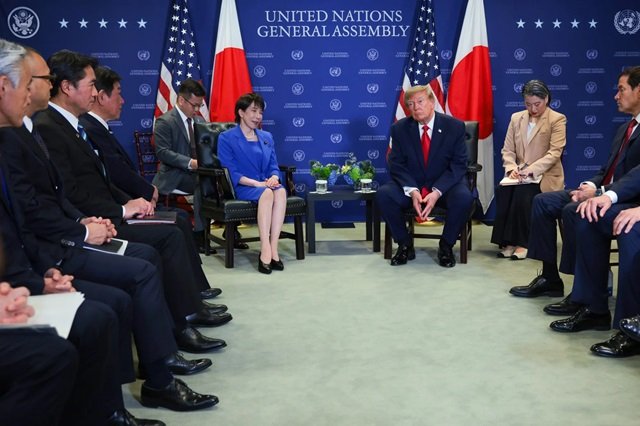
Takaichi’s UN appearance followed a 35-minute meeting with Trump at UN headquarters. The two leaders discussed China, Taiwan, economic security and cooperation on semiconductors, artificial intelligence and critical minerals, two days before Trump was due to meet Chinese President Xi Jinping in Washington.
Japan is concerned about China’s position on Taiwan and about the direction of US-China relations. Tokyo and Beijing have remained at odds since Takaichi said last November that a Taiwan contingency involving Chinese force could permit Japanese military intervention. China has demanded that she retract the remarks, while Takaichi has rejected doing so.
The Japanese and US leaders also discussed Japan’s defence build-up and agreed to continue implementing their $550 billion tariff agreement. Takaichi was also believed to have briefed Trump on Japanese investment in US oil infrastructure and electricity-generation projects linked to artificial intelligence.
In her UN speech, Takaichi said attempts to change the status quo through force or coercion “must never be tolerated anywhere in the world”. She called for stronger energy and critical-material supply chains, expanded cooperation for peace and stability, and preservation of a free and open international order based on the rule of law. “These challenges cannot be solved by any single country acting alone,” she said. “Now, more than ever, the flag of the United Nations must be held high.”