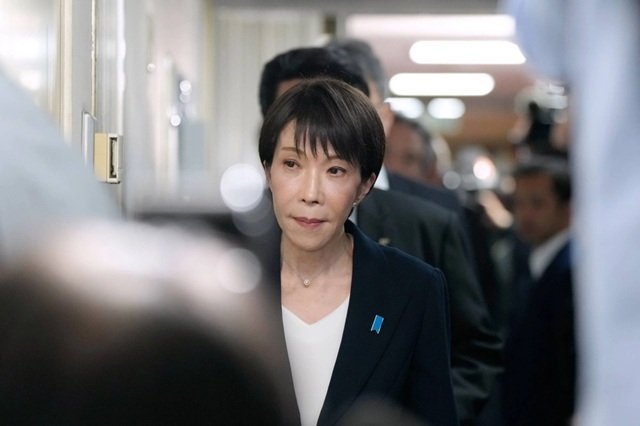
Japanese Prime Minister Sanae Takaichi is exploring an opportunity to meet US President Donald Trump during her visit to the United States later this month, as Tokyo seeks to exchange views with Washington on China and demonstrate the closeness of their ties ahead of a planned US-China summit.
The effort comes as differences have emerged between Japan and the United States over the International Criminal Court and Japan’s fiscal policy, adding complexity to Tokyo’s efforts to coordinate with Washington on China.
Japan will be “watching with great interest” the US-China summit scheduled for Sept. 24, Chief Cabinet Secretary Minoru Kihara told a news conference on Monday. “We will continue to closely coordinate at all levels, including between the Japanese and U.S. leaders and foreign ministers.”
Takaichi is scheduled to address the United Nations General Assembly for the first time during the general debate on Sept. 22. Trump is also scheduled to speak earlier that day, creating a potential opportunity for the two leaders to meet during their visits to the United States.
Tokyo’s interest in direct discussions with Trump comes as relations between Japan and China have deteriorated. Beijing strongly objected to parliamentary remarks by Takaichi concerning a possible Taiwan contingency, while Trump is seeking economic gains in negotiations with Chinese leader Xi Jinping ahead of the US midterm elections in November.
Against that backdrop, Takaichi sees a need to communicate Japan’s position on China to Trump before his meeting with Xi.
A Japanese government source said Tokyo had requested a meeting with Trump, suggesting that even a brief encounter could provide an opportunity for substantive discussions. “Even if we only have an opportunity for a brief chat, we can still have a substantive discussion,” the source said.
However, officials in Tokyo remain aware that differences with Washington could make a meeting more complicated. Japan has struggled to respond to the US decision to impose sanctions on International Criminal Court President Tomoko Akane, a Japanese national. While Tokyo has emphasised the importance of the rule of law, Takaichi has avoided directly criticising the United States. Washington is also considering efforts to dismantle the ICC.
Fiscal policy represents another point of disagreement. The United States has called on the Takaichi administration to reconsider the prime minister’s signature proactive yet responsible fiscal policy, amid concerns that rising interest rates in Japan could have an adverse effect on the US economy.
These disputes have prompted differing views within the Japanese government over whether a meeting with Trump would be advantageous at this stage. One Japanese government source suggested that “rather than holding a meeting that could result in disagreements, it would be better to forgo it for now.”
The source added that “It will be more important to hear (from Trump) by phone about it after the U.S.-China summit,” indicating that Tokyo may prefer direct communication after Trump’s discussions with Xi rather than risk an encounter dominated by differences between Japan and the United States.
Still, the possibility of a meeting has not been ruled out. Some Japanese officials believe international conferences scheduled through the end of the year could offer further opportunities for Takaichi and Trump to hold talks. Among them is a summit meeting linked to the Association of Southeast Asian Nations in November, which could provide another setting for discussions between the two leaders.
For Tokyo, the immediate challenge is to maintain close coordination with Washington on China while managing disagreements that could complicate the relationship. With Trump preparing for talks with Xi and Japan watching closely, Takaichi’s efforts to communicate directly with the US president could carry significance beyond a single diplomatic encounter.