At the entrance to Xingfuli, a residential compound in Ganzhou, Jiangxi province, a bulletin board displays the names, photographs, and phone numbers of the people responsible for managing the neighbourhood. Though an ordinary bulletin board at first appearance, among the building representatives and Communist Party members is an unexpected name: Kang Jiafei, a food delivery worker who is also listed as a community ‘grid worker.’
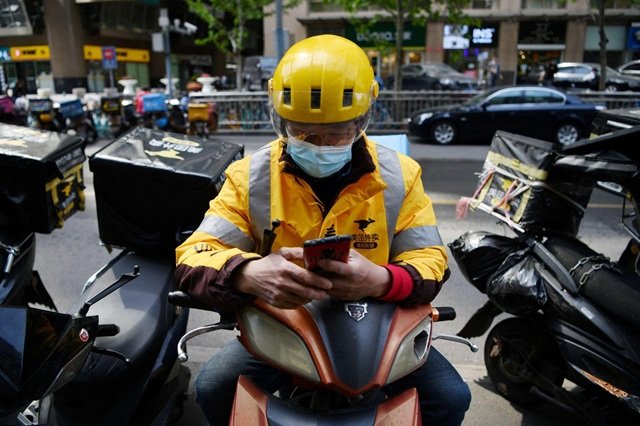
China has more than ten million food delivery workers, part of a rapidly growing global workforce whose lives are organized by algorithms, tight deadlines, and orders that take them across the city. They are among the most visible workers on China’s streets, yet often have no fixed workplace, no place to rest between orders, and limited access to conventional forms of employment protection. Their working hours are fragmented, their movements dictated by the next delivery. What, then, does it mean for one of these workers to have a recognized role in governing a residential community?
In China, urban neighbourhoods are divided into small geographical units known as grids (网格), with designated workers who monitor local conditions, respond to residents’ concerns, and coordinate with public departments. Kang is one of fifty delivery workers in Ganzhou’s Zhanggong District who have taken on this additional role.
During my visit in October, Wuzhifeng Road Community Party secretary Yin Guozhu responsible for this community explained how it works. Delivery workers like Kang know the neighbourhood through their daily deliveries. When he notices a blocked fire exit, debris near a lift, or another hazard, he reports it to the property management staff. Between orders, he also distributes the community’s anti-fraud leaflets. During recent typhoon weeks, riders who encountered fallen branches blocking drains cleared what they could and reported larger obstructions to the community, which contacted the responsible departments.
‘Our information is collected up layer by layer,’ Yin explained. She calls the riders ‘mobile probes’: in places community workers cannot see or reach in time, they provide first-hand information. The same mobility that makes these workers difficult to organize also gives them intimate knowledge of the city’s streets and neighbourhoods – knowledge that can now serve the wider community.
In 2020, the widely read investigation Trapped in the System《困在系统里》documented the tightening grip of delivery algorithms on these workers in China: a three-kilometre delivery window that fell from an hour in 2016 to only thirty-eight minutes by 2018. Riders described themselves as ‘racing with death, wrestling with the traffic police, befriending red lights.’ The sociologist Sun Ping, after seven years of fieldwork, described the condition as ‘transitional labour’—work suspended between employment and informality, in which the transition becomes permanent and the delivery economy runs like a great ‘furnace’, constantly burning as workers rotate through it.
Since 2021, national measures have sought to clarify platform companies’ responsibilities and extend labour protections in these ‘new forms of employment,’ notably in the gig economy. An occupational injury insurance programme, piloted from 2022 and expanded nationwide in 2026, places its premium obligations on platforms. Days before my visit, a draft regulation on protecting workers in new employment forms opened for public comment. Alongside these regulatory efforts, the Party has been extending its organisational work among workers dispersed across the platform economy.
A workforce without a fixed workplace lacks many of the spaces where workers’ welfare and social life have traditionally been anchored. One of the most immediate problems has a simpler name: the riders’ ‘four difficulties’ – eating, drinking water, resting, and finding a toilet, so the infrastructure has moved to the street.
The All-China Federation of Trade Unions has helped establish more than 186,000 outdoor worker rest stations nationwide, aiming to ensure that outdoor workers can find a place to rest, drink water, or charge their phones within a fifteen-minute journey. In Zhanggong District, thirty-three Qianxin stations can be found through phone map apps. They take their name from Qian (虔), an old name for Ganzhou, and xin (新), referring to the new employment groups.
President Xi Jinping once called delivery workers ‘hardworking little bees’; here, the community built them resting stations, including the one near the MixC shopping centre, shaped like a beehive. When the district launched its Qianxin program, a rider named Zhu Qiang said: ‘It gives us a home in the city.’
Workers waiting between orders had nowhere to shelter from wind and rain. Shopkeepers, worried that soaked riders might disturb their business, were often reluctant to let them inside. The community decided to build a place along the routes the workers already travelled.
‘With the station, it is as if we built them a warm harbour right where they must pass,’ Secretary Yin said of the station built in the Xingfuli residential block.
Inside are air conditioning, drinking water, a microwave, charging facilities, first-aid supplies, and a library stocked with books. Around it, the community has organised an alliance of businesses offering services and discounts. A rider can eat his fill at a participating canteen for fifteen yuan, compared with twenty or thirty for other customers. Some education providers offer half-price courses for workers’ children. Lawyers and family-education counsellors hold weekly consultations, while online links connect workers to departments responsible for insurance, schooling, and employment.
At the compound entrance, a rider-friendly map marks building entrances and nearby places where riders can rest. A few minutes lost searching for an apartment can mean a late order.
‘For them, time is money,’ Yin explained. The community began by making itself easier for the workers to navigate.
Kang Jiafei’s name on the grid board represents another step: the recognition that delivery workers are also contributors to collective life of the city beyond the services they perform for customers. For Yin, this is a reciprocal process.
‘Everything is two-way,’ she explained. By making the community more welcoming to riders, she believes their sense of social responsibility has gradually grown.
She described how the relationship developed over three years. Initially, riders found it difficult to join community activities, their working hours too fragmented and unpredictable. Today, when the community announces free medical examinations in their WeChat group, workers invite one another and arrive together. Workers also contact Yin directly about developments around the shopping district. Yin says she has gained not only partners in community work, but also ‘brothers and sisters.’
This is not a charity story. A bench, a socket, a microwave, and a bookshelf are material provisions for workers whose lives are organized around delivering the next order. But they also create spaces where otherwise dispersed workers can meet, develop social relationships, and participate in collective activities. The station becomes more than a place of rest: it becomes an organisational centre.
The methodology is Party-building adapted to a workforce that the factory no longer houses. The trade unions, Women’s Federation, and Communist Youth League are part of this wider effort to extend organisation into new employment groups. Where conditions for establishing Party branches do not yet exist, other mass organisations can provide an institutional foundation.
Party members among the delivery workers, like Kang, retain their primary organizational affiliations while participating in activities near their workplaces. The station holds ‘mini-Party lessons’, between orders—adapting political education to workers whose ‘time is fragmented and space is fluid,’ as Yin put it.
The challenge is not only to extend social protections, but also to overcome the atomisation produced by platform labour. The algorithms organise riders as individual units of labour, each racing against the clock. The community attempts to bring them into social relationships and institutions that extend beyond the commercial transaction.
The contradictions have not disappeared. A subsidized meal does not determine how much a rider earns per delivery, and a rest station cannot replace enforceable labour rights. Those questions remain central to China’s evolving regulation of still-new platform employment. But the community addresses another dimension of the problem: how workers who spend their days moving through a city can become recognised participants in its collective life.
The community where Kang Jiafei runs his route is called Xingfuli—‘Happiness Lane.’ Ninety-two years after the Red Army set off on the historic Long March from this very region, the long work of socialist construction continues in different forms: investigating new conditions, building new institutions, and organising a changing working class, one neighbourhood and one hive at a time.
Source: Globetrotter