On a warm May night, as a spring tide pushes the waters of Delaware Bay far up the beach, Atlantic horseshoe crabs emerge from the sea in their thousands. Under the new moon, the animals crawl across the sand along the eastern coast of the United States, their large oval shells appearing from a distance like scattered stones. Up close, their ten eyes and long, pointed tails become visible.
It is a spawning night. Females, which can grow to 60 centimetres, move towards the shore carrying smaller males attached to their backs, sometimes as many as ten. In the sand, the females will deposit hundreds of tiny eggs, which the males fertilise.
For Adrianna Zito-Livingston, a biologist and conservationist with the non-profit organisation The Nature Conservancy, the annual spectacle is also a measure of the species’ uncertain future. She has monitored the coastline near Cape May on the eastern side of Delaware Bay for years and had been worried because, until this particular night, relatively few horseshoe crabs had reached the shore.
The species has existed for more than 450 million years. It survived the age of the dinosaurs and several global mass extinctions. Only four species remain worldwide: three in South and East Asia and the Atlantic horseshoe crab along the American eastern seaboard. Their exact population sizes are unclear, but many populations are declining. The International Union for Conservation of Nature classifies all four species, where their status is known, as threatened or highly threatened.
For decades, horseshoe crabs were also shredded for fertiliser, while they continue to be used as fishing bait. But their most consequential role for modern society comes from something far more valuable: their blue blood.
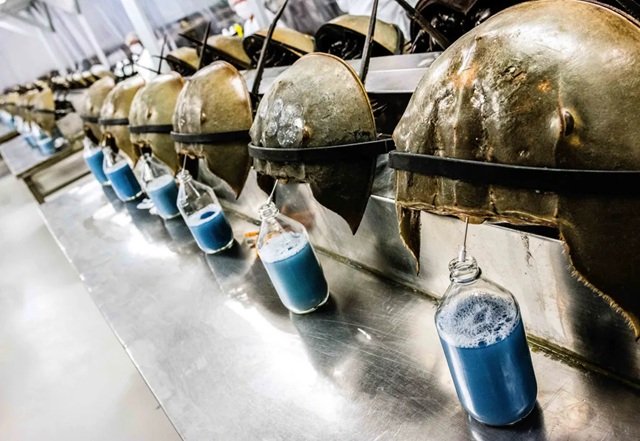
Pharmaceutical companies use a component of horseshoe crab blood to test vaccines and various infusions for contamination by endotoxins, toxins originating in the cell walls of certain bacteria. These substances can enter medicines through raw materials or contaminated surfaces. In humans, endotoxins can cause high fever and, in severe cases, shock-like conditions, multiple organ failure and death.
The testing system derived from horseshoe crab blood has therefore played a major role in protecting patients. Yet the process places a heavy burden on the animals that make it possible.
More than one million Atlantic horseshoe crabs are collected from the US coast each year for blood extraction, according to the commission responsible for monitoring the country’s populations. In laboratories, a needle is inserted into the animals’ hearts and as much as one-third of their blood can be removed. Around 15 to 20 per cent die during the process, while survivors are often severely weakened when returned to the sea.
The scale of mortality has increased dramatically. Since monitoring began more than two decades ago, the number of horseshoe crabs subjected to blood collection along the US eastern coast has increased approximately tenfold. The commission estimated that almost 146,000 animals died during blood collection in 2022, the highest figure recorded in the time series. Its first analysis, for 2004, estimated 25,000 deaths.
The medical industry did not turn to horseshoe crab blood without reason. Before the development of the modern test, researchers spent years testing medicines for endotoxin contamination on rabbits. A medicine sample was injected into a rabbit’s ear vein and the animal’s temperature monitored for fever. The method was painful, expensive, time-consuming and comparatively inaccurate.
In the 1950s, researchers discovered that the body fluid of horseshoe crabs clumps when exposed to endotoxins. Enzymes in the blood cause contaminated samples to develop a gel-like consistency, allowing potentially dangerous batches of medicines to be identified and removed. The resulting Limulus Amoebocyte Lysate test, known as LAL, became the standard method for testing pharmaceutical products for bacterial toxins.
The same discovery that transformed pharmaceutical safety, however, created a new pressure on an ancient species. In Delaware Bay, horseshoe crabs now have comparatively strong protection, with strict fishing quotas and areas where collection for biomedical purposes is prohibited. Elsewhere, the situation is more precarious. The population around New York is considered to be in poor condition, while horseshoe crabs in New England, including Cape Cod, have faced threats for decades.
Research also suggests that the consequences of blood collection do not end when an animal is returned to the water. Christopher Chabot, a biologist at Plymouth State University in New Hampshire, says studies indicate that horseshoe crabs can become disoriented after blood collection. Their spawning activity can decline significantly, while their mobility can also be impaired.
Yet the dependence on horseshoe crab blood is no longer technologically inevitable.
Scientists have been able to produce the crucial enzyme synthetically for decades. In 1995, researchers in Singapore cloned the blood component responsible for causing contaminated vaccines and infusions to clot. Tests based on the synthetic enzyme have been commercially available for years, and an increasing number of bodies responsible for pharmaceutical quality standards have recognised them, including regulators and standards organisations in the European Union, Britain, China and, more recently, the United States.
According to Chabot, synthetic tests can apparently detect bacterial toxins just as effectively as conventional methods. The difficulty is not necessarily scientific capability, but adoption.
In the United States, pharmaceutical companies must change each medicine individually. For every product that has already received approval, companies must demonstrate to regulators that the alternative test works and detects bacterial toxins at least as reliably as the established method. The transition can require changes to procedures, employee training and, in some cases, new equipment. For companies accustomed to existing systems, the process can consume both time and money.
Some pharmaceutical companies have nevertheless begun the transition. Eli Lilly, the world’s most valuable publicly traded pharmaceutical company, leads the sustainability scorecard compiled by animal-protection organisations. Around four-fifths of its products are now tested using synthetic alternatives, according to the company. In some countries, however, regulators have not yet treated the synthetic methods as equivalent, meaning LAL testing remains necessary.
Jay Bolden, a director responsible for bacterial testing at Eli Lilly who helped drive the transition, says some employees initially had doubts. The pharmaceutical industry, he argues, is highly conservative, with companies reluctant to change established procedures.
Yet the alternatives may offer advantages beyond animal welfare. Bolden says they are often more reliable than conventional LAL testing and cost less. Other pharmaceutical companies, including GSK and Sanofi, also report increasing use of alternative tests for detecting endotoxin contamination.
The motivation for change is not always conservation. Pharmaceutical companies also have an interest in protecting their supply chains. If horseshoe crab populations collapse, supplies of LAL could become scarce, forcing manufacturers to change their testing systems rapidly and without sufficient preparation.
That prospect is attracting the attention of investors as well. The activist shareholder group As You Sow last year urged the US manufacturer Abbott to assess the risk of an LAL shortage and investigate synthetic alternatives. There are also concerns within the industry that patients could eventually boycott medicines tested using LAL if public awareness of horseshoe crab deaths increases.
The ecological consequences extend beyond the crabs themselves. After the spawning nights in Delaware Bay, the beaches become feeding grounds for tens of thousands of red knots, migratory shorebirds travelling from South America towards their breeding grounds in the Canadian Arctic. Some have travelled around 10,000 kilometres and still have roughly 3,000 kilometres ahead of them. The energy-rich horseshoe crab eggs provide essential food during the journey.
Red knot populations have also declined over recent decades, and the International Union for Conservation of Nature classifies the species as potentially threatened.
For Zito-Livingston, the stakes therefore extend far beyond a single animal or a single industry. The survival of horseshoe crabs is connected to an entire coastal ecosystem, while their blood remains tied to the safety of modern medicines.
The paradox is increasingly clear. An animal whose unique biology has helped protect countless patients is itself becoming vulnerable to the system built around that biological gift. Yet the emergence of synthetic alternatives means that protecting the horseshoe crab does not necessarily require choosing between animal conservation and pharmaceutical safety.
The technology to reduce reliance on their blood already exists. The remaining challenge is how quickly industries and regulators are willing to adopt it. For an animal that has survived more than 450 million years, the question is no longer whether it can endure another change in the natural world. It is whether modern medicine can change fast enough to allow it to survive the demands placed upon it.