


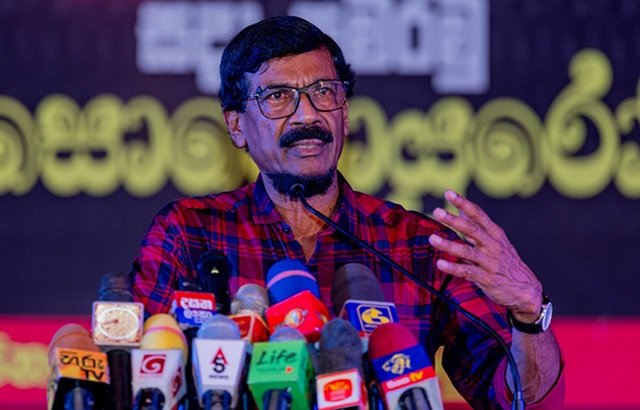
Wijeyadasa Rajapakse first entered Parliament through the United People’s Freedom Alliance (UPFA), which was formed by the Sri Lanka Freedom Party (SLFP) together with the Janatha Vimukthi Peramuna (JVP). His name was included in the UPFA’s National List with the agreement of Susil Premajayantha (UPFA Secretary) and Tilvin Silva (JVP Secretary). At that time, Wijeyadasa was part of Mangala Samaraweera’s team, which pushed for the alliance with the JVP. He worked alongside Tilvin, Wimal Weerawansa, and Anura Dissanayake to build the coalition.
Later, in the 2005 presidential election, Mahinda Rajapaksa became the UPFA candidate. Supporting him were not only Wijeyadasa, Tilvin, and Anura, but also Champika Ranawaka. Before Mahinda’s candidacy, the UNP—then led by Prime Minister Ranil Wickremesinghe—accused Mahinda of corruption, claiming that he had deposited tsunami relief funds into a private bank account. Kabir Hashim, now the SJB leader, was the UNP MP who raised the allegation. President Chandrika Kumaratunga even wrote to Mahinda, calling it a serious fraud. This was the first time in Sri Lankan history that a president from the same party had accused her own prime minister of corruption.
Did the JVP leave Mahinda because of these allegations? No. Instead, both Chandrika and the UNP dismissed the tsunami scandal as a conspiracy aimed at blocking Mahinda’s candidacy, and they defended him. Wijeyadasa was also part of that defense.
If Tilvin and Anura had said at the time, “We are a clean party; we will not support a corrupt Mahinda,” Sri Lanka’s political history would have been very different. Instead, Mahinda was elevated as a hero, became president, and lawyers like Wijeyadasa gave him legitimacy. Ironically, today, the JVP attacks Mahinda over corruption allegations, while Wijeyadasa’s own son faces bribery allegations.
Many politicians now jailed by the JVP were first elected to Parliament in 2004 thanks to JVP votes, including Mahindananda Aluthgamage, Sarana Gunawardena, and Wijeyadasa himself. They became ministers only because the JVP helped Mahinda win in 2005. Later, the UNP defeated them politically. However, Ranil and the UNP damaged their own political record by protecting Rajapaksa-era ministers accused of corruption after taking power from the Rajapaksa family.
Sajith Premadasa’s Samagi Jana Balawegaya (SJB) broke away from that political culture. The SJB built its platform around opposing corruption. For example, it brought a no-confidence motion against Minister Keheliya Rambukwella over allegations related to a medicine fraud. The JVP criticized the move, arguing that such motions only strengthened the government. The motion failed, but later, patients died after receiving medicines linked to the alleged fraud. Eventually, Keheliya was removed from office and jailed, and only then did the JVP begin holding rallies against him.
The SJB also took the Rajapaksas to court over allegations that they were responsible for bankrupting the country, while the JVP criticized them mainly through public speeches without taking similar legal action. When Speaker Ranwala’s degree certificate was alleged to be fake, the SJB collected signatures for a no-confidence motion, putting Anura’s government under pressure. Without the SJB’s action, Ranwala would still be the Speaker. Foreign Minister Vijitha Herath and Health Minister Nalinda Jayatissa stated that Ranwala had stepped aside until he provided his degree certificates.
Similarly, the SJB raised allegations over the coal issue under Anura’s government and brought a no-confidence motion against Energy Minister Kumara Jayakody. The JVP defended him, as it had previously defended Keheliya. The motion failed, but Jayakody was later removed from his ministerial position. Without the SJB’s motion, he would still be serving as a minister.
Even now, Ranwala remains an MP despite losing the speakership, and Jayakody remains an MP despite losing his ministerial portfolio. Meanwhile, senior figures such as Wasantha Samarasinghe and Deputy Minister Mahinda Jayasinghe face court cases.
When Charith Abeysinghe was arrested over bribery allegations linked to “Harak Kata,” Sajith was asked what action he would take. He responded clearly:
“No doubt—if he has committed a wrong, we will take disciplinary action.”
Can the JVP give the same clear answer regarding Ranwala, Jayakody, Wasantha, or Mahinda? That remains the real test.










