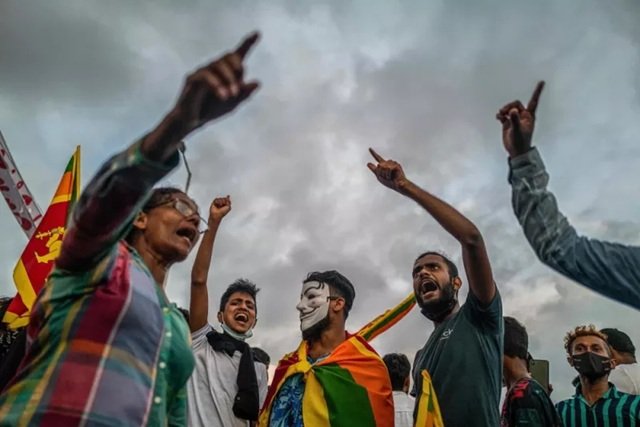
How the Navy’s secret evacuation plan saved President Gotabaya Rajapaksa as the Aragalaya stormed the President’s House.
The moment President Gotabaya Rajapaksa decided to take up residence at the President’s House (Janadhipathi Mandiraya), Fort, in the first week of April, 2022, the Navy had no option but to prepare a thorough contingency plan, in case the regime change project posed a realistic threat to the life of the President.
The President, in consultation with senior military officers, made his move within 48 hours after violence erupted outside his private residence at Pangiriwatte, Mirihana, on the night of 31 March, 2022. That decision seemed realistic and sensible at that time.
But, in the wake of the disastrous overall armed forces response to the coordinated violence unleashed by the regime change project on 09 May, 2022, in the aftermath of the Temple Trees ordered attack on Galle Face protesters, the top brass must have recognised the urgent need for total overhauling of security strategy. But, unfortunately, that hadn’t been the case. With violent crowds overwhelming the armed forces, deployed to block them, rapidly approaching the President’s House, those who had been at the makeshift Operations Room there were stunned.
In hindsight, the President’s decision to remain at the President’s House, regardless of the near failure on the part of the armed forces to repulse the raid on Temple Trees, on 09 May, seemed unwise. The rescue operation could have gone wrong and the war-winning President Mahinda Rajapaksa could have ended up in the hands of an angry mob.
Perhaps, the conspirators envisaged the President’s move, from Pangiriwatte to the President’s House, situated walking distance away from the Galle Face protest site, where they could draw additional strength.
The failure on the part of the government to take tangible measures, in the wake of the President’s House becoming the sole target on that fateful day, is a contentious issue that needs to be properly investigated. Don’t forget that the court case filed over the 09 May attacks on the residences and properties belonging to SLPP politicians, and some supporters ,was later withdrawn. The Wickremesinghe-Rajapaksa government never investigated the 09 May incidents.
Exactly two months after the mobs almost succeeded in breaking through defences at Temple Trees, on the night of 09 May/10, where Prime Minister Mahinda Rajapaksa was residing, they mounted the assault on the President’s House.
In the wake of the 09 May mayhem, President Gotabaya Rajapaksa named Lt. Gen. Vikum Liyanage as the Commander of the Army. He succeeded General Shavendra Silva who served as the CDS but was out of the country when all-out mayhem was unleashed by the Aragalaya mobs on 09 July, 2022, to oust the sitting government.
In spite of a direct and growing threat to the President’s House, on 09 July, 2022, the President felt confident in meeting the challenge. The President issued a directive to the Secretary, Ministry of Defence, General (retd.) Kamal Gunaratne, to shift the Operations Room from the Defence Force Headquarters, at Akuregoda, to the President’s House. Having shifted the Operations Room on 08 July, 2022, to the President’s House, as directed by the President, the top brass prepared to face the challenge.
Maj. General K.B. Egodawela, who served as an Additional Secretary (Administration) to the President, from the day the President moved to the President’s House, till he vacated on 09 July, 2022, in his memoirs ‘Aragalaya: Adarayen Prachandathwayata’ (From Love to Violence) revealed that though the top brass opposed the shifting of the Operations Room they carried out the directive. While the President felt that the top brass could collectively work at the President’s House to bring the situation under control, Gen Gunaratne proposed that the President should move to Akuregoda Defence Forces Headquarters, according to Egodawela. In fact, Gunaratne, who had been with Gotabaya Rajapaksa from the very beginning of the sinister campaign, strongly opposed the President’s decision to remain there.
Obviously, the President’s House pathetically failed to ascertain the scale of the protest and the rapidity with which protesters overwhelmed troops deployed outside the President’s House stunned the top brass. Had they swiftly reached consensus on Gen. Gunaratne’s suggestion, perhaps the 09 July regime change operation could have been thwarted. The armed forces could have resorted to tougher measures to prevent a march on Akuregoda Defence Forces Headquarters had the President agreed to move there.
Within two hours after the protest, targeting the President’s House began, video footage provided by drones indicated that troops couldn’t hold the rampaging mobs any longer. According to Egodawela, the top brass had been prepared to remove the President, even without his consent, by landing a helicopter in the Colombo harbor or by ship. Finally, they resorted to the second option. As the President and First Lady Ayoma got into a vehicle and took the rear exit into the adjoining former Navy Headquarters, mobs entered the President’s House. Another vehicle carrying several other persons followed.
The then Navy Commander Vice Admiral Nishantha Ulugetenne who had been with the President at the President’s House got into the vehicle carrying the President. Had they stayed at the President’s House for 10 more minutes, the consequences could have been devastating. https://island.lk/gotabayas-escape-from-aragalaya-mob-in-rti-spotlight/
Egodawela, who had been with the President from the very beginning of the presidential term, alleged that the raiders planned to kill the President and several others and display their bodies. The author quoted an unidentified intelligence officer as having told him that the raiders wanted to display the bodies the way LTTE leader Velupillai Prabhakaran’s body was shown.
Perhaps shifting the Operations Room from Akuregoda Defence Force Headquarters to the President’s House had been a risky move that, in a way, facilitated the regime change operation. The rationale in bringing those who had been tasked with countering the impending threat to one place (President’s House) to be with the target (Gotabaya Rajapaksa) seems unbelievably a dicey move. The President had been influenced by what he described as inordinate and unforgivable delay on the part of the Akuregoda Operations Room to carry out timely evacuation of Prime Minister Mahinda Rajapaksa on the night of 09 May from Temple Trees. Most probably, the President wanted to oversee the 09 July counter operation personally. But, in hindsight, the decision to shift the Operations Room from Akuregoda to the President’s House obviously hadn’t been a clever move.
SLN preparations
When mobs threatened to overwhelm the President’s security at Pangiriwattta, on 31 March, additional police and STF contingents were brought in. They were followed by the Navy and Air Force. The Army arrived at the scene, subsequently.
As pointed out by the President himself, the situation at Temple Trees, on 09 May, had been far worse and the combined police and armed forces response revealed that they hadn’t taken precautionary/counter measures, even after the Pangiriwatta fiasco.
At the time of the incidents, the overall Temple Trees security deployment included about 60 elite Special Boat Squadron (SBS) personnel deployed within the premises and were supplemented by seven SLN platoons. The Army also moved in to strengthen Temple Trees defences but the mobs pressed on till troops fired blank ammunition.
The top brass, directing counter measures from Akuregoda Defence Force Headquarters, had to act swiftly and decisively to evacuate those at the Temple Trees or face the consequences. As there hadn’t been any other alternative place of living proposed, Prime Minister Mahinda Rajapaksa, wife Shiranthi and their eldest son Namal were escorted to nearby former Air Force Headquarters and from there flown to the Trincomalee Navy base. VA Ulugetenne, over the phone, issued instructions to the relevant officer in Trincomalee to make arrangements as two helicopters carrying the group took off from the helipad on the top of the former Air Force Headquarters. The helicopters departed around 04 in the morning.
They had stayed at Trincomalee Navy House for about a week and, as requested by the Navy, paid for their stay because by then Mahinda Rajapaksa had resigned. Perhaps, they could have taken refuge at the Panagoda Army cantonment or at Saliyapura, home to the Gajaba Regiment, but, at the end, sought the protection at the Trincomalee Navy base.
Ironically, President Gotabaya Rajapaksa, too, had to take refuge at the Trincomalee Navy base, exactly two months later. Ever since the President moved into the President’s House, Fort, the Navy had been on their toes to meet any eventuality. The daunting task of arranging evacuation by sea fell on the shoulders of VA Ulugetenne, who, meticulously, planned the operation with his staff.
Having informed the President of the contingency plans, VA Ulugetenne stationed two Advanced Offshore Patrol Vessels (AOPVs), namely SLNS Sindurala and SLNS Gajabahu and four Fast Attack Craft (FACs), at the Colombo Port. It would be pertinent to mention that SLNS Sindurala, built at the Goa shipyard, in terms of an agreement signed at the tail end of the Mahinda Rajapaksa government, was adjudged the best vessel in the SLN fleet in 2022.
Additional SBS personnel and snipers, too, had been brought in to Colombo though none of them knew exactly what their task would be. The OPV and FAC crews most probably felt that they were awaiting orders for a major anti-drug operation in the high seas.
As the decision was made to evacuate the President and the First Lady, the Chief alerted the vessels and quickly deployed tugboats to pull SLNS Sindurala and, shortly thereafter, SLNS Gajabahu, formerly of the US Coast Guard, carrying the President and the First Lady. By the time the two AOPVs moved in different directions, on the instructions of VA Ulugetenne, the hand phones of SLNS Gajabahu crew were collected to prevent them from revealing what was happening. Along with the AOPVs, two pairs of FACs had moved out to sea. (https://island.lk/ranil-reveals-bid-to-get-rid-of-him-while-gr-was-fleeing-to-trinco-on-board-slns-gajabahu/)
Nearly 12-hour journey to Trinco
The SLNS Gajabahu, formerly of the US Coast Guard, had a crew consisting of over 100 officers and men. Someone, most probably a port employee, posted a short clip of some unidentified persons taking large travelling bags into the ship but the President, First Lady and VA Ulugetenne going in were never captured on a camera.
As the vessel began its journey towards Trincomalee, it remained approximately 12 nautical miles from land and the President received many calls, some of which weren’t answered. VA Ulugetenne, too, received quite a number of calls. Those familiar with the developments at that time said that some felt that SLNS Gajabahu should move out of Sri Lankan waters. There had been suggestions that the destination should be the Maldives, India or Singapore. Regardless of such suggestions, SLNS Gajabahu proceeded towards Trincomalee where the Navy made necessary arrangements to host them.
Captain Marlon Perera, who still serves the Navy, had been the Commanding Officer of the vessel. Perera now holds the Commodore rank.
During the journey precautions were taken to ensure the safety and security of the President and the First Lady. Although the crew hadn’t been aware that they would be entrusted with such a sensitive task at a time the country was in crossroads against the backdrop of an economic collapse and sovereign default, there were fears of the crew being affected by propaganda in support of regime change operation.
The attempt made by sailor Wijemuni Vijitha Rohana de Silva to cause harm to Indian Prime Minister Rajiv Gandhi, way back in July, 1987, underscored the necessity to take precautions during the Colombo-Trincomalee journey as the possibility of anti-Gotabaya campaign having an impact on at least some members of the ship crew couldn’t be ruled out.
On July 30, 1987, during a guard of honor in Colombo, the 21-year-old naval rating struck Gandhi on the shoulder and back with the butt of his rifle. Gandhi narrowly avoided the full impact of the blow by evasive ducking.
On the invitation of VA Ulugetenne, Gotabaya Rajapaksa attended all the formalities in respect of a visit undertaken by the President to the Trincomalee Navy base. The President participated in those formalities knowing that he couldn’t attend the commissioning parade that was scheduled to be held on 15 July, 2022. The Navy was not in a position to put off the commissioning parade hence the decision to invite Defence Secretary Gunaratne as the Chief Guest.
Ulugetenne retired from active naval service on 18 December, 2022, following a distinguished career, spanning over 37 years. He received the appointment as the 24th Commander of the Navy in July, 2020, just a couple of months after Gotabaya Rajapaksa’s election as the President.
Wickremesinghe, in his capacity as Gotabaya Rajapaksa’s successor, appointed Ulugetenne as Sri Lanka’s Ambassador to Cuba. The appointment was made in late 2023 and the retired Navy Chief presented his credentials to Cuban President Miguel Díaz-Canel on 13 February, 2024.
However, within weeks after the last presidential election held in late November, 2024, the NPP government recalled over a dozen top envoys appointed by the previous administration. Admiral Ulugetenne was among them. The government deprived a decorated officer, who had served the country for nearly four decades, from completing his term in Havana. Within months after his return, he became the target of a murder investigation.
Then out of the blue the retired Navy Chief became the focus of a murder investigation, that, too, post-war. The Criminal Investigation Department (CID) arrested him on 28 July, 2025, over the disappearance of a person reported in July, 2020.
Kurunegala High Court Judge Tikiri Jayatilleke, on 14 October, 2025, granted him bail. Jayatilleke declared that the CID acted in an illegal manner in respect of the former Navy Commander. His counsel Kalinga Indatissa, PC, alleged in court that his client had been apprehended only on the basis of an ex-LTTE cadre’s allegation in the absence of any evidence
The next hearing is scheduled for 08 July, 2026. Ulugetenne was held at the Kegalle Prison for four days and then transferred to the Dumbara (Pallekale) Prison. Altogether, he was in prison for 80 days, like a common criminal, despite him being a former Navy Commander with an unblemished career record.
Wartime Chief of Naval Intelligence, Rear Admiral (retd) Sarath Mohotti, who had been also arrested in connection with the same investigation, was also granted bail, a few weeks later.