Ukraine says that Russia launched an ICBM that crashed into a manufacturing facility in Dnipro.
Russia has said nothing.
Some Russian mil-bloggers seem to have taken Ukrainian propaganda and supplied video as real. They erred.
Numerous “reliable” news services, including AP, CNN and Reuters, dutifully published this garbage without asking US officials anything. The British Daily Mail made a big story out of it with lots of irrelevant photos and out of context threats made by Putin, according to the paper.
Finally the BBC reported that an unnamed US official said that Russia did not launch an ICBM. It was a “ballistic” missile, the unnamed official said, not an ICBM.
Many of the missiles Russia has launched against targets in Ukraine are ballistic. A ballistic missile is powered only in the boost phase of its flight. After that, launched at a high angle into the exoatmosphere, it flies to its target without rocket power.
An ICBM is a ballistic missile with intercontinental range.
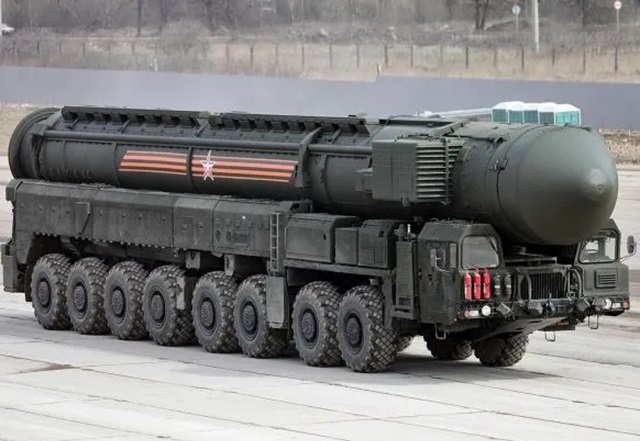
The Ukrainians claim the missile fired by the Russians was the RS-26 Rubezh. Exactly how they know this is unexplained.
The RB-26 is a road mobile ICBM that is launched from a TEL (Transporter, Erector and Launcher). Reportedly it can carry the Avangard hypersonic glide vehicle, Russia’s newest nuclear threat system. The missile weighs 36,000 kg (80,000 lbs.) and has a range of 5,800 km (3, 603 miles), not counting Avangard. The missile is mainly solid fueled and can reach Mach 20 (24,500 km/h or 15,200 mp/h).
RB-26 has a MIRV warhead of four nuclear warheads. MIRV means multiple independently targetable reentry vehicle.
There is no information that RB-26 has any conventional warheads, and given its accuracy, expressed in CEP (circular error of probability), as between 90 and 250 meters, using it as a conventional weapon makes little sense. It is another matter if it is fitted with hydrogen nuclear warheads and used to destroy large territorial areas, for example missile fields or even cities.
RB-26 is a very valuable part of Russia’s nuclear weapon’s capability because it is road mobile and hard for an enemy to accurately target, essentially making it both a first and second strike weapon.
There is no information on the price of the RB-26. The US silo-based equivalent, Minuteman 3 is priced above $30 million per copy, probably closer to $50 million (something that has caused strong pushback from Congress because of cost). The idea that Russia would be willing to essentially throw away its own huge investment for no appreciable gain is hard to fathom.
Had Russia launched an ICBM it would have been detected by US satellites on launch. That would have triggered a whole series of actions including bombers from the Strategic Air Command and Minuteman Missiles gone on alert.
There was no reported alert because there was no ICBM launch detected, or at least none was reported. The US has extensive space based capabilities to detect ICBM launches.
It would have been damned silly to waste a hugely expensive ICBM on a target that could be damaged or destroyed with other weapons in the Russian arsenal. That facility at DNIPRO manufactures missiles and other military hardware and was called Yuzhmash (the name means “Southern Engineering”). It is a massive plant originally built by the Soviet Union and now owned by the Ukrainian military. The Ukrainians renamed the plant as the “Production Union Pivdennyi Machine-Building Plant” abbreviated as Pivdenmash.
The entire ICBM threat was cooked up by Ukrainian propaganda to try and cause a NATO intervention to save Ukraine. There is no other explanation. It is a sad commentary that numerous press outlets accept and publish Ukrainian-origin fake stories.
UPDATE: Putin says strike was response to Kyiv’s use of US, UK-made weaponspublished at 12:32
Vitaliy Shevchenko
BBC Monitoring
More now from Russian President Vladimir Putin, who’s been addressing this morning’s strikes carried out on the central Ukrainian city of Dnipro:
“In response to the use of American and British long-range weaponry on 21 November this year, the Russian armed forces carried out a combined strike on one of Ukraine’s military-industrial complex sites,” Putin says.
“In combat conditions, a test was carried out of one of the latest Russian intermediate-range missile systems. In this case, with a non-nuclear hypersonic version of a ballistic missile,” he says, before adding that the “test was successful. The target was reached”.
“One of the largest industrial complexes known since the Soviet era has been hit on Ukraine’s territory, in the city of Dnipropetrovsk. It is still manufacturing missiles and other armaments,” he adds.