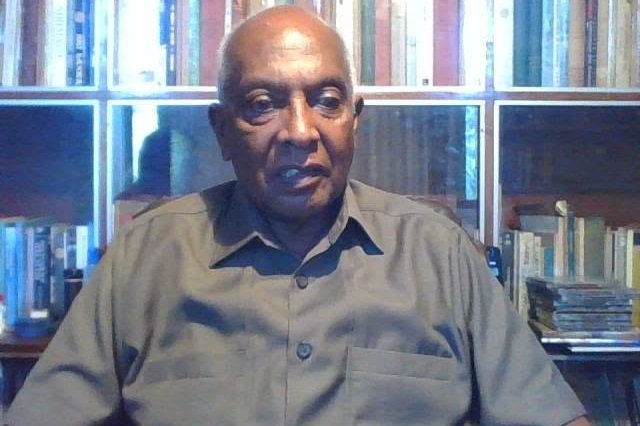
Lal Wijenayake is the first citizen to come out against the National People’s Power government. He came out against not just any government, but a government with a two-thirds majority. And a government that strictly maintains party discipline, ensuring that internal discussions within the party, the National People’s Power Alliance, or the cabinet are not leaked to outsiders or the media. A government that protects state secrets 100%.
Who is this fearless Lal Wijenayake?
Lal was born in 1941. His hometown is Kandy. He was educated at Dharmaraja College before entering the University of Peradeniya. He became the President of the Students’ Union at the University of Peradeniya and led the student movement. He was a student leader who dealt directly with the then Vice-Chancellor, Sir Nicholas Attygalle. In 1967, he became a lawyer. He first appeared in court for a rebel involved in the 1971 insurrection. That was before the Criminal Justice Commission. At the time, Lal was a junior to the renowned lawyer H.W. Jayewardene Nadesan. He appeared before the Criminal Justice Commission on behalf of a large group of rebels involved in the 1971 insurrection.
When the UNP government attempted to impose a water tax on farmers on the advice of the World Bank, Lal appeared on behalf of the farmers. He succeeded in having the water tax removed through a court order. He also represented people who lost their lands after the UNP government came to power in 1977 and sought to evict poor people who had acquired land through the Land Reform Commission.
Lal began his political career with the Lanka Sama Samaja Party. He was a member of the Central Committee and the Politburo of the LSSP. He also became the party’s treasurer. He joined the Lanka Sama Samaja Party in 1963. He contested an election for the first time in the 1988 Provincial Council election. He was elected Leader of the Opposition in the Central Provincial Council.
He served as a Provincial Council member for 15 years. He supported the alliance between the Lanka Sama Samaja Party and the Sri Lanka Freedom Party in the 1993 Provincial Council election and the 1994 General Election, firmly believing that the UNP government should be defeated. In the 1994 General Election, he was at the forefront of the campaign to end the UNP’s 17-year rule. He had high hopes for Chandrika, who became President in 1994. He believed she would abolish the executive presidency and establish a democratic system of government.
But after coming to power, Chandrika shattered the dreams of many people, including Lal. Instead of using her power to strengthen democracy, she focused on preserving her own authority. When this issue was debated within the LSSP Politburo, Lal Wijenayake strongly argued that the party should withdraw from Chandrika’s government. However, LSSP leaders Bernard Zoysa and Athauda Seneviratne were unwilling to leave the government. When discussions within the Politburo failed to produce results, Lal began expressing his views publicly. He openly clashed with Chandrika’s government when she attempted to influence the judiciary by appointing Attorney General Sarath Silva as Chief Justice. While even the Bar Association remained largely silent over Sarath Silva’s appointment, Lal joined the struggle led by ‘Ravaya’ editor Victor Ivan. Victor Ivan became one of the leading voices opposing the appointment. Nevertheless, Chandrika ignored those protests and appointed Sarath Silva as Chief Justice.
Lal Wijenayake reached the point of completely rejecting LSSP politics in 2009 following the murder of journalist Lasantha Wickrematunge under the Rajapaksa government. By then, the LSSP was a coalition partner in Mahinda Rajapaksa’s government, and LSSP leader Tissa Vitarana was serving as a minister. Lal could not tolerate what he saw as the party’s disgraceful conduct. The Freedom Platform was established in 2009 to protest against the murder of journalists and the suppression of media freedom.
“Lal, you should be on this platform…”
Civil society organisations, trade unions, and media organisations urged him.
“My longtime political enemy, the UNP, is also supporting this. How can I stand on such a stage?” Lal asked.
“We cannot see party lines now. We must unite against this oppression. Otherwise, a one-party dictatorship will emerge,” representatives of trade unions, civil society organisations, and media organisations replied.
“Okay, I will come,” Lal decided.
Lal joined the platform without hesitation. The Rajapaksa family was furious. LSSP leaders serving in the government’s cabinet were summoned and reprimanded. Tissa Vitarana feared losing his ministerial portfolio. Lal was immediately expelled from the party. But he was not discouraged. On that very day, he established the Lawyers for Democracy organisation.
Lal Wijenayake was also among the lawyers who raised their voices against the Rajapaksa government’s removal of Chief Justice Shirani Bandaranayake in 2012. He was one of the leading figures in that campaign. He also played a prominent role in the civil society movement that sought to defeat the Rajapaksas in the 2015 presidential election and elect Maithripala Sirisena. Later, he also criticised Maithripala Sirisena and Ranil Wickremesinghe when they acted contrary to the mandate they had received.
Lal was a member of the Politburo of a party that supported two presidents of Sri Lanka: Chandrika Kumaratunga and Mahinda Rajapaksa. During that period, many lawyers affiliated with left-wing parties accepted the title of President’s Counsel from Chandrika and Mahinda. However, when Lal was offered the title of President’s Counsel through the LSSP, he declined it.
“The title of President’s Counsel cannot silence my voice.”
He said this firmly. Only two or three lawyers in Sri Lanka have refused the title of President’s Counsel. S.L. Gunasekara, R.K.W. Goonesekera, and Gomin Dayasiri are among them. Lal belongs to that group.
The JVP has traditionally been cautious about working closely with veteran left-wing activists. However, it needed Lal Wijenayake because of his long history of political struggle. That is why the JVP appointed him to the Executive Committee and Leadership Council of the National People’s Power. Lal joined the National People’s Power to fulfil a dream he had held since 1978: abolishing the executive presidency and dismantling the political system created by J.R. Jayewardene. Neither Chandrika, Mahinda, nor Maithripala fulfilled that dream. He believed that, for the first time in Sri Lanka’s history, a left-wing party would win the presidency and finally achieve it.
But by now, Lal’s dream has been shattered. He has become the first member of the National People’s Power Leadership Council to publicly challenge the National People’s Power itself. His emergence has succeeded in shattering the old walls of the National People’s Power.