Editor’s Note: The following article is based on excerpts from an in-depth interview conducted by Christian Smith with George Friedman, chairman and founder of Geopolitical Futures.
In the ever-shifting landscape of global power, the recent summit of the Shanghai Cooperation Organisation (SCO) in Tianjin, China, has sparked renewed discussion about a possible coalition of anti-Western powers. The gathering of leaders from China, Russia, India, and Pakistan, alongside the celebratory military parade featuring Vladimir Putin and Kim Jong-un, was widely interpreted in Western media as signalling a potential challenge to the existing global order. Yet, according to George Friedman, chairman and founder of Geopolitical Futures, the reality is far more complex and less threatening to the United States than it may appear at first glance.
“The idea that India and China, which have fought border wars in the recent past, are going to come together in a coalition against the United States… means that the United States, which is not suffering nearly as much from these tariffs as China and India would, that they’re going to do this is simply not a possibility unless they’re prepared to experience deep problems,” Friedman observes. He emphasises that while these countries may aspire to challenge American dominance, the inherent conflicts in their national interests prevent the formation of a coherent coalition.
The backdrop of these developments is shaped by complex economic interdependencies. “None of them want to be caught in the trap of the United States, but there is a fundamental trap that the United States has,” Friedman notes. Over a quarter of the global economy is generated in the United States, a reality that underpins both Chinese and Indian growth. “The Chinese economic miracle occurred because of access to being able to export to the United States, and as well as depending on American investment. The same is true with India. You cannot develop radically without access to one quarter of the world’s economy.”
China’s economic growth, he points out, has slowed considerably in recent years. From the staggering rates of around 15 percent five years ago, growth has now fallen below four percent. This deceleration has created internal pressures, including the challenge of providing for a large rural population, and has contributed to a broader sense of economic instability. India, meanwhile, is growing at rates reminiscent of China a decade ago, yet both nations remain dependent on the United States for export markets and investment capital. “Both the Chinese and the Indians are heavily dependent for their economies on the United States,” Friedman emphasises, underscoring the structural obstacles to a unified anti-Western bloc.
Russia presents an additional complication. Its preoccupation with the ongoing conflict in Ukraine constrains its ability to form meaningful alliances with other SCO members. “Russia is obsessed with Ukraine. It is now claiming that it is going to defeat them after three and a half years… China did not endorse the Russian activity in Ukraine. When they went to the United Nations, they abstained when it was time to vote,” Friedman explains. The Chinese have provided some material support to Russia, yet they have refrained from direct military engagement. India, meanwhile, remains wary of both Russian ambitions and Chinese territorial assertiveness, highlighting a persistent clash of priorities even within this seemingly aligned grouping.
From an economic standpoint, Friedman is similarly sceptical about the potential for an SCO-led alternative to the Western economic order. While initiatives such as a proposed SCO development bank and large-scale infrastructure projects are being discussed, their feasibility is constrained by the participants’ capacities and interests. “The Russian economy is not going to be able to support that kind of activity… These countries are facing current crises… which ultimately can only be satisfied with an accommodation with the United States for both of them,” he argues. Even projects such as a massive gas pipeline from Russia to China, while strategically significant, face long lead times and require capital that is not readily available.
Friedman repeatedly stresses the distinction between gestures and substantive policy. The public displays of unity among China, India, and Russia, for example, do not reflect a genuine operational alliance. “This is not a fraternity where you guys get together and have a good time, and if you’re together, you’re friends. These countries have interests, limits, imperatives, and they’re not compatible, particularly economically or militarily as to what Russia is doing,” he says. In other words, symbolic posturing may capture headlines but often masks deep structural divisions.
When comparing contemporary dynamics to the Cold War, Friedman notes that ideological alignment played a central role in creating durable alliances. “There was an ideology. The ideology matched Soviet power… That was a very different situation,” he observes. In the current era, nationalism, rather than ideology, drives state behaviour. Nationalist governments prioritise their own interests above collective ambitions, making coalition-building far more difficult. “Now as nationalism rises… there is a fragmentation of nations. They no longer engage in alliances because they’re pursuing their own interests,” he explains. This ideological shift from collective commitments to individual national priorities fundamentally alters the mechanics of international cooperation.
China, despite its desire to be perceived as a stable alternative to the United States, faces significant structural constraints. “China is a country that’s an exporting country… it has vast amounts of exports, is growing at a low rate. As the exports decline, domestic consumption can’t absorb this,” Friedman observes. The domestic economy, he notes, is hindered by challenges such as the real estate market collapse, which limits the internal accumulation of wealth. Without access to large foreign markets, China cannot independently drive global economic integration.
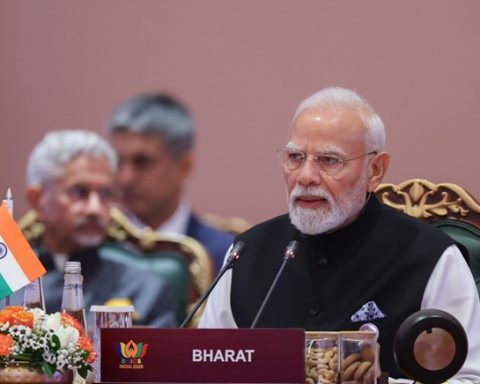
India’s position is similarly pragmatic. Prime Minister Narendra Modi’s participation in SCO events, Friedman suggests, is largely motivated by the desire to maintain leverage with the United States. “The point of getting together was getting together. And the point of the media is they confuse a conversation with an agreement,” he explains. The gestures of friendship and public displays of solidarity do not reflect a shift in substantive policy; rather, they are a strategic signal designed to optimise India’s negotiating position with the United States.
Friedman underscores the broader economic calculus that constrains both China and India. “China and India really don’t like what the American would want to do to be less dependent on imports… The United States being a vastly larger economy in relation to population than China has these options,” he observes. In other words, the United States’ market size provides it with leverage over both nations, shaping their economic strategies in ways that limit their capacity to form a countervailing bloc.
From a military perspective, the recent parade in Tiananmen Square serves more as theatre than as evidence of strategic alignment. “Russia had only one ally in this war. It was North Korea. That’s pretty sad for the former Soviet Union… The fact was they’d kill me if they wanted to, and I didn’t have any choice. So there is gestures in politics, and it’s not unimportant, but ultimately you have to sit down and look at power, economic, military, and other sorts, and then see if a merger is possible,” Friedman observes. The display signals defiance, yet the underlying military and economic capabilities necessary to sustain a unified front are lacking.
Even among ostensibly friendly nations, historical tensions and ongoing disputes complicate prospects for cooperation. Friedman points to the long-standing border disputes between India and China as a stark example: “Between India and China, there’s an economic competition and they have recently fought battles along their border. How do you reconcile that?” Likewise, historical grievances between Russia and China, or the complex relationship between China and Pakistan, underscore the fragility of potential alliances based purely on shared antipathy towards the West.
Friedman also highlights the structural limits of economic power in determining alliance potential. While the combined populations of India and China are enormous, per capita income remains relatively low. “China… in terms of per capita income… ranks about 70. India as well is a country that’s divided between different ethnic groups, different religions,” he points out. Economic scale alone, he argues, cannot compensate for the disparities in wealth distribution and the competing domestic priorities of these nations.
The SCO summit and accompanying celebrations, Friedman suggests, are best understood as theatrical performances with limited practical significance. The public gestures are designed for international audiences, particularly the Western media, but they obscure the reality of conflicting imperatives and structural constraints. “Gestures are gestures. They’re worth every penny you spend on them, nothing. And now the parade’s over, everybody going home,” he remarks. The only substantive outcome, he notes, is the Chinese-Russian pipeline agreement, which will take years to materialise and carries limited immediate impact.
Friedman emphasises the importance of evaluating nations’ capabilities rather than intentions. “I look at what they’re capable of doing, not what they intend to do or would like to do,” he explains. In practice, this means assessing economic strength, military capacity, and the practical limits imposed by geography, resources, and domestic politics. Public displays of solidarity, he argues, must be interpreted in this context: without the necessary means to back up their ambitions, nations’ gestures remain largely symbolic.
Even the role of authoritarianism in shaping international coalitions, Friedman suggests, is secondary to pragmatic considerations of power and interest. While many of the SCO nations are authoritarian or “authoritarian light,” this ideological similarity does not override their economic and military divergences. “Even under communism, the Russians and the Chinese fought border wars… There is a need to demonstrate solidarity, but an inability to be solid,” he observes. Structural and strategic realities outweigh any superficial convergence in governance style.
Iran’s exclusion from the summit further illustrates the careful balancing of risk and strategic interest within the SCO. Friedman notes that Russia, in particular, has reasons for caution: “The Russians are worried about the Iranians because some of the terrorist groups inside Iran were ones that blew up a concert hall in Moscow in a terrorist attack.” Even for states with shared grievances against the West, historical conflicts and security concerns limit the scope for genuine collaboration.
Ultimately, Friedman’s analysis suggests that while the SCO summit and associated events may generate headlines, the prospects for a durable anti-Western coalition are limited. “There is no common interest here except really hating the United States at this point. That does not make a foreign policy,” he asserts. Economic dependence, military preoccupations, historical animosities, and domestic imperatives constrain the ability of these nations to translate symbolic unity into actionable strategy.
In the final analysis, Friedman’s perspective underscores the enduring centrality of the United States in global geopolitics. Even as nations gesture towards alternative alignments, the structural advantages afforded by economic scale, military capacity, and domestic stability continue to anchor the existing order. The SCO may stage impressive displays, but in practical terms, “China can only generate the necessary income by exporting… India… access to the American market is critical. They can’t afford a break with the United States.” The political theatre of Tianjin, therefore, should be read as performance rather than policy, a vivid illustration of aspiration constrained by reality.
The recent parade, summit, and symbolic handshakes serve as reminders of the gap between ambition and capability in international politics. While the leaders of China, Russia, and North Korea may seek to project power, the underlying constraints of economy, history, and national interest temper their ability to act collectively. As Friedman concludes, international relations are governed less by gestures and ideology than by the hard realities of economic and military power, domestic imperatives, and the practical limits of what each nation can achieve.