
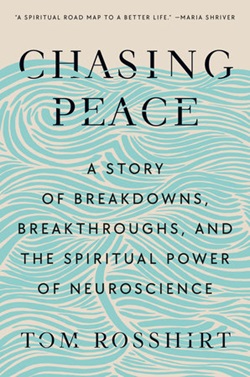
Tom Rosshirt’s Chasing Peace: A Story of Breakdowns, Breakthroughs, and the Spiritual Power of Neuroscience unfolds as an eloquent exploration of human vulnerability, resilience, and the profound interplay between self-perception and mental well-being. Rosshirt navigates the reader through the poignant terrain of personal transformation, enriched by his nuanced understanding of neuroscience and spirituality. With evocative prose and searing honesty, he reveals how crises of identity and purpose can, paradoxically, become portals to peace. It is a work that does not merely illuminate but also invites the reader into an intimate reckoning with their own inner struggles.
From the opening lines, Rosshirt challenges the conventional paradigms of self-actualisation. “I hate it when life tells me I’m not who I think I am. And it’s the best thing that ever happens to me,” he declares. This paradox encapsulates the book’s central thesis: that our most significant breakthroughs often emerge from the ashes of our most cherished illusions. Rosshirt frames this journey through the lens of what he terms the “Self-Image Model of Happiness,” a construct that underscores the fragility of tying one’s identity to external achievements or rigid self-conceptions. “True peace,” he posits, “is not becoming who you want to be but accepting who you are.”
The narrative is steeped in personal anecdotes, each layered with psychological and philosophical insights. Rosshirt’s candid recounting of his own “breakdowns”—moments of profound disillusionment and despair—serves as both cautionary tales and redemptive arcs. Whether detailing the collapse of a youthful dream or the torment of chronic anxiety, he writes with an unflinching authenticity that evokes empathy without veering into melodrama. These vignettes are interwoven with reflections on neuroscience, particularly the concept of neuroplasticity, which he champions as a source of hope and empowerment. “Our brains,” he asserts, “are not prisons but playgrounds of possibility.”
One of the book’s strengths lies in its interrogation of cultural narratives surrounding success and happiness. Rosshirt critiques the relentless pursuit of self-improvement as a form of spiritual materialism, wherein individuals commodify their own growth in pursuit of external validation. He draws a compelling contrast between happiness—defined as the alignment of one’s self-image with reality—and peace, which he describes as a state of inner harmony independent of external conditions. “Happiness,” he writes, “is a moving target, while peace is a still point.” This distinction resonates throughout the text, providing a conceptual framework that challenges readers to re-evaluate their own pursuits.
The book’s exploration of identity is enriched by Rosshirt’s engagement with spiritual traditions, from Socratic philosophy to Buddhist mindfulness. In a particularly evocative chapter, he recounts reading The Apology of Socrates while perched on a mountaintop as a college student. The philosopher’s admonition to “know thyself” becomes a recurring motif, underscoring the transformative power of self-inquiry. Similarly, Rosshirt draws on Buddhist teachings to illuminate the concept of impermanence, encouraging readers to embrace the transient nature of their own thoughts and emotions. “Our pain,” he observes, “loses its fist when we stop trying to pry it open.”
Central to the book’s appeal is its integration of neuroscience with spiritual wisdom. Rosshirt delves into the science of the brain with a clarity that demystifies without oversimplifying. He explains how the brain’s left hemisphere constructs narratives to maintain a coherent sense of self, even at the expense of truth. This “interpreter function,” he notes, often perpetuates false beliefs that reinforce anxiety and self-doubt. Yet, Rosshirt is quick to highlight the brain’s capacity for change, citing research on mindfulness meditation as evidence of its ability to rewire neural pathways. “We are not condemned by our wiring,” he asserts. “We are the architects of our neural landscapes.”
The book’s structure mirrors its thematic content, oscillating between moments of rupture and resolution. Chapters such as “The Beginning of Breaking Down” and “Crisis” are juxtaposed with “Grace” and “Breakthrough After Breakthrough,” reflecting the cyclical nature of growth. Rosshirt’s prose is both lyrical and incisive, imbued with a vulnerability that disarms and a wisdom that inspires. Consider his reflection on loss: “The dreams that shatter are often too small to contain the lives we are meant to live.” Such insights, rendered with poetic precision, linger in the reader’s consciousness long after the page is turned.
While the book’s philosophical depth is one of its virtues, it occasionally ventures into abstraction. Some readers may find its metaphysical musings less accessible, particularly when Rosshirt delves into existential questions about the nature of reality and consciousness. However, these moments are balanced by the author’s grounding in personal narrative and practical application. Each philosophical reflection is tethered to a tangible experience, ensuring that the text remains relatable even as it soars into the theoretical.
One of the most striking aspects of Chasing Peace is its treatment of vulnerability as a gateway to strength. Rosshirt challenges the societal stigmas surrounding emotional fragility, advocating for a paradigm shift that views breakdowns not as failures but as opportunities for profound transformation. “To be broken,” he writes, “is to be opened. And to be opened is to be free.” This reframing of vulnerability as a form of courage is both radical and liberating, offering readers a new lens through which to view their own struggles.
The book’s practical wisdom is encapsulated in its closing chapters, which provide actionable steps for cultivating peace. Rosshirt emphasises the importance of mindfulness practices, from meditation to journaling, as tools for quieting the mind’s incessant chatter. He also advocates for the power of gratitude, describing it as “the antidote to scarcity thinking.” These recommendations are presented with humility, as Rosshirt acknowledges the non-linear nature of healing. “Peace is not a destination,” he concludes. “It is a practice, an ongoing act of return.”
In its totality, Chasing Peace is both a memoir and a manifesto, a deeply personal account that transcends the individual to address universal themes. It is a book that invites readers to confront their own shadows with compassion and curiosity, to dismantle the stories that confine them, and to step into the expansive freedom of self-acceptance. Rosshirt’s synthesis of neuroscience, spirituality, and lived experience creates a rich tapestry of insight, ensuring that the book will resonate with a diverse audience.