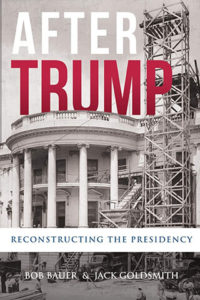
Editor’s Note: Bob Bauer and Jack Goldsmith are among the most influential contemporary American legal scholars writing on executive power, constitutional structure, and the law of the presidency. Bauer, a Professor of Practice and Distinguished Scholar at New York University School of Law, served as White House Counsel to President Barack Obama from 2009 to 2011 and has been a central figure in debates over democratic governance and executive accountability, most notably through his co-authored works After Trump and The Unravelling. Goldsmith, the Learned Hand Professor of Law at Harvard University and a former Assistant Attorney General heading the Office of Legal Counsel, is widely regarded as one of the leading authorities on presidential power, national security law, and foreign affairs, with a substantial body of scholarship including books, casebooks, and sustained commentary through platforms such as Lawfare and Executive Functions. This essay is based on their recent public discussion concerning the United States’ use of military force in Venezuela, the legal rationales advanced by the executive branch for that action, and the subsequent seizure and removal to the United States of Venezuela’s head of state and his first lady for criminal proceedings. Drawing on their exchange, the essay examines the deeper implications of this episode for the law of war powers, the role of executive legal precedent, and the uneasy boundary between legality and politics in the contemporary exercise of American military and judicial power.
The dialogue between Bob Bauer and Jack Goldsmith offers an unusually candid and sobering examination of the contemporary state of United States war powers law. What makes the exchange particularly significant is not merely its subject matter—the unilateral deployment of force in Venezuela and the extraordinary seizure of a foreign head of state—but the degree to which both speakers converge on a deeply sceptical conclusion about the meaningfulness of legal constraint in this domain. Over the course of the discussion, Goldsmith articulates a position that is at once descriptive, pessimistic, and quietly radical: that the law governing presidential uses of force has been hollowed out by practice, executive precedent, and congressional acquiescence to such an extent that legality itself has become largely performative. Bauer, while pressing on the implications of this claim, ultimately reinforces rather than dismantles it, revealing a shared concern that constitutional war powers have become a political artefact rather than a juridical limit.
At the heart of Goldsmith’s argument is the absence of judicial engagement. As he bluntly observes, “we don’t have any Supreme Court precedents. So the court really has not engaged with the question ever about the circumstances under which the president can use unilateral force.” The sole exception he identifies—the Prize Cases of the Civil War—is narrow and context-specific, validating Lincoln’s actions under a theory of self-defence. Outside that historical moment, the judiciary has consistently avoided adjudicating the core separation-of-powers question. This judicial silence is not merely a gap in doctrine; it is the structural condition that allows executive power to expand unchecked. Without authoritative judicial interpretation, the constitutional text becomes malleable, and its meaning increasingly shaped by political practice rather than legal principle.

Goldsmith emphasises that the relevant legal materials are themselves deeply contested. He notes that “we’ve got the constitutional text and we’ve got 250 years of practice,” and that while there is “a great debate over the original understanding of the War Powers and the Declare War Clause, the Commander-in-Chief Clause, and the like,” that debate has been “overtaken by practice in 250 years.” This practice, he argues, has moved overwhelmingly in one direction. “It’s all been in favour of the president,” he says, stressing that over time presidents have asserted “greater and greater and more extravagant and extravagant uses of force without congressional authorisation.” The repetition in his phrasing underscores the cumulative nature of this expansion, suggesting not a single rupture but a slow accretion of authority through repeated action.
Congress, in Goldsmith’s telling, has played a largely passive role in this process. While formally vested with the power to declare war, it has “basically acquiesced” to presidential initiative. Even the War Powers Resolution of 1973, often cited as a legislative attempt to reclaim authority, is dismissed as “Swiss cheese” that “has not proven to be much of a check on the president.” The metaphor is revealing: the statute is not merely weak, but riddled with holes through which executive discretion easily flows. Goldsmith does not deny that Congress possesses tools to resist presidential overreach—funding restrictions, conditions, oversight—but he treats their use as episodic and politically contingent rather than structurally reliable.
This leads to one of the central tensions in the discussion: the legal significance of practice. Bauer presses Goldsmith on whether presidential action, repeatedly unchallenged, effectively becomes law. He frames the issue starkly, asking whether presidents “get away with it because the political process just is simply not structured to respond effectively,” and whether that success “has legal significance that you didn’t respond in that situation to the claim of authority that I, the president, made.” Goldsmith’s response is cautious but revealing. He acknowledges that, in theory, long-standing practice could be argued to “liquidate the meaning of the Constitution in separation of powers,” particularly if Congress is deemed to have acquiesced. Yet he also notes that such an argument would be fiercely contested, especially given Congress’s claim that silence does not equal consent and that the War Powers Resolution represents an ongoing objection.
Importantly, Goldsmith separates this theoretical constitutional debate from practical reality. Even if one could construct a sophisticated argument about liquidation and acquiescence, he insists that “the courts aren’t going to adjudicate this.” As a result, the real law governing presidential uses of force is not constitutional text interpreted by courts, but a body of executive branch opinions that “now constitute a body of precedent that drives executive branch decision-making.” This is a striking admission. Law, in this domain, is effectively generated by the very institution whose power it is meant to constrain. Judicial review is absent, congressional resistance is sporadic, and executive interpretation becomes self-reinforcing.
Bauer raises the obvious concern that this process is inherently self-serving. Presidents, he suggests, are able to “order up these legal opinions,” shaping the legal debate to suit their preferences. Goldsmith resists the implication that executive lawyers are mere rubber stamps, noting that “there are lots of instances of executive branch lawyers saying no to the White House.” Yet he concedes that the dynamic changes fundamentally when national security is at stake. In such cases, the weight of precedent and the perceived urgency of presidential judgement make refusal exceptionally difficult. “When the president decides that he thinks he needs to use force,” Goldsmith explains, “it’s very hard for lawyers in light of all those precedents and all those opinions… to say no.”
This difficulty is compounded by the substantive content of the executive branch’s legal doctrines, particularly the concept of national interest. As Bauer notes, Secretary Rubio repeatedly invoked national interest as the justification for the Venezuela operation, defining it expansively to include drug trafficking, Hezbollah presence, regional stability, and economic concerns. Goldsmith’s assessment of this justification is damning in its implications. “There’s no declared boundary in the OLC opinions,” he states. National interest has been invoked across a “long list” of contexts, including self-defence, humanitarian concerns, and regional security, and “the list doesn’t purport to be exclusive.” Indeed, he notes, “they’ve been adding to them in recent decades.”
What emerges is a doctrine that carries “the patina of legal analysis” without meaningful constraint. Aside from the narrow caveat concerning “significant boots on the ground with significant presence that poses a significant threat to US troops,” Goldsmith sees no real limits on what can qualify as national interest. This flexibility allows almost any foreign policy objective to be reframed as a legal justification for force. As Goldsmith observes, a president could plausibly maintain “that it is in the national interest of the United States… to ensure that no regimes take hold south of our border… that we deem hostile.” Historical precedent, particularly the long history of US intervention in Central and South America, only reinforces this permissiveness.
Goldsmith’s scepticism culminates in one of the most provocative passages of the discussion, where he challenges the value of legality itself in debates over war powers. “Immediately after these operations happen,” he says, “we immediately jump to the law and commentators immediately say this is illegal… or they defend it as being lawful.” He continues, “I frankly think it’s kind of a meaningless debate in almost every circumstance.” This is not a rejection of law as such, but a claim that legal argument has become disconnected from the mechanisms of constraint. Without judicial enforcement or sustained congressional resistance, legality functions more as rhetoric than as rule.
Bauer responds by questioning whether abandoning legal debate altogether risks conceding too much. He asks whether it is not “important that anybody actually cares enough to raise the question of whether something is legal,” warning that if legality “passes completely from the dialogue,” society may drift “completely outside the zone of any concern for law.” Goldsmith’s reply is nuanced. He does not discourage legal argument, acknowledging that “law is the language through which we criticise presidential uses of war powers.” However, he remains doubtful about its efficacy. “I’m just not sure what purpose it serves,” he admits, given the absence of judicial review and the dominance of executive precedent. At best, legal rhetoric may influence politics; at worst, it obscures the true locus of power.

This emphasis on politics over law frames the transition to the second major topic of the discussion: the legal consequences of Maduro’s capture and prosecution. Here, Goldsmith’s tone shifts from scepticism to doctrinal confidence. Unlike war powers, criminal jurisdiction and trial procedure occupy “a much more clearly defined zone of law.” Drawing on precedents such as the Noriega case, Goldsmith systematically dismantles potential defences based on the manner of Maduro’s arrest. Under the Ker–Frisbie doctrine, he explains, “the circumstances in which the person is brought to trial do not impact due process.” What matters is the fairness of the trial itself, not the legality of the apprehension.
Similarly, arguments based on international law fare poorly. The UN Charter, Goldsmith notes, is unlikely to succeed because it is “not self-executing and didn’t confer individual rights,” a conclusion consistent with prior case law. Head of state immunity, while superficially more compelling, is also unlikely to prevail. Courts accord “extraordinary deference” to the executive branch on questions of recognition and immunity, and Goldsmith suggests that even a recognised head of state could be denied immunity if the executive so determined. The overarching lesson is that, once within the US judicial system, the defendant’s prospects are governed by well-settled doctrines that favour prosecution.
The contrast between these two domains—war powers and criminal law—is instructive. In the former, legality dissolves into politics; in the latter, doctrine asserts itself with force. This asymmetry reveals something fundamental about constitutional structure. War powers lie at the intersection of foreign affairs and national security, areas historically resistant to judicial oversight. Criminal prosecution, by contrast, fits comfortably within the judiciary’s institutional competence. The result is a system in which the most consequential exercises of state power—the decision to use force abroad—are the least legally constrained.
The discussion closes on a bleak note. Reflecting on the broader implications of the Venezuela operation, Bauer observes that “this is not only where we are, but where we have been for a long time.” Goldsmith agrees. “The president gets to decide how to use military force abroad, and that’s where we are.” The simplicity of the statement belies its constitutional significance. It suggests that, whatever the formal allocation of powers, the effective constitution of war powers in the United States has been rewritten through practice.