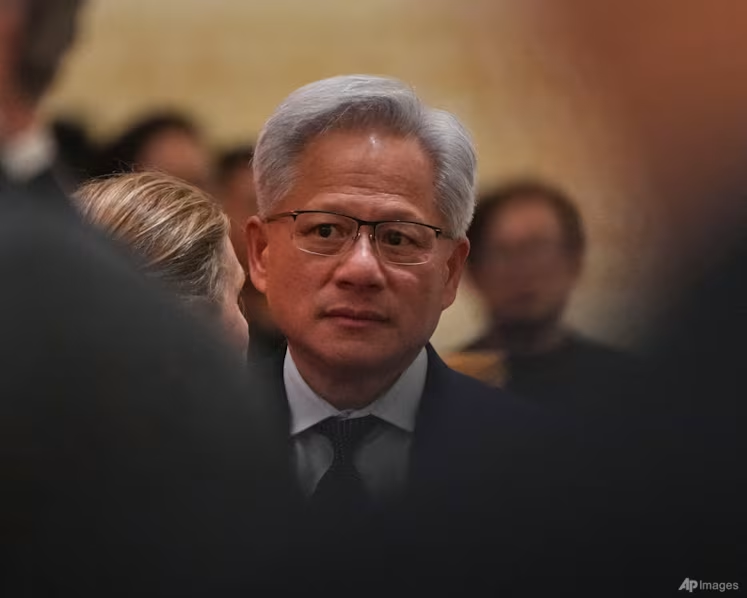
The $1.1 trillion wiped off Nvidia’s market value following reports about Jensen Huang’s personal life has exposed the financial risks of companies built around powerful founders, as AI billionaires increasingly consolidate control over businesses seeking public investment.
The stock market wiped $1.1 trillion off Nvidia’s value in the two weeks between the New York Times first reported an alleged affair involving its chief executive, Jensen Huang, and a woman suspected of being a Chinese spy, and reports of his resignation. The episode, covered by The Observer UK, has become an illustration of the financial exposure created when a global technology company becomes closely identified with one individual. Whatever the personal consequences for Huang, the market reaction has demonstrated how developments involving a chief executive can become a major corporate and financial event.
Huang occupies an unusual position in the technology industry. He founded Nvidia 33 years ago in a Denny’s coffee shop and has led the company ever since, building it into the dominant supplier of artificial intelligence chips, accounting for more than 85 per cent of the global market. As demand for AI infrastructure has expanded, Nvidia has become central to the industry’s development, with Huang emerging as one of its most influential figures. The company’s importance has made his personal standing and leadership increasingly consequential to investors and the wider technology sector.
The episode has brought renewed attention to what The Observer describes as “personality cult capitalism”: a corporate model in which the identity, authority and reputation of a founder become inseparable from the company itself. Nvidia is not alone. Across the AI industry, several of the most valuable businesses are organised around founders whose personal influence extends well beyond conventional executive responsibilities. The concentration of authority creates risks not only for individual companies and their shareholders but also for markets and the global economy.
When reports about Huang’s alleged relationship with Alice Huang, a woman working for a technology business in Singapore, first emerged, Nvidia responded with a statement that attracted attention for its unusual wording. A company spokesperson said: “Jensen’s interactions with Ms Huang are not unusual or unexpected.” The Observer characterised the response as a non-denial that exposed a company struggling to address a controversy involving its chief executive. It subsequently emerged that Huang had also had an affair with Kimberly Powell, Nvidia’s vice-president of healthcare.
The circumstances surrounding the company’s response also drew attention to its governance arrangements. According to The Observer, Huang had structured Nvidia without an independent chair, maintained 60 direct reports, deliberately avoided succession planning and retained the position of the company’s principal public voice. This concentration of responsibility meant that the organisation had limited capacity to communicate independently when its chief executive could not speak on its behalf. The problem extended beyond public relations to the company’s institutional dependence on one individual.
Similar arrangements are becoming more pronounced elsewhere in the AI sector. Anthropic, led by Dario Amodei, SpaceX, led by Elon Musk, and OpenAI, led by Sam Altman, are among the companies whose identities are closely associated with their founders. While the prominence of individual executives is not new, the current trend goes further by embedding their authority in corporate governance structures, including arrangements that restrict the influence of ordinary shareholders.
Anthropic’s proposed public offering provides one example. Amodei has established a single Founder share through which he and his fellow co-founders would control 50.1 per cent of voting rights, despite not holding the corresponding proportion of the company’s economic ownership. The proposed offering values Anthropic at more than $1.2 trillion. The arrangement would allow the founders to retain decisive control even as the company seeks investment from public-market shareholders.
Musk has adopted a comparable approach at SpaceX. When preparing the company for a public-market flotation, he introduced a dual-class voting structure that would leave him with approximately 85 per cent of voting rights. If SpaceX were subsequently merged with Tesla, Musk would control more than 50 per cent of the combined business, valued at $3.4 trillion. Such structures are not unprecedented in corporate finance, but the scale of voting control being retained by founders represents a significant concentration of authority.
The Observer argues that these arrangements could weaken shareholder democracy by allowing companies to raise money from public investors while limiting their ability to influence corporate decisions. Investors may acquire an economic interest in a business without gaining a proportionate say in how it is managed. As major technology founders establish such structures, other companies may adopt similar models, further reducing the distinction between public ownership and private control.
The financial consequences could extend beyond individual companies. Nvidia, recently described by The Economist as the “central bank of AI”, has developed a role that reaches beyond selling semiconductor chips. It has mobilised approximately $500 billion in financing and invested in more than 100 companies involved in building data centres and using its technology. Infrastructure businesses, including Nscale, which is seeking its own initial public offering, operate within a wider financing network whose stability is linked to the spending and investment decisions of major technology companies. The extent to which these businesses depend on financing from hyperscalers and other major industry players creates additional exposure if confidence in a central company deteriorates.
The concentration of corporate power also carries political consequences. The Observer points to Musk’s ability to activate or deactivate Starshield in Ukraine and influence the visibility of political and other voices through his X platform. Huang, meanwhile, has advocated a more liberal approach to the sale of AI chips to China. These examples illustrate how decisions made by unelected technology billionaires can affect matters extending into international security, information flows and US policy towards China.
The implications are not confined to corporate governance or geopolitical influence. Artificial intelligence is changing how societies organise work and interact with technology, while a relatively small number of company founders exercise considerable influence over its development and commercial deployment. Their decisions increasingly affect the systems through which businesses operate and new forms of human behaviour emerge.
The Observer also draws comparisons with the instability that can follow the decline of dominant corporate or institutional leaders, citing Russia after Stalin, General Electric after Jack Welch and Manchester United after Alex Ferguson. In some cases, organisations recover their direction; in others, the transition produces prolonged disruption. The central concern is that companies built around the authority and reputation of individual founders may find it difficult to maintain stability when those figures lose influence or become unable to lead.