


by Our Political Affairs Editor
Congratulations, Anna. Few politicians walk away from an established platform to pursue an idea they truly believe in. Your decision to chart an independent course makes this one of the most intriguing political developments in recent Tamil Nadu politics.
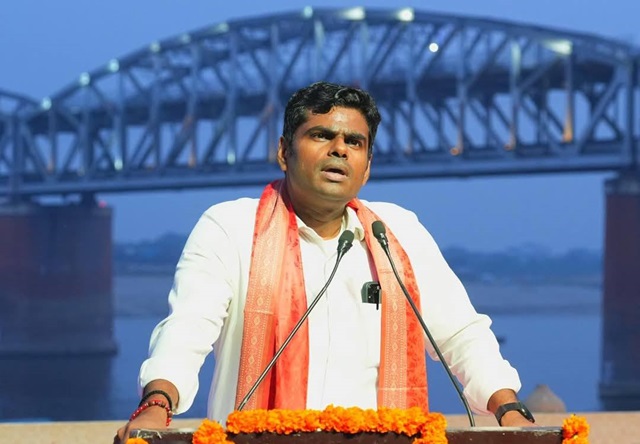
Shortly after formally resigning from the BJP, former Tamil Nadu BJP chief K Annamalai appeared before the public through a live video address on Friday and unveiled what he called a new political movement. More importantly, he made it clear that this movement is not intended to remain a discussion forum or pressure group. It is expected to evolve into a political party that will contest future elections, including the next Assembly polls.
For observers of Indian politics, this is not merely another leader changing party colours. Tamil Nadu is entering unfamiliar territory. For nearly six decades, power in the state has revolved around a handful of political traditions, powerful personalities and inherited party structures. Annamalai’s announcement raises a larger question: can a politician build a movement around leadership training, governance and political ethics rather than dynasty, celebrity or caste arithmetic?
The most striking aspect of Annamalai’s speech was that it sounded less like an election launch and more like a political manifesto in search of a generation. “This is going to be a new beginning. I wanted to leave with respect,” he said, portraying his departure not as a rebellion born out of bitterness but as a conscious decision to pursue a different political path.
He argued that his original reason for entering public life was never simply to win elections. “I want to create a new form of governance,” he said, linking his next chapter to ideas that predate his BJP years. In many ways, the speech was an attempt to present continuity rather than rupture. The message was simple: the mission remains the same, only the vehicle has changed.
Annamalai revisited his political journey, beginning with an internship-like experience with Vijayakanth’s DMDK before eventually joining the BJP. Reflecting on that path, he remarked that after seventeen years he remains committed to the same objective—improving politics and governance. That statement may reveal how he wishes to be seen: not as a party loyalist, but as a political reformer moving through different platforms in pursuit of a larger goal.
One of the most revealing moments came when he addressed long-standing speculation about superstar Rajinikanth. According to Annamalai, Rajinikanth personally approached him before he joined the BJP. Faced with multiple choices, Annamalai said he considered what would be best for Tamil Nadu, what would be best for Rajinikanth, and what would be best for himself. At the height of the COVID-19 crisis, he concluded that Rajinikanth should stay out of politics and that he should honour the commitment he had already made to BJP leader BL Santhosh. He ultimately joined the BJP and later apologised to Rajinikanth. The anecdote appeared designed to reinforce an image he repeatedly cultivates—that of a politician guided by conviction rather than convenience.
Equally notable was his attempt to define himself in relation to Tamil identity and Indian nationalism, an issue that has long shaped political debate in the state. “I am always asked whether I am a Tamilian or an Indian,” he said. “I am both—a traditional Tamilian and a proud Indian.” In a state where questions of identity often dominate political discourse, Annamalai appears determined to reject the notion that the two identities are in conflict.
His remarks also shed light on the disagreements that reportedly emerged during his final years in the BJP. Annamalai reiterated that he had consistently pushed for the party to contest elections independently in Tamil Nadu rather than through alliances. For him, political growth required direct engagement with voters rather than dependence on larger regional partners. That position often placed him at odds with strategic calculations within the party.
At the same time, he defended his record in the BJP, arguing that he never compromised on issues affecting Tamil Nadu. From the hydrocarbon controversy to the Mekadattu dispute, he said he had always stood with the interests of the state and its people. This appears to be a crucial element of his future political appeal: convincing voters that he can champion Tamil concerns without embracing the anti-national rhetoric that his opponents often associate with national parties.
Yet the most ambitious part of the project lies elsewhere. Annamalai is not merely talking about contesting elections. He is talking about manufacturing leaders. He announced plans to create a Centre for Politics and Ethics in Coimbatore, an institution that would train ordinary citizens to enter public life. “We are going to train common people to become political leaders,” he declared.
That idea may sound idealistic, but it strikes at the heart of one of India’s most persistent democratic complaints—that politics has become the preserve of families, celebrities and career politicians. By promising to build cadres from the ground up and cultivate leadership among ordinary citizens, Annamalai is attempting to position himself against the entrenched culture of political inheritance.
Whether this vision can survive contact with electoral reality remains uncertain. Tamil Nadu is one of India’s most politically sophisticated states, and voters have heard promises of political renewal before. Building a movement is difficult; transforming it into a party capable of winning elections is even harder.
Still, Annamalai’s departure from the BJP deserves attention beyond Tamil Nadu. It represents a rare moment when a national party’s most recognisable regional face chooses uncertainty over security. Most politicians leave parties in search of office. Annamalai appears to be leaving office in search of an idea.
The coming years will determine whether that idea becomes a political force or merely another footnote in Tamil Nadu’s long history of political experiments. But one thing is already clear: this is not a routine resignation. It is a wager on the belief that Indian politics still has room for something new.










