


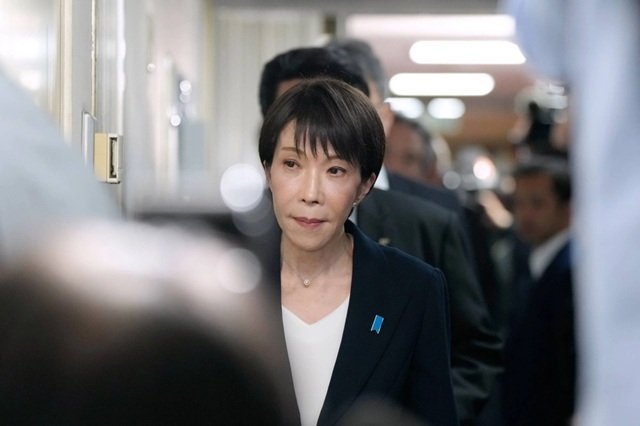
Sanae Takaichi’s rise to power was greeted by many in her home region of Nara as the arrival of a politician capable of breaking Japan’s long-running cycle of ageing demographics, weak growth and political caution. But as she approaches her first full year as prime minister, the confidence surrounding her premiership is beginning to face tougher tests.
The Financial Times, which reported on Takaichi’s political and economic challenges, describes a leader whose popularity remains substantial but whose approach is increasingly colliding with Japan’s established political habits and financial constraints. Takaichi took office last October and won a landslide victory in a snap general election in February, giving the Liberal Democratic Party an unprecedented two-thirds majority in the lower house.
Her approval ratings remain above 50 per cent, although polls have begun to move in different directions. The more decisive judgement has come from financial markets. This week, selling of benchmark 10-year Japanese government bonds pushed yields to 3 per cent, their highest level in three decades.
Economists say the bond-market pressure reflects concerns about Takaichi’s large stimulus plans, the fiscal strain facing heavily indebted Japan and whether her government can pursue aggressive spending without provoking a wider market backlash.
Her governing style has also begun to challenge the country’s slower political instincts. LDP officials in the provinces say her legislative activity is unusually rapid, while business leaders complain that they are being ignored. Domestic media organisations believe she is bypassing them through X and other social media, while bureaucrats have objected to her preference for reading documents rather than attending in-person briefings.
Takaichi’s supporters regard these habits as evidence of determination rather than weakness. Her nationalism, commitment to restoring Japan to a more prosperous era and desire to secure its long-term future are viewed by people who have known her for decades as genuine.
Tomohiko Taniguchi, head of Nippon Kaigi, a hardline Shintoist group that exercises influence within the LDP, calls her the architect of Japan’s “quiet revolution”. Her personal ideal is Margaret Thatcher, whom she admires for confronting established interests and imposing dynamism on an economy she believed had become resistant to change.
That image helped Takaichi build an unusually broad coalition of support among women, younger voters and people who had previously backed smaller populist parties. Yet some of that coalition is now showing signs of strain.
Her economic programme has become a particular source of uncertainty. Takaichi has sought to fight inflation by capping petrol prices and proposing a reduction in the consumption tax on food from 8 per cent to 1 per cent. Supporters see the measures as immediate relief for households, while critics question the fiscal risks.
From late July, her government also undertook a $96bn currency intervention in co-ordination with Washington. The yen subsequently lost more than half of the gains made during the intervention. US Treasury secretary Scott Bessent has publicly urged the Bank of Japan to raise interest rates more aggressively.
The tension reflects a central contradiction in Takaichi’s economic agenda: she wants to spend heavily to stimulate growth while expecting monetary policy to accommodate that spending rather than sharply increasing borrowing costs. Traders are therefore watching each move for signs of whether the government can sustain its plans without provoking the bond market.
Political scientist Mieko Nakabayashi of Waseda University argues that Takaichi’s emphasis on combating inflation reflects a less optimistic reality than her rhetoric about a “beautiful country”. Her policies, Nakabayashi says, are aimed at people seeking immediate help after years of weak economic performance.
Her nationalist agenda has also generated controversy. The final weeks of parliament before the summer break included a law change intended to help secure male-only Imperial succession and the criminalisation of desecrating the Japanese flag. Both measures coincided with unexpectedly bruising opinion polls.
Takaichi’s foreign policy presents another major challenge. Relations with China have remained frozen for 10 months after she said early in her premiership that Japan could theoretically become militarily involved if China were at war with Taiwan. Chinese media have increasingly accused her of pursuing a neo-imperial remilitarisation of Japan.
Her refusal to retreat has strengthened support among her base but created difficulties for Japanese businesses dealing with the country’s largest trading partner. The planned summit between US President Donald Trump and Chinese President Xi Jinping in late September could prove particularly important. If Washington and Beijing move towards a broader agreement, analysts warn, Takaichi could face domestic pressure to reconsider her position.
She must also manage a delicate relationship with the Trump administration over the International Criminal Court, to which Japan is the largest contributor and which is headed by Japanese judge Tomoko Akane. After Washington imposed direct sanctions on Akane in August, Takaichi initially called the move “very unfortunate”, before subsequently saying it was “incompatible with Japan’s position and we take it extremely seriously”.
At home, an expected cabinet reshuffle presents another test. Takaichi must balance former prime minister and faction head Taro Aso, protect her loyalists and contain potential challengers ahead of next September’s LDP presidential election.
Her political gamble ultimately depends on whether her anti-establishment image can survive the realities of governing from within Japan’s dominant political party. As Tetsuro Kobayashi of Waseda University puts it, her support is driven largely by “the feelings she inspires”. But he warns that it is “actually quite shallow”.
In Nara, the changing mood is reflected at the Mahoroba Museum, where a restored 1991 white Toyota Supra once driven by Takaichi remains on display. The museum reportedly attracted more than 600 visitors a day when she became prime minister. Now, according to its receptionist, it is quieter — with a single visitor who has not even stopped to look at the car.









