by Eric
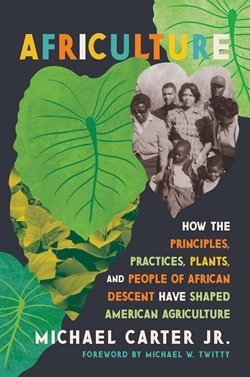
The book Africulture: On the Erasure of African Agricultural Genius is a forceful intervention into the history of agriculture, race, and epistemic authority, structured around a central provocation: that modern agricultural systems—and by extension modern American wealth—cannot be understood without confronting the systematic erasure of African and Indigenous agrarian intelligence. Its opening claim is deliberately sweeping: “Without African crops, expertise, and innovation, American agriculture and America itself would not exist.” This is not presented as metaphor but as historical correction, a recalibration of what counts as foundational knowledge. The book’s ambition is therefore not merely to recover forgotten histories but to rewrite the epistemic ground on which agricultural modernity rests.
From its earliest chapters, the text positions land not as inert resource but as contested archive of violence and knowledge. “The first and most underappreciated abuse was the act of running the original soil managers (the Indigenous nations) off the land, which they had stewarded for hundreds if not thousands of years.” The phrase “soil managers” is analytically significant: it reframes Indigenous presence as technical expertise rather than passive belonging. Yet the conceptual boldness of this reframing also raises questions about whether the language of management risks translating relational ecological systems into modern technocratic categories. The book’s broader project oscillates between critique of colonial epistemologies and occasional reliance on their vocabulary.
A central analytical thread concerns what the author terms ethnobotanical racism. “The ideas of Linnaeus and his kind became pollutants in the soil medium where Western ideology would plant its roots and grow. This was the poison known as scientific racism, and it metastasized into what I call ethnobotanical racism.” This metaphor is intellectually productive: it fuses taxonomy, ecology, and ideology into a single diagnostic framework. Yet its rhetorical density also risks overextension. The claim that “It wasn’t just people that were discriminated against, it was African plants, as well” expands racism into botanical classification in ways that are conceptually suggestive but analytically under-specified. The book’s strength lies in revealing how scientific classification encoded hierarchy; its vulnerability lies in occasionally stretching analogy into ontology.
The critique of land-grant institutions is among the book’s most empirically grounded and politically urgent sections. The assertion that “The 1862 land-grant schools might as well be called land grab schools” is supported by a wider historical argument about dispossession and institutional enrichment. The contrast between 1862 and 1890 institutions, where “the original land-grant schools garnered $2 billion more in revenue,” is deployed to demonstrate structural inequality rather than incidental disparity. Yet the text does more than quantify injustice; it reframes institutional history as ongoing extraction. This is further sharpened by the claim that “The USDA as the last plantation,” a phrase that is deliberately incendiary but analytically grounded in the observation that “Most applications that Black farmers submitted were delayed, denied, or offered only on unfavorable terms.” The rhetorical force here is undeniable, though it raises a familiar tension between metaphorical intensity and institutional specificity.
Perhaps the most striking intervention in the book is its insistence that agricultural racism operates not only through policy but through culture, imagery, and taste. The discussion of watermelon is emblematic: “Watermelon was one of the best cash crops for Black farmers… But since Reconstruction… watermelon has been denigrated as the lowly fruit of the Black community.” This is extended into a media critique in which “Minstrel shows featured songs about Black people loving watermelons.” The argument reaches its most provocative point in the claim that “The seedless watermelon was created partly out of this negative perception.” Whether or not this causal linkage is fully substantiated, its analytical purpose is clear: to demonstrate how racialisation can reshape even biological commodities. The claim that agricultural stigma persists in “jokes, cartoons, songs, and out-of-touch marketing campaigns” situates food within a semiotic economy of race that is rarely acknowledged in mainstream agrarian histories.
The book’s treatment of scientific racism is equally assertive. Linnaeus is recast not merely as taxonomist but as ideological architect: “Linnaeus claimed to have the ability to identify and judge plants by their native region, and implied that African plants were inferior.” More provocatively, his system is described as producing human hierarchies in which African characteristics were rendered inherently deficient. “His description of the African species is more negative and derogatory than that of the other species.” This critique culminates in the formulation that “The Carl Linnaeus effect is: ‘What good thing could come out of Africa?’” The argument here is less about historical accuracy alone than about epistemic inheritance: classification systems become cultural residues that continue to structure perception long after their scientific premises have been discredited.
One of the book’s most compelling narrative strategies is its insistence on linking macro-structures of agricultural dispossession to intimate histories of labour, trauma, and memory. The personal account of the grandfather’s farm, where “the ponderosa… represented refuge, peace, sanctuary,” is abruptly disrupted by tragedy when “the tires slipped and the tractor flipped over.” This anecdotal material is not decorative; it functions as epistemological grounding for broader claims about land loss. The observation that “the land can be associated with the tragedy and traumas that happen upon it” introduces a psychological dimension often absent in economic histories of agriculture. Yet this also raises methodological questions: to what extent can inherited trauma be analytically generalised without collapsing into metaphor?
The book’s discussion of Black agricultural decline is framed in explicitly ecological terms. The statement that “We are experiencing a Black farmer extinction-level event” is deliberately stark, designed to force recognition of demographic collapse as systemic rather than incidental. This is reinforced by statistical claims such as “Between 1910 and 1997, Black ownership of farmland in the South dropped by 90 percent.” The argument is not simply that discrimination occurred, but that it produced irreversible structural transformation. However, the extinction metaphor introduces its own risks, potentially naturalising what is in fact politically produced.
A particularly provocative dimension of the book is its reinterpretation of resistance practices, including poisoning. “The enslaved didn’t give up; they were always thinking about how to get out of their ungodly situation.” Stories of botanical knowledge used against enslavers are framed as acts of agency rather than criminality. The case of “Auntie Eve… burned to death” becomes emblematic of how resistance was criminalised and punished with extreme violence. While the recuperation of agency is ethically important, the framing of poisoning as coherent strategy risks flattening the complexity of historical survival under coercion into a unified theory of resistance.
The book is at its most intellectually ambitious when it interrogates the relationship between agriculture, capitalism, and racial ideology. The claim that “Cotton was king as a commodity crop” and that it underpins global financial systems reframes modernity itself as agriculturally structured. Similarly, the assertion that “Slavery… was a 100 percent tax on your being” seeks to articulate slavery not only as labour exploitation but total expropriation of embodied and intellectual life. These formulations are rhetorically powerful, though they occasionally prioritise moral intensity over analytical precision.
At times, the book moves into speculative or controversial terrain, particularly in its discussions of biological difference and crop adaptation. Questions such as “Why do certain plants like nightshades affect African bodies differently than they do European bodies?” risk slipping into essentialist frameworks even as they attempt to critique Eurocentric agronomy. The intention is to expose how agricultural science has been historically racialised; however, the phrasing occasionally blurs the line between critique of racism and reproduction of biological generalisation.
Despite these tensions, the book’s most enduring contribution lies in its insistence that agriculture is not merely technical but profoundly political and cultural. The declaration that “Africulture is your history” universalises its argument in deliberately confrontational terms. It demands that readers recognise their own embeddedness in systems of extraction and racialised knowledge. Yet this universality is double-edged: it risks dissolving specific histories of Black agricultural labour into a totalising narrative of global implication.
The book is best understood as an intervention rather than a settled argument. It reconstructs agricultural history as a site of epistemic struggle, where knowledge, land, and race are inseparable. Its greatest strength lies in exposing the depth of erasure that underpins modern agricultural systems; its greatest weakness lies in the occasional overextension of metaphor into explanatory framework. Nevertheless, it succeeds in forcing a reconsideration of what counts as agricultural knowledge and who has historically been authorised to produce it. In doing so, it leaves the reader with an unsettling but necessary question: not only what agriculture has been, but what forms of knowledge have been systematically cultivated—and which have been deliberately uprooted.