


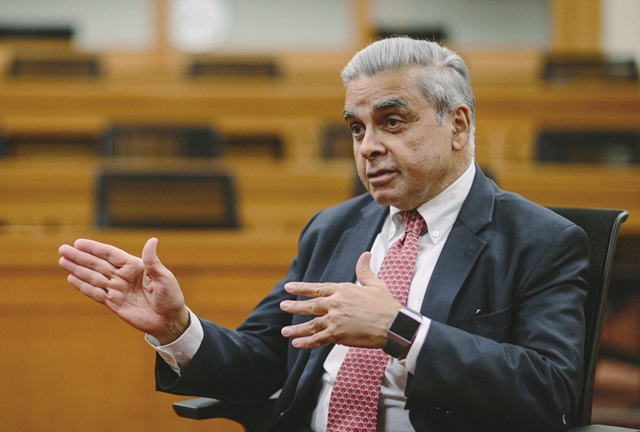
In his essay in Foreign Affairs, Kishore Mahbubani reflects on the warning issued by Alexander Stubb, the president of Finland, that the West faces a decisive moment in its global influence. Stubb argues that the countries of the global South, comprising billions across Asia, Africa, and Latin America, will determine whether the world moves toward cooperation, fragmentation, or domination. Mahbubani notes that Western countries continue to treat the rest of the world with a sense of moral superiority and condescension, failing to fully recognize the interests and perspectives of nations outside Europe and North America. The essay stresses that dialogue requires more than issuing demands; it requires listening and reassessing one’s own assumptions about global order.
The essay highlights a critical disconnect between Western perceptions of threats and the realities seen by countries in the global South. While Western policymakers frame China and Russia as looming menaces, most nations in Asia, Africa, and Latin America do not share these fears. Historical context, such as Western interventions and colonial legacies, shapes how the global South interprets the actions of the United States and European powers. Mahbubani emphasizes that this gap in understanding has consequences for Western influence, as countries that feel dismissed are less likely to cooperate in global initiatives led by Europe or the United States.
One illustrative example is the war in Ukraine. Many countries condemned Russia’s invasion as illegal, yet when the West imposed sanctions, most nations outside the West refused to comply. India, under Prime Minister Narendra Modi, welcomed Russian President Vladimir Putin in New Delhi with a ceremonial 21-gun salute in December 2025, signaling that Western attempts to isolate Russia had limited effect. Mahbubani points out that while Western leaders stress moral high ground in opposing Russia, they rarely acknowledge that policies such as NATO’s eastward expansion contributed to Russian grievances. Voices from the global South, like Brazilian President Luiz Inácio Lula da Silva, have argued that accountability for the Ukraine conflict is shared and that preventive diplomacy could have averted escalation.
The essay also scrutinizes European responses to simultaneous crises in Ukraine and Gaza. While Europeans vocally condemned civilian deaths in Ukraine, they largely remained silent as Israeli military operations in Gaza resulted in far higher casualties. Estimates cited in Mahbubani’s essay suggest that Israeli actions may have caused the deaths of five to ten percent of Gaza’s prewar population, a figure exponentially higher than the losses in Ukraine. This selective moral indignation undermines European credibility in the eyes of the global South. Countries witnessing these disparities perceive Western advocacy of human rights and democracy as inconsistent and self-serving.
Economic consequences of the Ukraine war further shaped perceptions in the global South. Several African nations saw development aid diverted to support European interests, leaving local populations bearing the brunt of resource shortages. Mahbubani notes that U.S. efforts under former President Donald Trump to promote negotiation and reduce conflict in Ukraine were generally welcomed by global South countries, whereas EU leaders appeared more interested in thwarting compromise, encouraging Kyiv to hold a maximalist position. The result, Mahbubani argues, is that the West has isolated itself from both its allies in the global South and potential partners in the United States.
The essay underscores that the West’s mismanagement extends beyond Russia to China, a rising economic and geopolitical power. In 2000, the combined GDP of EU nations was roughly seven times that of China. Today, China’s GDP is nearly equal to the EU’s, and projections suggest that by 2050, the EU’s economy will be only half the size of China’s. Despite this shift, European nations continue to block deals and speak condescendingly toward Beijing, limiting opportunities for mutually beneficial cooperation. Mahbubani notes that China’s government enjoys broad legitimacy at home, having overseen decades of social and economic development. In the eyes of many countries in the global South, the Chinese model represents a highly competent state that delivers results, contrasting with Western democratic systems perceived as inconsistent or self-interested.
Mahbubani also critiques Western calls for regime change or aggressive pressure on China, observing that such positions appear absurd to the vast majority of the world’s population, which resides outside the West. Stubb’s essay, Mahbubani writes, wisely counsels that Western nations should maintain confidence in their values while recognizing that different models may prevail elsewhere. Stronger multilateral institutions, reformed to accommodate rising powers, could prevent global competition from escalating into conflict. Mahbubani emphasizes that reforms to the United Nations Security Council and the International Monetary Fund are overdue. He notes that current Security Council arrangements fail to reflect demographic and economic realities, and that IMF voting rights are disproportionately skewed toward Europe despite China’s comparable global economic share.
Among specific proposals discussed in Mahbubani’s essay, Stubb advocates a “7-7-7 formula” for Security Council reform, comprising seven permanent members representing major powers, seven semipermanent seats filled on a rotating basis by influential nations, and seven additional seats for remaining UN members. Mahbubani underscores the logic of transferring the United Kingdom’s permanent seat to India, given India’s projected economic and demographic strength relative to Britain by 2050. Such a move would not only acknowledge historical injustices but also strengthen the legitimacy of global governance structures and enhance Western credibility in the eyes of the global South.
Mahbubani further warns that the West’s reluctance to reform international financial institutions risks pushing countries toward alternative institutions led by China, such as the Asian Infrastructure Investment Bank and the Belt and Road Initiative. In the absence of equitable participation in global governance, countries in the global South may increasingly rely on parallel structures, reducing Western influence and undermining the notion of a cooperative international order.
The essay concludes with a call for the West to embrace a new symmetry of power among the global West, East, and South. Such a balance, Mahbubani writes, would allow countries to address pressing global challenges through dialogue among equals. Yet achieving this balance requires genuine listening, humility, and willingness to share authority. Mahbubani notes that the West, which accounts for only 12 percent of the world’s population, has not yet demonstrated the capacity to engage meaningfully with the remaining 88 percent. Without such engagement, the risk of fragmentation, resentment, and conflict will persist, undermining the West’s long-term strategic interests.
Mahbubani emphasizes that Stubb’s essay serves as a timely warning: the global order is no longer dictated solely by Western powers. The rise of the global South, China’s sustained economic expansion, and the legitimacy of alternative governance models challenge old assumptions and compel a reevaluation of Western strategy. Stubb’s message, as interpreted by Mahbubani, is clear: dialogue without listening is insufficient, and the West must adapt to a rapidly changing world where cooperation depends on recognition, respect, and recalibrated influence.
The essay in Foreign Affairs therefore positions the West at a crossroads. Its ability to preserve influence will depend not merely on military or economic might, but on its willingness to accept the perspectives, priorities, and agency of countries in the global South. Mahbubani argues that failure to do so risks the West becoming increasingly irrelevant, as the global South asserts its voice, builds institutions, and shapes the future on its own terms. In the coming decades, the balance of global power will hinge less on Western projection of authority and more on the West’s capacity to listen, understand, and adapt in a world no longer dominated by a single perspective.









