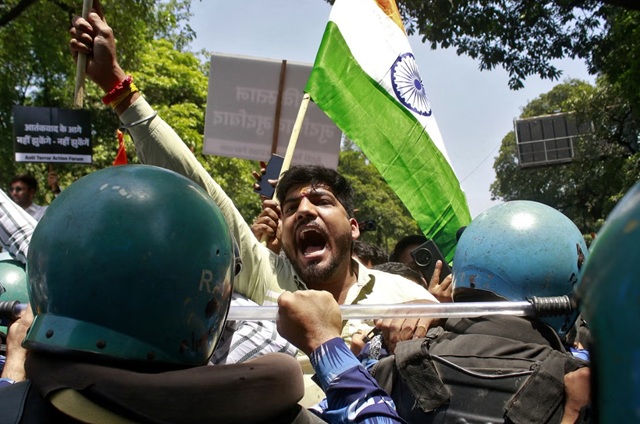
The terrorist attack in Pahalgam, Jammu and Kashmir, which brutally claimed the lives of 26 innocent tourists, demonstrates the sheer heartlessness of the perpetrators. Reports suggest that the terrorists demanded each tourist identify their religion and executed those found to be Hindus. This act reveals the extreme cruelty and warped mindset of such individuals.
The Pahalgam attack has sent shockwaves across India and around the globe, with several world leaders strongly condemning the incident. However, the harsh reality remains that this is not the first instance of such heinous acts. Attacks such as the 11th September 2001 assault on the Twin Towers in New York, the 26th November 2008 Mumbai attacks, the 21st April 2019 Easter Sunday bombings in Sri Lanka, and various other incidents across Europe and other regions all underscore a grim truth: the global fight against terrorism has not yet succeeded. Terrorists continue to strike where and when they please. The Pahalgam attack only reinforces the fact that, thus far, efforts to counter terrorism remain largely ineffective and mostly confined to rhetoric.
Investigations into these incidents often reveal that many of the perpetrators claim allegiance to Islam. This is deeply unfortunate, as the Holy Quran – the foundational text of Islam – does not promote violence, but rather encourages love, compassion, charity, and adherence to a righteous way of life in pursuit of the Almighty.
A small section of those identifying with Islam appear to have misunderstood or deliberately distorted its core principles, believing that Islam should be spread by any means, irrespective of morality or human cost. As a result of their actions, the term “Islamic terrorists” has gained widespread, though regrettable, usage in global discourse.
The question now is how to effectively eliminate terrorism from the world stage. Recently, the President of Palestine urged the Hamas militant group to surrender their weapons to the Palestinian Authority. Speaking in Ramallah, he criticised the Hamas-led attack on Israel in 2023, stating that it provided Israel with a pretext to devastate Gaza. Terrorist groups worldwide must take note of and reflect upon this position, which amounts to a clear denunciation of terrorism.
Following the Hamas attack, Israel launched a severe counteroffensive, resulting in the destruction of much of Gaza and the deaths of thousands of civilians. Although Israel continues to use force in Gaza and neighbouring areas, much of the international community has remained largely silent, seemingly due to a prevailing belief that Israel is engaged in a legitimate fight against terrorism.
Is the only way to eliminate terrorism through retaliatory attacks, even at the cost of innocent lives? In response to the Pahalgam incident, Indian Prime Minister Modi firmly declared that he would pursue and eliminate terrorists wherever they are. But is this truly the only solution? The prevailing global sentiment seems to support such an approach.
A closer examination reveals that terrorist groups often operate from within certain countries, sometimes with tacit or indirect support from those governments. These nations, which enable terrorism as a geopolitical strategy, must understand that they too are at risk. Terrorists who receive safe haven can just as easily unleash their brutality within the very countries that shelter them.
While this article refrains from naming specific nations, those providing sanctuary to terrorists must seriously reassess their policies in light of global condemnation and learn the right lessons.
Finally, since many terrorists claim to act in the name of Islam, peace-loving and devout Muslims have a vital role to play in the global fight against terrorism. Islam is a noble and great religion, and its followers must not allow extremists to tarnish its image. While the world must continue to oppose terrorism in all forms, Muslims across the globe bear a unique responsibility, as many attacks are carried out under the guise of defending or spreading their faith.