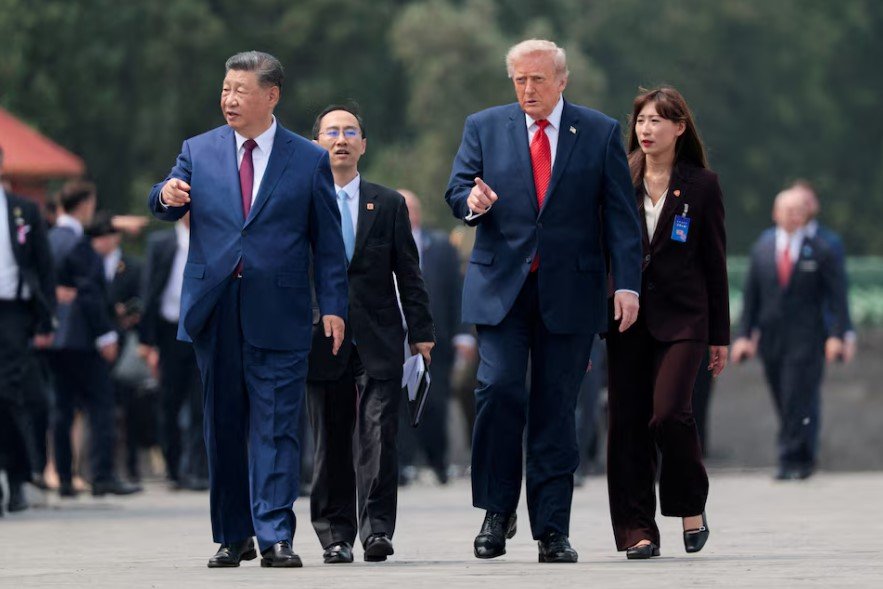
US President Donald Trump and Chinese President Xi Jinping are due to meet in Washington on September 24, with trade expected to dominate a summit shaped by shifting economic fortunes and mounting geopolitical pressures. Analysts say expectations for a major breakthrough have diminished since the leaders last met, as Xi has overseen a surge in China’s trade with the world while Trump has faced falling approval ratings at home and the costs of a war with Iran.
The central question is whether the two leaders will signal an extension of a trade truce agreed last year that helped avert a major shock to the global economy. Issues including Taiwan are also expected to surface, but the immediate focus is likely to be maintaining stability in the economic relationship rather than securing sweeping new agreements.
“Xi is not really looking for anything tangible. He wants to extend the gentleman’s agreement with Trump so that China has time to fortify itself,” said Jon Czin, a foreign policy expert at the Brookings Institution who formerly served as China director at the US National Security Council.
Preparatory talks in New York on Sunday, led by US Treasury Secretary Scott Bessent and Chinese Vice Premier He Lifeng, sought to establish the basis for potential agreements covering AI guardrails and trade in non-sensitive products. White House officials have nevertheless played down expectations of major breakthroughs, a significant shift from Trump’s earlier pledge to use tariffs to tackle what he described as a trade imbalance with China that was “killing” the United States.
Since the October 2025 trade truce, Trump’s attention has increasingly been divided between other foreign-policy disputes, including the wars in Iran and Ukraine and disagreements with Europe over free speech. China, meanwhile, has continued to face weak domestic demand and a prolonged property crisis, but its export performance has remained strong.
China’s global trade surplus is on pace to exceed $1 trillion for a second consecutive year. Although US efforts to restrict the cheap parcels used by online retailers such as Shein and Temu have had an impact, more than half of the roughly 6,500 product categories China has sold to the United States so far this year have recorded growth compared with 2025.
A delegation of Chinese business leaders, potentially including companies facing US regulatory scrutiny as they seek greater market access, is expected to accompany Xi to Washington. Scott Kennedy, an expert on the US-China economic relationship at the Washington-based CSIS, said the Trump administration had believed “massive unilateral pressure” could force Beijing to make concessions, but that this had not happened.
The summit could also test how economic negotiations intersect with Taiwan. Xi has repeatedly raised the issue with Trump, including arms sales and Washington’s resolve to defend the democratically governed island claimed by Beijing. Trump has described a pending $14 billion US arms package for Taiwan as a “negotiating chip”, raising concern in Taipei and Tokyo that Washington could seek political or commercial gains from the issue ahead of November’s midterm elections.
Possible gains could include Chinese purchases of Boeing jets or US farm goods, as well as commitments to curb the flow of fentanyl precursor chemicals. Wu Xinbo, a professor at Shanghai’s Fudan University who advises China’s foreign ministry, said US-China relations had become “more transactional”, with Taiwan potentially central to Beijing’s calculations.
Iran adds another layer to the summit. Washington sees Xi as capable of exerting pressure on Tehran to help end the war, but Beijing has shown little inclination to do so. Reuters has reported that Chinese goods continue to reach Iran through a sanctions-evasion scheme, a claim China’s foreign ministry says it is not aware of.
Against this backdrop, analysts say both leaders have an interest in keeping US-China relations stable. For Trump, that could allow greater focus on Iran; for Xi, it could provide time to strengthen China’s domestic resilience. The September 24 meeting is therefore likely to be measured not by a sweeping realignment, but by whether Washington and Beijing can preserve a fragile period of economic stability while their wider strategic differences remain unresolved.