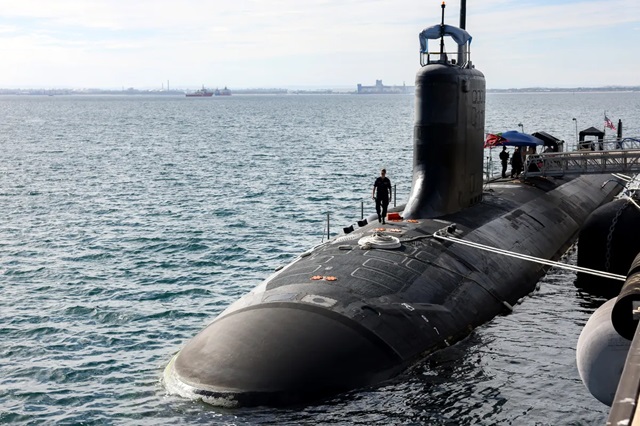
U.S. President Donald Trump announced Thursday that Washington will allow South Korea to build nuclear-powered submarines in the United States, a move with potential implications for Japan’s own naval strategy. The submarines will be constructed at Philadelphia Shipyard, a commercial shipbuilder acquired by South Korea’s Hanwha Group as part of its ongoing investment in U.S. shipbuilding.
Trump confirmed the decision on his Truth Social account, stating that the approval replaces Seoul’s existing diesel-powered submarines with more advanced nuclear propulsion. The announcement followed talks with South Korean President Lee Jae Myung ahead of the Asia-Pacific Economic Cooperation (APEC) leaders’ summit in Gyeongju, where the two leaders agreed on the need for Seoul to secure fuel for the nuclear vessels.
The approval coincides with a $350 billion trade deal between the allies, including $200 billion in cash installments and $150 billion earmarked for cooperation in shipbuilding, with Washington reducing tariffs on South Korean goods as part of the agreement. Lee emphasized that the nuclear-powered submarines are intended to patrol and defend the East and West Seas of the Korean Peninsula, which he said would alleviate operational pressure on U.S. forces.
Although the submarines are not intended to carry nuclear weapons, experts warn the initiative could accelerate a regional arms race. Australia is also set to acquire nuclear-powered submarines through its AUKUS partnership with the U.S. and the United Kingdom. Nuclear propulsion allows vessels to operate farther from national waters and remain submerged for extended periods, increasing their deterrence value.
Many details of the project remain unclear, including timing, scope, and U.S. regulatory approvals. Masashi Murano, a security expert at the Hudson Institute, noted that implementing the program would require navigating the constraints of the existing “123 Agreement,” the Non-Proliferation Treaty, and restrictions on reactor, enrichment, and reprocessing technologies. He added that American shipyards may struggle to meet both domestic and foreign submarine production demands.
The announcement also has potential ramifications for Japan. The new government under Prime Minister Sanae Takaichi is considering expert recommendations to develop submarines with “next-generation propulsion systems” and long-range missile capabilities. Defense Minister Shinjiro Koizumi noted that “no options are being ruled out,” and Takaichi has previously expressed support for the idea of nuclear-powered submarines, emphasizing a careful approach.
Experts warn that any move by Tokyo toward nuclear propulsion would face diplomatic, technical, legal, and domestic hurdles. Japan’s U.S.–Japan Nuclear Cooperation Agreement restricts nuclear material to peaceful purposes, and its pacifist constitution and “three nonnuclear principles” limit military use. Misato Matsuoka, associate professor at Teikyo University, added that utilizing nuclear technology for submarines would blur civilian and military applications and could reignite public unease over Japan’s nuclear past.
The U.S.-approved program for Seoul is likely to intensify debates in Tokyo and across the region about the future of nuclear propulsion and strategic deterrence in East Asia.