More than a century ago, Franz Kafka imagined an America where politics resembled a travelling circus. In his unfinished novel America, written between 1912 and 1914, the young emigrant Karl Roßmann encounters a populist procession moving through the streets of a vast city. A candidate campaigning for an approaching judicial election literally drums up support. A band plays, lanterns are waved, posters are held aloft and, above all, free beer flows. The promises are extravagant, the atmosphere theatrical and the candidate resembles what Kafka later calls one of the country’s many “Schwindeldoktoren” — confidence tricksters.
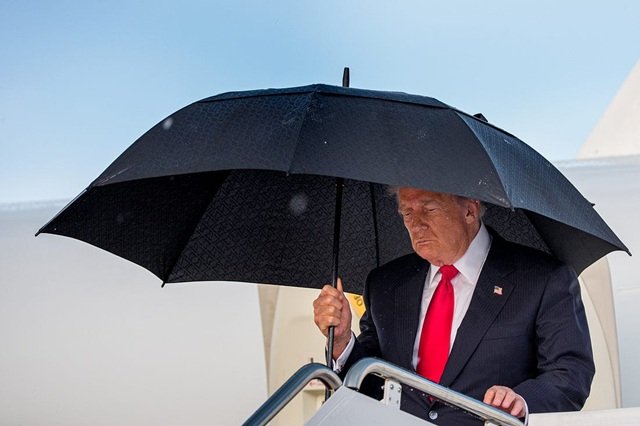
More than 100 years later, a similarly strange political spectacle is unfolding in the United States. At a Republican Party convention in Dallas, Donald Trump declared that America had never “made so much money” as it does now and had never been so strong or successful. His reward for that supposed prosperity was a remarkable electoral promise: every adult American would receive $5,000 if Republicans won majorities in both the Senate and the House of Representatives in the forthcoming elections. There was one condition: the money would have to be spent in the United States.
The promise is striking not merely because of its size, but because of the direct transaction it appears to establish between political support and personal financial gain. The proposed payment would involve roughly $1.17 trillion if extended to the adult population — approximately the scale of the US defence budget. Trump has made a similar promise before. Last year, he said every American would receive $2,000 supposedly generated by his tariff policies. That money never arrived.
The latest proposal therefore has the appearance of a campaign stunt whose credibility is already in question. Yet its significance lies in something larger than whether the promised cheque will ever be written. The idea belongs to a much wider political phenomenon in which governments and political parties increasingly seek to reach voters through their wallets.
The boundary between buying votes and pursuing social policy, however, is not always straightforward. Before Turkey’s 2015 election, for example, a provincial mayor promised a special payment of roughly €165,000 to whichever municipality achieved the highest share of votes for Recep Tayyip Erdoğan’s AKP. The party also regularly sent lorries into poorer neighbourhoods shortly before elections to distribute heating coal, food and clothing — areas that had in fact been comparatively neglected by previous governments.
The distinction matters because not every government payment to citizens is inherently corrupt. Democratically elected governments routinely use public money to pursue economic or social objectives, and voters are perfectly entitled to support a party because its policies materially improve their lives.
Germany offers an example. During the financial crisis, the government introduced the Abwrackprämie, paying people to replace older cars with new ones. The purpose was not simply to put money into voters’ pockets, but also to support the domestic automobile industry and stimulate the economy. With some generosity, Trump’s $5,000 proposal could likewise be described as an unusually designed economic stimulus: the recipients would be required to spend the money within the United States.
But Trump’s own branding exposes another dimension. He calls the proposed payment the “Trump-Dividende”. What might otherwise be presented as economic policy becomes personalised political patronage, with the president placing his own name on the promised benefit.
That personalisation reflects a broader change in how citizens are encouraged to think about politics. In Germany, economic research institutes, sometimes working with media organisations, increasingly calculate the precise financial consequences of political parties’ proposals for individual households. Such calculations can show who gains and who loses from different programmes: wealthier citizens may pay more under left-wing proposals, poorer citizens may benefit, while traditional mainstream parties attempt to appeal to the middle and to families.
These calculations can also produce an apparently simple answer to a much more complicated question: how much money would a particular party’s policies put into an individual’s pocket?
The attraction is obvious. Complicated questions about taxation, public spending and economic policy are transformed into a single number. Political choice can begin to resemble a personal financial calculation: vote for this party and you will have a certain number of euros more each month. The apparent precision of such calculations — sometimes down to the second decimal place — can make politics feel tangible in a way that abstract debates about institutions, values and competing visions of society often do not.
Yet a political relationship based primarily on money may be fragile. Parties of the political centre increasingly attempt to reach voters through their material interests, perhaps partly because they struggle to reach them emotionally. A relationship constructed around transfers, calculations and financial benefits does not necessarily produce the same attachment as political identification or a shared sense of belonging.
The contrast with the AfD is revealing. Its stable emotional connection with its supporters means it does not necessarily need to promise them a few extra euros. According to the argument presented here, its voters are not easily persuaded by calculations showing that a different political choice might leave them financially better off. The question “What will you personally get out of it?” can therefore be both refreshingly concrete and a sign of something diminished in political life.
Trump’s promise takes that logic further. It can be understood as what might be called an Abwrackprämie for democracy: a financial incentive attached directly to political allegiance.
That idea bears comparison with the Racket theory developed, in fragmentary form, by members of the Frankfurt School during their years in American exile in the 1930s and 1940s, particularly Max Horkheimer, Theodor W. Adorno and Otto Kirchheimer. The English word “racket” refers to a gang or swindle, while racketeering describes organised criminal activity. The theory sought to explain a difficult political paradox: why people who are marginalised or exploited do not necessarily unite against powerful elites, but can instead enthusiastically support elites whose conduct appears corrupt.
For Horkheimer and his colleagues, the answer involved a kind of collective system of intimidation and reward. Some people are threatened with violence or exclusion; others are offered a share of the spoils. Political loyalty can thus be constructed not through equality or shared ideals, but through participation in a system of protection and distribution.
That framework provides a stark lens through which to view the politics described in the United States today. While the Trump clan has, according to the source text, become extremely wealthy in recent months, the president is presenting voters with a combination of intimidation and what resembles free beer from Kafka’s political travelling circus. Political opponents are subjected to pressure, while potential supporters are offered a financial reward.
Yet there is an important limit to the comparison. Trump’s poor polling numbers have, so far, not translated the promise into electoral success. The proposed $5,000 payment remains a promise, just as the earlier $2,000 payment never materialised.
And that may be the most revealing feature of the spectacle. Kafka’s America presented politics as a travelling circus populated by grand promises and “Schwindeldoktoren”. More than a century later, the American version has acquired a distinctly modern form: the political rally, the personalised dividend and the promise of money in exchange for electoral victory.
The question is no longer simply whether governments can use public money to improve people’s lives. It is whether citizens are increasingly being invited to understand democracy itself as a transaction — a system in which political loyalty has a price, and the state becomes the prize.