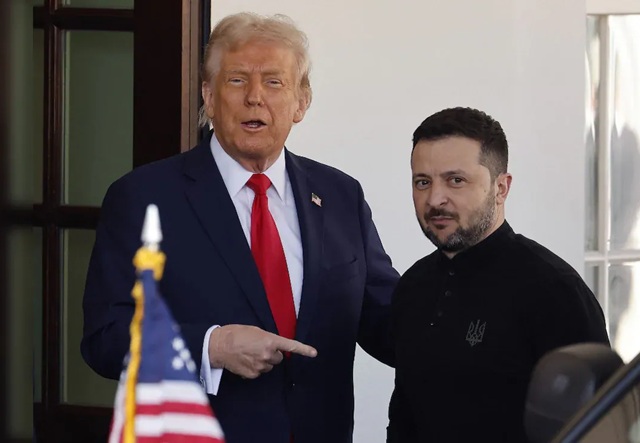
Ukrainian President Zelensky’s colossal misstep in dealing with President Donald Trump could ultimately become one of the most profound blunders in recent history. To Trump, Zelensky is merely a “modestly successful comedian” and a “dictator.” However, it is a misguided assumption to believe that Russia will inevitably win this war, yet the divisions within Ukraine’s ranks are deepening, fuelled by ambitions that go beyond territorial conquest, pushed by Western powers steering Ukraine down an uncertain path. It is not far-fetched to suggest that Zelensky’s days are numbered. A professional comedian skilled in turning tragedy into spectacle, as Marx famously said of history, he now finds himself caught in a high-stakes game where the true motivations remain obscured. One cannot forget that Donald Trump is no traditional dictator, nor a political liberal.
At his core, he is a dealmaker—driven by the pursuit of fame and profit. Israel’s Prime Minister Netanyahu knows this; Indian Prime Minister Narendra Modi is trying to understand it, while Russian President Vladimir Putin is exploiting it. Chinese President Xi has structured it, while the rest of the leaders, particularly in Europe, are struggling to grasp it. To grasp Trump’s approach to global affairs, one must abandon the reductive comparisons to tyrants like Stalin, Hitler, or Mussolini. Trump operates in a different sphere entirely, one that requires a certain mental flexibility to understand. He is not concerned with maintaining power for the sake of ideology or historical legacy; his concern is to make deals that secure material gain.
The world should not mistake him for a man of irrational impulses, for Trump understands the machinery of influence as few others do. His transactional nature is evidenced in his interactions with foreign powers, where his primary concern is leverage, not political principles. A prime example of this comes from Indian Prime Minister Narendra Modi’s recent visit to the White House. When an Indian journalist posed a question regarding India’s role in countering China, Trump’s response was strikingly unconventional. Rather than fall into the trap of aligning with India against China, Trump instead spoke of bringing China, Russia and India together for mutual benefit. This pragmatic approach—concerned not with antagonising one party but rather with securing cooperation from all sides—highlights the difference between Trump’s brand of leadership and that of conventional political figures who cling to rigid ideologies.
Trump’s worldview is not shaped by traditional political theories; his primary motivation lies in extracting profit from every situation. In this sense, he is a modern-day merchant who sees international relations not as a matter of diplomacy, but as an opportunity for lucrative transactions. This is, after all, a man who, in his bestselling book The Art of the Deal (1987), writes, “Sometimes by losing a battle, you find a new way to win the war.” This is not the rhetoric of a conventional politician; it is the language of a businessman who understands that in the grand game of power, winning often means losing a few battles along the way.
Trump was notorious for cultivating a media presence that exaggerated his wealth and success, as evidenced by the time he manipulated Forbes magazine into listing him as one of the wealthiest individuals, despite his financial situation not reflecting the claim. This is the same man who views international politics through the lens of economic opportunity, where every diplomatic interaction is an avenue for profit. History is replete with similar deals between empires and powerful states—arrangements that were often secretive, strategic and ultimately aimed at controlling the flow of resources and wealth.
Take, for instance, the Treaty of Kadesh in 1259 BCE, a diplomatic agreement between Egypt and the Hittite Empire. While the public version of the treaty touted peace and cooperation, hidden elements revealed that both empires carved up regions like Syria for their benefit, securing timber from the cedars of Lebanon and ensuring access to crucial trade routes. These covert arrangements were not only about peace—they were about ensuring control over vital natural resources.
The very fabric of ancient geopolitics was woven from such secretive deals, where military confrontations were often avoided in favour of securing wealth through backdoor agreements. In the late 19th century, European powers engaged in secretive deals to partition Africa and exploit its resources. The Berlin Conference of 1884-85 is the most notorious example, where the European powers divided Africa without regard for its indigenous populations. This was not merely an exercise in territorial expansion; it was a calculated effort to control Africa’s mineral-rich regions—such as the Congo, with its vast deposits of rubber, ivory, and later, uranium and cobalt. These resources were not just crucial to the European economies—they were the lifeblood of the empires’ military and industrial prowess. It is a tragic irony that while European powers publicly championed the benefits of their imperial ventures, the truth behind their actions was one of resource exploitation, where local populations were trampled in the pursuit of wealth. East Timor, in the late 20th century, is one of the blunt examples. Following the region’s independence from Portugal in 1975, East Timor was invaded by Indonesia, with the tacit approval of Western powers, particularly Australia and the United States.
While these nations publicly condemned Indonesia’s actions, they secretly supported its annexation in exchange for access to the Timor Sea’s oil and gas reserves. The 1989 Timor Gap Treaty between Australia and Indonesia was signed behind closed doors, securing Australia’s share of East Timor’s undersea resources despite the ongoing political turmoil.
The exposure of these secret dealings years later revealed how, even in the post-colonial era, resource-rich nations were still subject to exploitation by global powers looking to maximise their profits at any cost. Now, as we return to the present-day conflict between Russia and Ukraine, we see similar patterns at play.
It is no secret that the United States has provided substantial military ‘aid’ to Ukraine, while making American defence industries the most profitable companies from the war, consequently indebting Ukraine with heavy financial burdens. Zelensky, in his pursuit of securing Ukraine’s future, has unwittingly become a puppet of Western interests, never considering the long-term consequences for his country.
Meanwhile, Russia, with its military operations focused on specific regions rich in minerals, continues to tighten its grip on strategic areas like Donetsk and Luhansk, which are abundant in coal, graphite, and other vital resources. As of February 2025, Russia controls approximately 18.6 per cent of Ukrainian territory, including these resource-rich regions.
It is no coincidence that these areas, crucial for energy production and manufacturing, are the focal point of Russia’s military campaign. US Defence Secretary Pete Hegseth, during his first visit to Europe recently, declared that a return to Ukraine’s pre-2014 borders is unrealistic, and the Trump administration does not view NATO membership for Kyiv as a solution. On the other hand, President Putin, with his characteristic bluntness, recently remarked that had the 2020 US elections not been ‘stolen,’ Donald Trump would have won, and the war in Ukraine would never have begun.
This is realpolitik in action. Putin knows how to play the game, not just with Trump, but with any leader, as Angela Merkel aptly noted. Therefore, Trump and Putin could sign a secret deal on Ukrainian minerals, marking a crucial point in history. What is particularly striking is the growing divide between the political circles in Ukraine.
Zelensky’s leadership is increasingly seen as compromised, with many wondering if his time is up. Trump, whose sharp criticisms of Zelensky have become more pointed, continues to offer a path to deal with the mineral wealth of Ukraine—one that may well align more with Russia’s interests than those of the West.
Source: Daily Pioneer