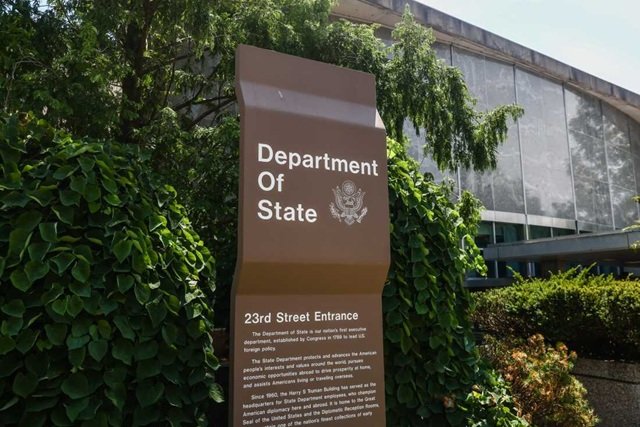
The U.S. State Department is undergoing one of the most extensive transformations in its modern history, with President Donald Trump’s second administration reshaping America’s diplomatic establishment through sweeping personnel changes, structural reforms and a new approach to foreign policy. According to a report by the Financial Times, the changes have altered the role of career diplomats, reduced the department’s workforce and shifted influence over international negotiations toward political appointees and presidential confidants.
The scale of the transition is reflected in the department’s diplomatic vacancies. As of late June, more than half of U.S. ambassadorial posts remained unfilled, including assignments in countries such as Germany and Saudi Arabia. Nearly 80% of American embassies across Africa were also without ambassadors, creating an unusual situation in which many of the United States’ most significant overseas missions are operating without Senate-confirmed diplomatic leadership.
Since returning to the White House in January 2025, Trump has repeatedly criticised what he has described as America’s foreign policy establishment. According to the Financial Times, his administration has departed from decades of precedent by appointing far fewer career foreign service officers to ambassadorial positions. Of the 101 ambassadorial nominations made during his second term, only nine have gone to career diplomats, marking a significant shift from the practice followed over the past six decades, when career officers typically led at least two-thirds of U.S. embassies.
The restructuring has coincided with extensive reductions in staffing. The department’s workforce has declined by more than 3,000 employees, representing a reduction of more than 20% since Trump resumed office. Administration officials have described the changes as part of a broader effort to modernise the department, arguing that it had become bureaucratic, resistant to change and insufficiently aligned with national security priorities.
Current and former diplomats interviewed by the Financial Times present a different assessment. They argue that the restructuring has weakened institutional expertise while reducing the role of professional diplomacy in shaping U.S. foreign policy. Former U.S. ambassador to China Nick Burns described the situation as the most damaging crisis in the history of the Foreign Service since its creation more than a century ago.
Former CIA Director and veteran diplomat Bill Burns also expressed concern about the long-term effects of the reforms. Having previously served as ambassador to Russia and deputy secretary of state, he told the Financial Times that the current changes extend beyond previous periods of political upheaval, including the McCarthy era, when anti-communist investigations resulted in the loss of expertise on China. According to Burns, the current restructuring affects expertise across all regions rather than a single area of foreign policy.
The report also highlights concerns raised by former officials regarding the administration’s approach to international negotiations. Trump has increasingly relied on trusted advisers and political allies rather than career diplomats to conduct high-profile diplomatic initiatives. Among those playing prominent roles are businessman Steve Witkoff, ambassador Tom Barrack and Trump’s son-in-law Jared Kushner. Critics cited by the Financial Times argue that the reduced involvement of experienced diplomats has affected complex negotiations, including recent discussions with Iran.
Yael Lempert, who served as U.S. ambassador to Jordan before being removed at the beginning of Trump’s second term, told the publication that Iran’s negotiating team benefited from extensive technical expertise while the United States lacked comparable institutional experience during recent talks. Bill Burns similarly argued that experienced, non-partisan negotiators remain essential in dealing with counterparts who possess detailed knowledge of diplomatic issues.
Administration officials reject those criticisms. A senior Trump administration official told the Financial Times that the State Department’s role is to represent presidential foreign policy rather than formulate it. The official said Secretary of State Marco Rubio entered office believing the department required fundamental reform and described the restructuring as a deliberate effort to align the institution with the administration’s “America First” agenda. Officials also argue that advances in communication technology and direct leader-to-leader contact have reduced the traditional importance of diplomatic reporting from overseas embassies.
The report notes that some veteran diplomats acknowledge reforms were needed. They cite overlapping responsibilities and organisational inefficiencies that had developed over time. However, several expressed concern about the speed of the restructuring, drawing comparisons with the closure of the U.S. Agency for International Development, which they said demonstrated how rapid institutional changes can produce operational disruption. Jacob Shapiro, professor of international affairs at Princeton University, told the Financial Times that while consolidation may have been justified, the implementation appeared to proceed with limited analysis of its wider consequences for American diplomacy.
The changes have also altered the way foreign governments engage with Washington. Diplomats from allied countries told the Financial Times that they increasingly seek contact with individuals close to Trump rather than relying on traditional State Department channels, reflecting a perception that policy decisions are now concentrated within the president’s inner circle. Former diplomats also said career officers have become increasingly cautious in internal reporting, concerned about how policy disagreements may be interpreted.
Alongside institutional restructuring, the department is experiencing broader cultural change. The Financial Times reported that Trump’s administration has sought to reshape the organisation around its America First agenda while conservative groups, including the Ben Franklin Fellowship, argue the department had gradually adopted a liberal institutional culture over previous administrations. Matt Boyse, one of the fellowship’s founders, told the publication that reforms are intended to restore ideological balance within the department. Former diplomats, however, said many career officials now operate in an atmosphere of heightened political scrutiny, expressing concern that alternative policy views may be viewed as disloyalty.
The debate has also extended beyond the current administration. According to the Financial Times, foreign policy specialists aligned with the Democratic Party are increasingly discussing whether any future administration should attempt to restore the State Department to its previous structure or instead develop a new diplomatic model reflecting changes in global politics and communications. Bill Burns told the publication that the department is confronting what he described as a generational challenge and argued that simply restoring previous arrangements would not address the transformation that has already taken place. As the restructuring continues, the future shape of American diplomacy remains closely tied to the institutional changes now underway inside one of the country’s oldest foreign policy institutions.