


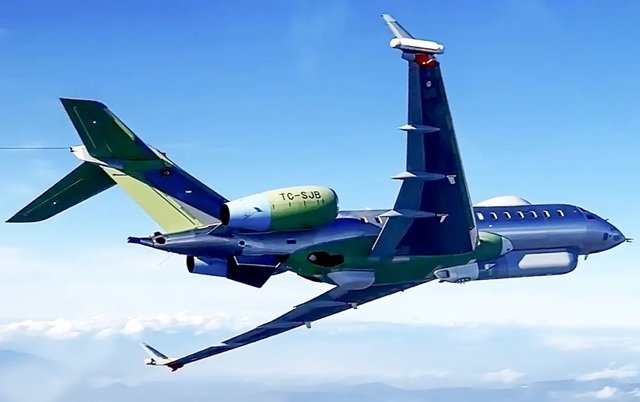
Turkey’s secretive HAVA SOJ airborne electronic warfare aircraft has appeared in its clearest imagery to date, offering the strongest indication yet that the long-running program is approaching a more advanced stage of development. The brief footage, highlighted by The War Zone, was released as part of a video celebrating the 115th anniversary of the Turkish Air Force and has reignited attention on one of Ankara’s most ambitious indigenous defense projects.
The HAVA SOJ, short for Airborne Standoff Jammer, is designed to suppress enemy air defenses and disrupt communications networks from long distances without entering hostile airspace. The concept mirrors specialized Western electronic attack aircraft such as the U.S. Air Force’s EA-37B Compass Call, reflecting Turkey’s determination to establish itself among a select group of nations capable of producing sophisticated airborne electronic warfare platforms.
The newly released footage shows the aircraft in an unpainted state, equipped with prominent external fairings and antennas that house its specialized mission systems. Observers noted a cable extending from the top of the vertical stabilizer, likely a trailing cone used during flight testing to gather aerodynamic and atmospheric data. An air-data probe attached to the nose further suggests the aircraft remains in an intensive test phase.
The appearance follows earlier sightings this year. In February, two examples of the aircraft were reportedly tracked during test flights, while a low-quality image captured in March showed one aircraft departing from the Turkish Aerospace Industries (TAI) facility in Ankara. Together, these developments point to increasing flight activity around the program after years of limited public visibility.
The roots of the HAVA SOJ project stretch back to the late 2000s, when Turkey and defense electronics giant Aselsan began exploring a domestic replacement for the Turkish Air Force’s aging standoff jamming fleet based on the Transall C-160 transport aircraft. The objective was to create a modern platform capable of supporting increasingly complex military operations in an era defined by advanced radar networks, integrated air defense systems, and electronic warfare.
Delays, however, have repeatedly challenged the project. At one stage, Turkey considered an interim solution under a separate initiative known as Golge, or Shadow. That effort envisioned converting Bombardier Global Express aircraft into temporary electronic warfare platforms using a combination of domestic and international technologies. Negotiations ultimately stalled, and the program was abandoned in 2017.
The current HAVA SOJ fleet is built around Canadian-made Bombardier Global 6000 business jets. The first airframes arrived at Turkish Aerospace Industries facilities in 2019, and four aircraft are planned under the program. Turkish Aerospace Industries is responsible for integrating the systems, while Aselsan supplies the sophisticated mission equipment that forms the aircraft’s operational core.
According to Turkey’s Defense Industry Agency, the aircraft is intended to suppress hostile radar systems, interfere with communications, and disrupt enemy command-and-control networks through both deception and noise jamming techniques. Such capabilities are increasingly viewed as essential in modern warfare, where the ability to blind or confuse an adversary can determine the outcome of military operations before conventional weapons are even employed.
At the heart of the HAVA SOJ’s mission is a combination of electronic support measures and electronic attack systems. The aircraft is expected to detect, identify, and geolocate hostile radio-frequency emissions before directing focused electronic attacks against them. Rather than relying solely on broad-spectrum jamming, the aircraft is believed to use advanced active electronically scanned array technology capable of targeting multiple emitters simultaneously with highly precise electromagnetic beams.
This approach would allow the aircraft to neutralize enemy radars, air defense systems, and communications networks while remaining outside the engagement range of many threats. Military planners increasingly value such standoff capabilities as air defense systems continue to evolve and become more lethal.
The aircraft’s external design hints at a broad mission set extending beyond traditional jamming. Large fuselage fairings likely house receiver systems, electronic intelligence equipment, and communications hardware. Analysts have also speculated that some of the aircraft’s sensors may support cyber operations, potentially enabling attacks on networked systems through radio-frequency pathways.
Another notable feature is the long canoe-shaped fairing beneath the fuselage. Similar structures appear on aircraft such as the U.S. Army’s ME-11B HADES and the Royal Air Force’s retired Sentinel R1 surveillance aircraft. In those platforms, the fairings contain synthetic aperture radar and ground moving target indicator systems capable of producing highly detailed imagery and tracking vehicles in all weather conditions. While Turkish authorities have not confirmed the exact function of the HAVA SOJ’s ventral fairings, their presence has fueled speculation that the aircraft could possess significant intelligence-gathering capabilities in addition to electronic attack functions.
The aircraft also carries large satellite communications enclosures along its upper fuselage. These systems would allow intelligence and targeting data collected during missions to be transmitted rapidly across military networks, enhancing coordination with aircraft, ground forces, and command centers. Such connectivity is increasingly important in modern military operations, where information dominance is often as valuable as firepower.
Despite its promise, the HAVA SOJ enters service amid ongoing debates about the survivability of large electronic warfare aircraft. Long-range surface-to-air missile systems continue to expand their reach and sophistication, raising questions about whether even standoff platforms can safely operate near heavily defended regions. Nevertheless, proponents argue that electronic warfare remains indispensable, particularly as military forces become more dependent on interconnected sensors, communications systems, and digital command structures.
Beyond its domestic role, the HAVA SOJ may also become a significant export product. Turkey has enjoyed growing success in international defense markets, and countries seeking advanced capabilities without restrictions associated with certain Western technologies could find the aircraft attractive. Pakistan has previously been identified as a potential customer, while a partnership between Aselsan and Saudi Arabia’s Taqnia aims to market an export-oriented version known as Kasih.
The aircraft’s development delays have pushed delivery schedules well beyond initial targets, with the first operational aircraft originally expected in 2023. Yet the recent increase in testing activity suggests that the program may finally be entering a more mature phase.
For Turkey, the emergence of the HAVA SOJ represents more than the arrival of a new aircraft. It symbolizes the country’s broader effort to achieve greater technological independence in defense and to establish itself as a major supplier of advanced military systems. As global demand for electronic warfare capabilities grows in response to increasingly sophisticated air defenses, the HAVA SOJ could become one of the most strategically significant assets in Turkey’s expanding aerospace portfolio.










