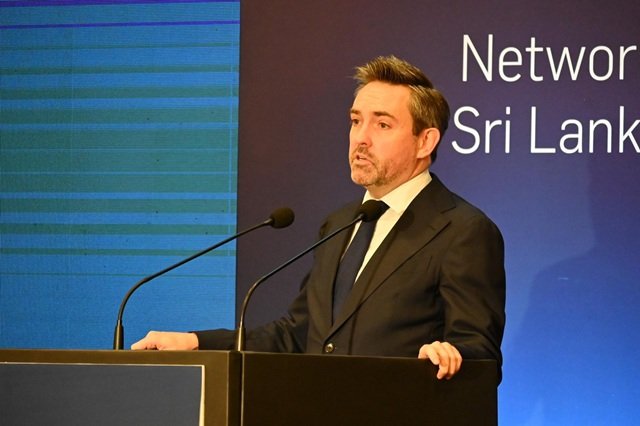
Sri Lanka’s legislative process is facing serious shortcomings, while many parliamentarians are voting on bills without fully understanding their contents, United Nations Resident Coordinator in Sri Lanka Marc-André Franche has said.
Addressing a group of civil society representatives in Colombo, Franche said he had recently spoken to around 45 MPs following the passage of the Online Safety Act, including parliamentarians who had voted in favour of the legislation. According to Franche, however, a majority of those MPs had not read the relevant bill and were not properly aware of the issues on which they had voted.
Franche said that members of Parliament are elected by the public and sent to Parliament to fulfil fundamental responsibilities, including understanding and scrutinising legislation. If MPs failed even to perform that basic responsibility, he argued, there was little point in them holding parliamentary office.
His comments highlight concerns about the process through which legislation is examined and approved, particularly where elected representatives may not have studied proposed laws before voting on them. The remarks also point to broader weaknesses in policymaking, which Franche said could ultimately result in laws that are harmful or unpopular among the public.
Franche also spoke about the role of the Opposition Leader, saying that he had recently met the Opposition Leader to discuss problems facing the country. During that meeting, Franche said, it became clear to him that the Opposition Leader had sufficient grounds to criticise or oppose the Government’s actions.
“I recently met the Opposition Leader and discussed the problems facing the country. It became clear to me that he had more than enough grounds to criticise or oppose the Government’s actions. Even so, I cannot understand why he does not pay proper attention to those matters,” he said.
Beyond Parliament, Franche identified what he described as a breakdown in the relationship between civil society and the political authorities. He said successful countries elsewhere in the world had developed strong links between civil society and political systems, creating an effective bridge between citizens and those responsible for political decision-making.
According to Franche, the weaknesses in this relationship have consequences for policymaking in Sri Lanka. He argued that laws which are at times harmful or unwelcome to the public emerge partly because of shortcomings across the broader policy-making process.
His remarks place responsibility not only on individual parliamentarians but also on the wider relationship between political institutions, civil society and the public. The concerns he raised suggest that effective lawmaking depends not simply on passing legislation, but on ensuring that elected representatives properly examine proposed laws and that civil society has a meaningful connection with the political process.