


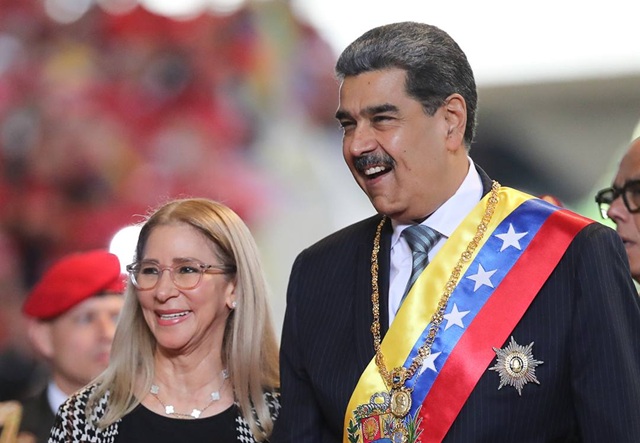
The United States government has doubled its reward to $50 million for information that leads to the arrest or conviction of Venezuelan President Nicolás Maduro, citing his alleged involvement with drug cartels and narcotics trafficking into the U.S.
The announcement came Thursday from U.S. Secretary of State Marco Rubio and Attorney General Pam Bondi, who accused Maduro of orchestrating drug trafficking operations through criminal organizations including the notorious Cartel of the Suns, which Rubio described as responsible for smuggling drugs into the United States for over a decade.
“Maduro uses foreign terrorist organizations like Tren de Aragua, the Sinaloa cartel, and Cartel of the Suns to bring deadly drugs and violence into our country,” Bondi said in a video statement. She further noted that the U.S. Justice Department had seized tons of cocaine linked to Maduro’s network.
The U.S. Department of Justice first unsealed an indictment in 2020 charging Maduro and other Venezuelan officials with narco-terrorism, drug trafficking, and weapons offenses. Maduro has consistently denied all allegations.
The increased reward follows recent developments, including the Trump administration’s decision last month to grant Chevron a license to resume oil production in Venezuela. This move, seen as a potential financial lifeline for Maduro’s government, sparked criticism from Rubio and opposition groups, as it contrasts with his hawkish approach toward Caracas.
The Chevron license came shortly after a prisoner swap between the U.S. and Venezuela, in which ten American detainees were released, and 250 Venezuelans deported to El Salvador by the U.S. were repatriated. Venezuela’s democratic opposition has condemned the license as a “lifeline” for Maduro’s regime, accusing the Biden administration of backtracking on sanctions after allowing a similar license to expire in May.
Venezuela’s economic crisis remains dire. The bolívar currency has lost approximately 70 percent of its value against the dollar since October, and annual inflation soared to 229 percent in May, according to the independent Venezuelan Finance Observatory.
The Venezuelan government dismissed the bounty on Maduro as a “ridiculous smokescreen.” Foreign Minister Yván Gil called the move “pathetic” in a post on Telegram.
Maduro, a revolutionary socialist who succeeded Hugo Chávez in 2013, secured a controversial third term in January following an election last year widely criticized as fraudulent. The opposition candidate Edmundo González, recognized by Washington and other Western allies as the legitimate winner based on independently verified vote tallies, has not been acknowledged by Maduro’s administration.
Following the disputed election, Maduro intensified a crackdown on dissent, detaining opposition leaders, demonstrators, foreign nationals, and independent economists who report critically on Venezuela’s economic conditions.
Rubio condemned Maduro’s actions, stating, “He has strangled democracy and grasped at power in Venezuela,” adding that the U.S. does not recognize Maduro as the country’s legitimate president and that he has failed to produce any credible evidence of his electoral victory in 2024.









