


The US Justice Department has quietly removed language identifying Nicolás Maduro as the leader of the so-called Cartel of the Suns, softening one of its most sweeping accusations against the Venezuelan president while keeping core drug trafficking charges intact. The change appears in a revised indictment filed shortly after US forces captured Maduro and his wife, Cilia Flores, in a dramatic operation in Caracas ordered by President Donald Trump.
A 2020 indictment had alleged that Maduro “helped manage and ultimately lead the Cartel of the Suns as he rose to power in Venezuela,” a claim repeatedly cited by Trump to justify an aggressive anti-drug campaign in the Caribbean. Washington has long accused the cartel’s leadership of backing criminal organizations such as Venezuela’s Tren de Aragua and Mexico’s Sinaloa Cartel as part of a conspiracy to traffic narcotics into the United States.
In the updated indictment, however, prosecutors largely removed references describing the cartel as a structured criminal organization under Maduro’s command. Instead, the document accuses him of participating in and protecting “a culture of corruption in which powerful Venezuelan elites enrich themselves through drug trafficking and the protection of their drug-trafficking partners.” It says profits flow through a clientelist system “led by those at the top, known as the Cartel of the Suns,” a phrase that now appears only twice, compared with dozens of mentions in the earlier filing. The cartel’s name comes from the sun-shaped insignia worn by Venezuelan generals.
The shift contrasts with Trump’s public remarks over the weekend, when he said the operation to seize Maduro was part of a broader offensive to dismantle what he again described as the Cartel of the Suns. The United States formally designated the group a Foreign Terrorist Organization in 2025, after previously listing it as a Specially Designated Global Terrorist entity. Several Latin American governments supported the move, while Venezuela and Cuba rejected it as a US fabrication. Analysts inside Venezuela have long questioned whether the cartel exists as a coherent organization, noting that allegations date back to 2004 claims of drug trafficking within the National Guard.
Maduro and Flores appeared Monday before a federal court in New York for the first time since their arrest. Maduro pleaded not guilty to charges of narco-terrorism and weapons possession, declaring himself “a prisoner of war.” Their capture followed a rapid US military operation early Saturday that triggered fierce condemnation from Caracas.
Venezuela’s Attorney General, Tarek William Saab, announced the appointment of three prosecutors to investigate deaths caused by what he called a “horrible war crime and unusual aggression” during the US attacks on Caracas and other regions. Authorities have yet to release an official toll of casualties, but the scale of the losses is slowly emerging from scattered official and media reports.
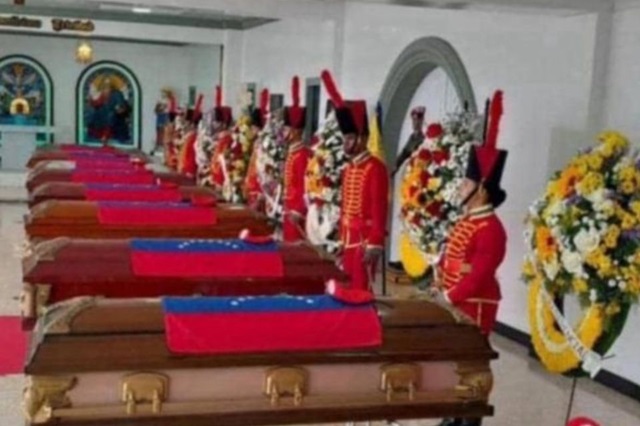
Cuba said 32 of its military personnel stationed in Venezuela were killed in “combat actions” during the operation. President Miguel Díaz-Canel said the troops had been carrying out missions at the request of Venezuelan authorities, while Havana later confirmed the dead included members of the Revolutionary Armed Forces, intelligence services, and interior ministry. Trump acknowledged that “many Cubans” protecting Maduro were killed, while US officials said about half a dozen American soldiers were wounded.
Venezuelan military losses have also been confirmed. The Venezuelan Army reported the deaths of 23 enlisted officers during US attacks across Caracas, La Guaira, Miranda, and Aragua in the early hours of January 3, publishing a series of condolence messages honoring soldiers who, it said, died “in defense of peace, sovereignty, freedom and independence.” The Bolivarian Militia separately announced the death of First Sergeant José Salvador Rodríguez Ramírez. Earlier army posts had referred to 24 dead without naming them, underscoring the uncertainty surrounding the final toll.
Civilian casualties have deepened public anger. In La Guaira state, residents mourned Rosa Elena González, an elderly woman killed when an explosion struck her apartment near a military academy targeted in the strikes. Local residents said she was injured in her home, taken to hospital, and later died, while her apartment was destroyed. Venezuelan sources cited by The New York Times put the total death toll at around 80, though neither Caracas nor Washington has confirmed the figure.
As investigations begin and courts take up the case against Maduro in the United States, the revised indictment highlights a striking recalibration by US prosecutors. Even as Washington presses forward with drug trafficking charges and defends the operation that brought Maduro to New York, it has stepped back from one of its most politically explosive claims, leaving unanswered questions about the scope of the alleged cartel and the true cost of the operation that ended his rule.









