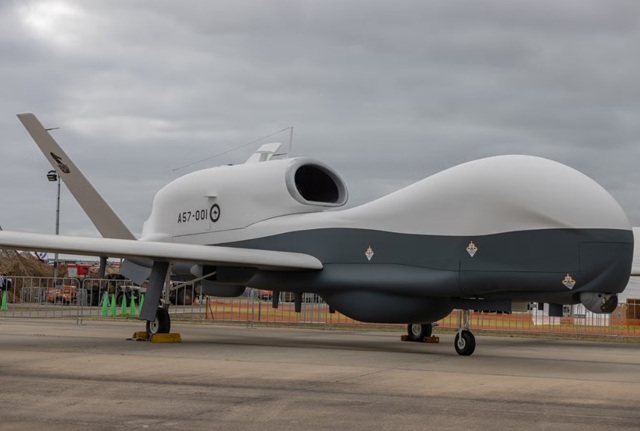
The United States is set to deploy several MQ-4C Triton long-range surveillance drones to Okinawa, Japan, amidst increasing tensions between China and Taiwan. Japan’s Defense Minister, Gen Nakatani, confirmed that the drones will be stationed indefinitely at the Kadena Air Base on Okinawa’s main island, with the deployment expected to begin in the coming weeks.
This deployment is seen as a strategic response to China’s escalating military activities in the region, particularly near Taiwan. The Triton drones will play a key role in monitoring China’s growing drone presence and conducting surveillance over key flashpoints in the area. Kadena Air Base, due to its central location in the Pacific, is a prime spot for Intelligence, Surveillance, and Reconnaissance (ISR) operations, allowing the US military to keep an eye on numerous potential hotspots across the region.
“The deployment of these drones is expected to significantly enhance the intelligence-gathering capabilities of the Japan-US alliance, thereby bolstering our collective deterrence and response strategies,” said Nakatani during a press briefing. This strategic collaboration underscores the importance of the Japan-US alliance as a counterbalance to China’s increasingly assertive actions in the region.
The MQ-4C Triton drones, which have a wingspan similar to that of a Boeing 737, can operate at altitudes of over 50,000 feet and remain airborne for more than 24 hours. With a range of 7,400 nautical miles (13,700 kilometers), these high-altitude drones are well-equipped for extended reconnaissance missions, making them a critical asset in the US military’s surveillance arsenal.
Although the move is viewed positively by US officials, it has raised concerns among some local Japanese leaders, particularly in Okinawa. Governor Denny Tamaki expressed opposition, noting that the increased US military presence contradicts the regional government’s efforts to reduce the burden of US bases in the area.
The US’s decision to deploy the drones comes as tensions between China and Taiwan have escalated. In recent days, Beijing conducted large-scale military drills near Taiwan, signaling growing concerns about the island’s sovereignty. China views Taiwan as a breakaway province and has repeatedly threatened military action to assert its control. Meanwhile, Taiwan’s government, led by President Lai Ching-te, has continued to bolster its defenses in response to China’s actions, including deploying its own warships in response to Chinese maneuvers.
The latest surge in Chinese military activities, including frequent drone operations near Japan’s southwestern islands and daily drills around Taiwan’s Air Defense Identification Zone (ADIZ), has prompted renewed concerns in the region. In 2023 alone, China deployed at least 30 drones around Japan, marking a significant increase from previous years.