


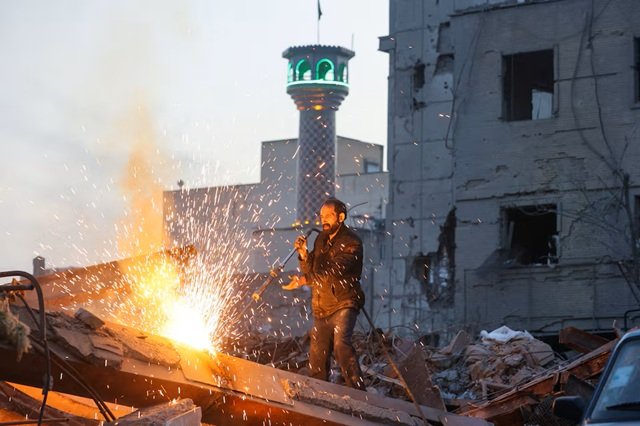
The United States has completed its 11th consecutive day of military strikes against Iran as the cost of the conflict climbed to $37.5 billion, while the Trump administration moved to deepen strategic ties with Saudi Arabia by preparing to submit a civilian nuclear cooperation agreement to Congress without longstanding non-proliferation safeguards.
U.S. Central Command (CENTCOM) said the latest strikes targeted Iranian military operations centres, maritime capabilities, aircraft hangars, drone storage facilities and military logistics infrastructure. According to CENTCOM, the attacks were intended to “further degrade” Iran’s ability to threaten commercial shipping through the Strait of Hormuz. The command said Iran has attacked more than 30 commercial vessels transiting the strategic waterway, adding that the attacks had endangered hundreds of mariners and undermined freedom of navigation.
As military operations continued, two sources told Reuters that the Trump administration plans to submit a so-called 123 Agreement with Saudi Arabia to Congress within days. The agreement, which is expected to be signed by U.S. Energy Secretary Chris Wright and Saudi Energy Minister Prince Abdulaziz bin Salman, would permit U.S. government agencies and American companies to cooperate with Saudi Arabia on developing a multibillion-dollar civilian nuclear industry.
According to the sources, the agreement does not include the “Gold Standard” provision that would prohibit Saudi Arabia from enriching uranium or reprocessing spent nuclear fuel, both regarded as potential pathways to developing nuclear weapons. The sources also said the agreement omits the International Atomic Energy Agency’s “Additional Protocol”, which provides expanded inspection powers, including access to undeclared nuclear sites.
One source told Reuters the agreement creates a legal framework for cooperation across the nuclear fuel cycle, including uranium enrichment, but does not require the United States to transfer enrichment capabilities or related technology to Saudi Arabia. Chris Wright has previously said the preliminary agreement was not about enrichment and contained the non-proliferation standards required under the U.S. Atomic Energy Act.
The proposed agreement is expected to undergo a congressional review period of approximately 90 days after submission. Congress could block the agreement only by passing a joint resolution with sufficient support to override a presidential veto. Reuters reported that many Democrats and some Republicans, including Secretary of State Marco Rubio during his time in the Senate, have argued that any agreement with Saudi Arabia should include stronger non-proliferation safeguards.
Saudi Arabia’s nuclear ambitions have drawn attention because Crown Prince Mohammed bin Salman has previously stated that if Iran acquires a nuclear weapon, Saudi Arabia would pursue one as well. The kingdom has also maintained that it wants to retain the right to enrich uranium.
Meanwhile, Defense Secretary Pete Hegseth told lawmakers that the cost of the Iran war has reached $37.5 billion, including projected expenditures through 30 September. He urged Congress to approve nearly $90 billion in supplemental funding requested by President Donald Trump, most of which is linked to the conflict, as well as a proposed $1.5 trillion defence budget for 2027.
Hegseth warned that military training, maintenance and future capability investments could be affected without additional funding. Chairman of the Joint Chiefs of Staff General Dan Caine acknowledged that sustaining military readiness would become increasingly difficult if Congress failed to approve the requested funds.
The funding request comes as lawmakers from both parties have criticised the administration over its handling of the conflict. Senator Patty Murray accused President Trump of threatening escalation, while Senator Kirsten Gillibrand questioned the administration’s public messaging on the war, saying its statements had been inconsistent.
The conflict has intensified since a ceasefire between the United States and Iran collapsed earlier this month. The Pentagon said the number of U.S. service members killed in the war has risen to 18, while about 430 have been injured. According to the Pentagon, 100 troops have been injured since 7 July, with 96 per cent having already returned to duty. President Trump said on Tuesday that the United States would strike Iran’s underground nuclear-linked Pickaxe Mountain facility “pretty soon,” following previous threats to expand attacks to additional strategic targets within Iran.










