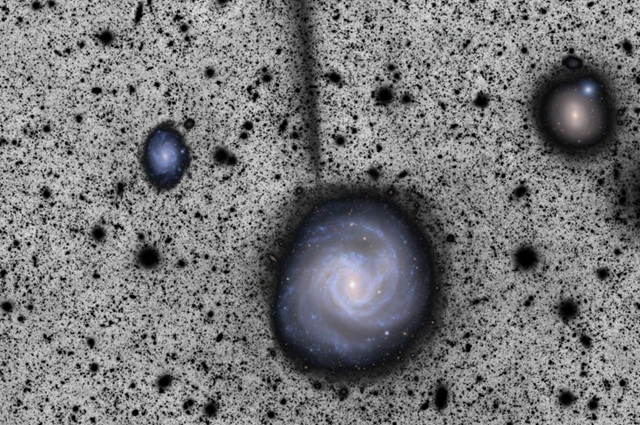
Just months after its highly anticipated debut, the Vera C. Rubin Observatory in Chile is already reshaping astronomers’ understanding of galaxy evolution. Its massive camera, the largest digital imaging device ever built, captured its first test image and revealed a striking discovery: a stellar stream extending from the well-studied galaxy Messier 61. The faint trail of stars suggests that the galaxy once tore apart a smaller companion, a finding reported in Nature.
Messier 61, located in the Virgo Cluster and first catalogued in 1779, is a starburst galaxy known for prolific star formation and multiple supernovae. Despite decades of scrutiny using powerful observatories such as the Hubble and James Webb Space Telescopes, this stellar stream had gone undetected until Rubin’s first image was analyzed. Astronomers filtered out excess light from the image to reveal a stream spanning 55 kiloparsecs, or roughly 180,000 light-years, likely originating from a dwarf galaxy torn apart by Messier 61’s gravity. The interaction may have even fueled the galaxy’s unusually vigorous star formation.
“This is the first stellar stream detected from Rubin,” said Sarah Pearson, an astrophysicist at the University of Copenhagen. “And it’s just a precursor for all of the many, many features we’ll find like this.” Aaron Romanowsky of San Jose State University, an author of the study, added that while every galaxy is expected to be surrounded by such streams, previous instruments lacked the sensitivity to detect them at this scale.
Rubin’s first image alone captures ten million galaxies, providing a tantalizing glimpse of the observatory’s potential. Over the next decade, Rubin is expected to image light from 20 billion galaxies, offering an unprecedented survey of the cosmos and likely uncovering countless previously hidden stellar streams. As Romanowsky noted, the hope is that “every single galaxy should be surrounded by these streams,” highlighting their fundamental role in galaxy formation.