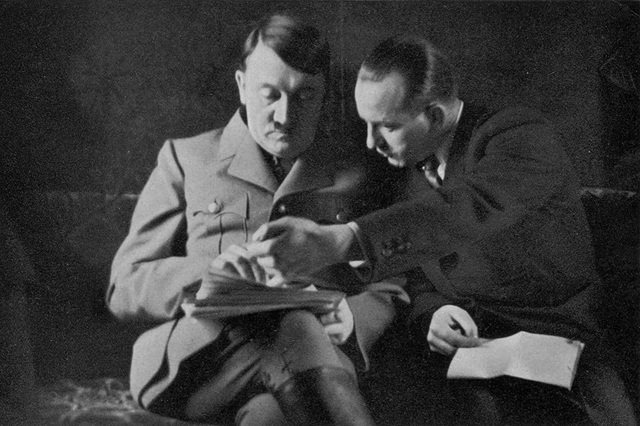
I might as well begin with two servings of fascist potatoes. The first comes from Wilhelm Reich, the great renegade psychoanalyst, who observed in 1934 that “Hitler’s gift of a sack of potatoes to every worker was ninety-nine percent ideology and only one percent practical value.” The second is from just a few years later, 1941, and appears in Peter Viereck’s Metapolitics. Viereck writes that in fascism, “even the price of potatoes must be heroic.”
Today, perhaps, we should replace potatoes with eggs. Earlier this year, one sensed a sore point, perhaps even a symptom, when Donald Trump reposted Charlie Kirk yelling: “Shut Up About Egg Prices–Trump is Saving Consumers Millions.” Right after that, egg prices spiked. But the idea that there might be something at least aspirationally heroic about egg prices—that seems to be entirely lost on all those pundits who, in the wake of Trump’s return, keep admonishing us to get real, get serious, and pay attention to what really matters – otherwise known as the economy.
Consider an opinion piece from January this year by James Carville, the man who once spun Bill Clinton into office. Now here Carville was again, a fortnight before Trump’s second inauguration, first conceding that he was wrong about Kamala Harris and then offering the requisite atonement, the ritual return to reality: “We lost for one very simple reason,” wrote Carville. “It was, it is, and it always will be the economy, stupid. We have to begin 2025 with that truth as our political north star and not get distracted by anything else.” This is not just a centrist tic. Bernie Sanders, too, seemed to think he’d put his finger on the main pathology of Trumpism when he pointed out, just afterthe inauguration, that Trump, in his address, had said nothing about the economy. Both Carville and Sanders, despite their many differences, used this notion of the economy as if its meaning and also its authority were self-evident. Brass tacks. Bread and butter. Cost of living. What could be more self-explanatory?
Before digging into this, a couple of qualifiers. First, by putting pressure on this notion of economy, I’m not saying that the real action is necessary somewhere else. Actually I want to look harder at this curiously self-certain notion of economy. Second qualifier: I realize that what I’m doing might in some ways seem just the sort of thing that anthropologists have always done, namely, to insist that the formalistic, free-floating, fetishized thing that modern economics calls the economy is an ideological reification. That’s all well and good, that’s true—but it’s also not enough.
OK, so if we want to mess a bit with this complacent concept, the economy, let’s begin by considering how the meaning of the ritual admonishment—“it’s the economy, stupid”—how this meaning would start to slide if economy also meant psychic economy or libidinal economy. Or what if when former Biden adviser Neera Tanden says, “people understand this cost-of-living problem,” she also meant to engage the psychic cost of living? I really don’t think this is a fanciful or whimsical proposition. The only thing that makes it sound at all provocative is the bogus self-evidence of the idea of the economy. What, actually, could be more self-evident than that basic problems of flourishing, provisioning, health, and education are just as much a question of our psychic affordances as they are of dollars and cents?
As for my second qualification, that the economy is an ideological reification, the reason I said that’s true but also not enough is because we also need to pay attention to the kinds of psychic work that a notion like that does. In particular, perhaps, we need to think about the anxiety-soothing work it does, the way it helps us not to have to face up to certain libidinal investments of our own—and yes, investments is an apt term here, invoking both the stock market and the quasi-theological authority assumed by the one who is in-vested, enrobed in the vestments.
Part of the reason the opposition to Trump is flailing so badly is that they don’t want to go there. They don’t know how to go there. They still think that they can score points by demonstrating that DOGE’s rampage through the federal government earlier this year didn’t actually produce the advertised savings. But wasn’t the whole point of DOGE the libidinal kicks invited by being allowed to watch a tech-child army going in there and ripping things apart, giving all those bureaucratic stiffs in their slack-off sinecures a tight slap around the chops?
The best that the Democrats could come up with in response, when they weren’t earnestly fact-checking the numbers, was some variant on Tim Walz’s weak wannabe zinger from the previous summer: “they’re weird.” In that tradition, after Trump’s victory in November 2024, Ezra Klein complained that the challenge with making sense of Trump is that the reality he creates is so crazy that it’s hard to even engage it without starting to sound unhinged. That sense of losing the normal as things get weird is precisely why so many find comfort in scurrying back to the safe zone marked the economy.
A specter is haunting the economy—Or maybe it’s a phantasm? Here I’d like to think along with the argument that Judith Butler developed in their keynote address at our 3CT anniversary conference last spring. Butler was talking about what they called “fascist passions.” They suggested that fascist passions are animated by certain phantasms that work, as they put it, as “condensed sites of excitability.” Examples of such spectral sites of excitability would be gender-affirming care for trans kids, immigrants eating your pets, taking your jobs, and diluting the brittle grandeur of American whiteness, and just generally everything that can be imagined as perverting the grand course and cause of patriarchal American whiteness. All of them are phantasms that, to quote Butler, “incite fears that convert into hatred and popular support for authoritarian leaders.” I really like Butler’s formulation “condensed sites of excitability” because it reminds us that the phantasms are powerful media of incitement, of provocation, of activation.
Now, to get back to the question of economy, we could say that these phantoms are sites of libidinal investment that go ‘beyond economy’ in the sense that they are libidinally priceless.At the same time, publicists and strategists are constantly trying to economize them—that is, to harness them to various symbolic economies, which is to say, various ideological discourses. To put it very schematically, this whole game is a dialectic of incitement and containment. Or, you could say, a dialectic of phantasm and economy. The thing about this dialectic is that it is both necessary and impossible. It’s necessary because you can’t secure a political yield from your phantasm unless you find a way of yoking it to an ideological discourse that has its own economy, its own logic of equivalences. But the dialectic is also impossible, because the power of the phantasms comes from inciting excitements that are irreducible to any calculation of interest, cost/benefit, good and evil, or rational choice. Irreducible to all those kinds of terms that we throw around too readily: economies, logics, grammars.
Consider, for instance, the undocumented immigrant worker in northeastern Pennsylvania who tells a journalist right around the time of the 2024 election: “I love Mr. Trump. Of course he could send me back at any moment, but if he did, I would still love him.” This kind of excitement is at once inside and outside economy. It’s not enough only to say, as some do, that such excitements exceed economy because the point is that their very excess is what allows them to feed and animate economies, both symbolic and financial. Or to put it differently, they are an important reason why people will—passionately—vote for policies that will shred their lives.
Speaking of passions, Butler, in their paper, also makes the important point that a passion is something that one undergoes. Passion, they write, implies “passivity or yielding, even a captivation, or a way of being held captive not by an external force, but by what we might call the force of fantasy.” There’s a great deal to say about this—but for now, let me just suggest that if economic life is generally imagined as a space of agency, then passionate, phantasmic life could be called a space of patiency. A Neoplatonist might say that what we call agencyis our power to make, and that what I am calling patiency is our power to be made. Which is another way of saying our power to be activated by phantasms. Perhaps there’s some mileage in thinking the unresolvable dialectic of economy and phantasm this way: as a dialectic of agency and patiency—of what we do and what we undergo?
What I do know for sure about phantasms is that they are not just sites of reactionary effervescence. Any political project or even social order that expects our commitment needs its own phantasms—its own condensed sites of excitability. One reason that the Democratic opposition to Trump has been so ineffectual is that so many of its leaders still hew to the fond liberal fantasy that if we could just clear the air of all these feelings, if we could just get back to making good arguments – for example, if we could just focus on the economy for a moment and not get so distracted by all these ‘cultural’ issues, then we could stabilize the ship of state again.
The problem with this demand is that it misses its own phantasmatic attachment—to be specific, it misses the intensity of its enjoyment of the phantasm of, precisely, the economy. One of the characteristics of liberalism, especially in its technocratic forms, is its curious belief that it is free of jouissance—that it is sober and measured. My friend the philosopher Aaron Schuster puts it well: “It is not that the technicians do not play, but that they ‘do not know that they are playing’—play, that is enjoyment, is their blind spot, even though, or precisely because, they claim to represent knowledge.”
In the current configuration of American national politics, then, we find ourselves confronted with a dismal choice: on one side, a neofascist politics whose face is all shameless enjoyment; on the other, a liberalism that is unable to consider its own enjoyments because it refuses to confront the fact that it has any. One could say, perhaps, that if Trumpism is constantly inventing new ways to economize enjoyment, then its critics too often remain stuck in an unwitting enjoyment of economy—which is to say, an anxious drive-attachment to this spuriously self-evident figure of the economy as a measure of common-sense reality. The talisman that will stop things from getting too weird.
Just a couple of things in conclusion. Sigmund Freud’s advice on how each of us may husband our enjoyments in Civilization and its Discontents is well known: “Happiness, in the reduced sense in which we recognize it as possible, is a problem of the economics of the individual’s libido. There is no golden rule which applies to everyone: every man must find out for himself in what particular fashion he can be saved.” There’s a lot that could be said—that has been said—about this passage. The way it privatizes the problem—each the master of their own libidinal oikos. The way, despite all of Freud’s misgivings about religious longing, it still invokes salvation—but again as a solitary project. But I want to underline the tone of hard-won realism that Freud adopts here: happiness, in the reduced sense in which we recognize it as possible. The problem, as Freud sees it, is that balancing the libidinal books necessarily means sacrifice, compromise, resignation: pleasure and reality are forever at odds. In that sense, there is no libidinal economy for Freud, there is just a kind of negotiated settlement.
I opened this essay with Freud’s turbulent disciple Reich, who broke with Freud specifically because he found Freud’s resignation politically—humanly – unacceptable. Reich saw quite clearly, almost a century ago now, that the organized Left, in its rigid economism, suffered from a disastrous refusal to think clearly about the libidinal structures of capitalism, of the patriarchal family, and of the way that they train us for authoritarianism. Just as Karl Marx historicized the political economists, so Reich historicized Freud’s libidinal resignation as a specific—and therefore not inevitable—bourgeois formation. Viereck’s line about how fascism needs even the price of potatoes to be heroic is, I think, wiser than it knows. Because if there’s a curious grandeur, a curious sense of the momentous around potato—or egg—prices under fascism then that is not because fascism perversely needs to aestheticize every last banal corner of everyday life. Rather, it’s because fascism responds to real needs that most of its opponents don’t really know how to talk about. If the price of potatoes can take on a heroic glow, then it’s because this whole notion of the economy condenses investments, libidinal investments, that go way beyond dollars and cents.
Reich and others saw this clearly almost a century ago. Today, too, the right has long since stolen a march on the opposition when it comes to the libidinal. Too much ground has already been lost. MAGA-adjacent folks are calling themselves “vitalists,” even as right of center liberals like David Brooks decry the Trumpies as “pagans.” Once more, in the name of getting real, many Democrats seem to think that political energy is the same thing as toxic masculinity. Consider John Fetterman. Or the mortifying spectacle of Gavin Newsom manning up to Joe Rogan.
We really can’t afford this nonsense. So: in search of counter-imaginaries, counter-phantasms—in search of what they might afford—let’s consider the affordances of our shared archives. We have the experience of the ones who gave the beast a long, hard look last time—and it wasn’t only about potatoes. Consider Georges Bataille, who had a thing or two to say about libido and its ambiguous relation to economy. Amid a rising fascist tide in the mid-1930s,Bataille insisted that other phantasms—other sites of excitability—were possible: “From the outset, the mere consideration of affective social formations reveals the immense resources, the inexhaustible wealth of the forms particular to affective life. . . . It remains possible to envision . . . forms of attraction that differ from those already in existence. . . an organized understanding of the movements in society, of attraction and repulsion, starkly presents itself as a weapon—at this moment when a vast convulsion opposes, not so much fascism to communism, but radical imperative forms to the deep subversion that continues to pursue the emancipation of human lives.”