


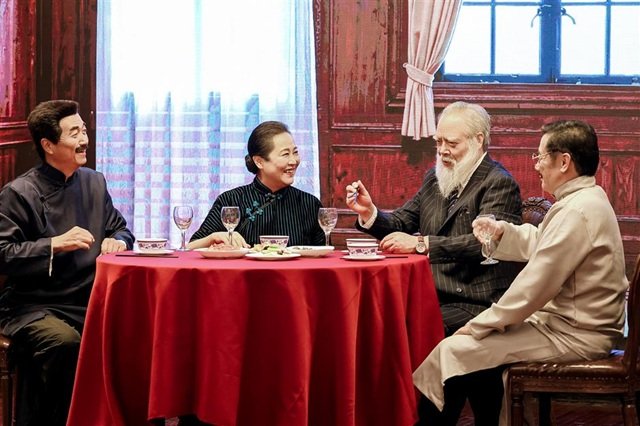
A symposium in Shanghai has revisited the celebrated eight-hour meeting between Irish playwright George Bernard Shaw and Chinese literary pioneer Lu Xun in 1933, using historical reenactments, scholarly discussion and cultural exchange to explore how a brief encounter between two influential writers continues to shape literary dialogue and reinforce the enduring cultural relationship between China and Ireland.
George Bernard Shaw spent less than a day in Shanghai in February 1933, yet the conversations, photographs and written records from those eight hours have endured for nearly a century. On Sunday, scholars, diplomats, academics and cultural figures gathered in Shanghai to revisit that remarkable encounter, demonstrating how an afternoon shared between two literary giants continues to resonate across borders and generations.
The symposium, held at the China Securities Museum in Hongkou District, brought together nearly 100 Chinese and international guests to commemorate the 170th anniversary of Shaw’s birth and the 90th anniversary of the death of Lu Xun, widely regarded as the forefather of modern Chinese literature. Hosted in the building once known as the Astor House Hotel, the event returned participants to one of the locations closely associated with Shaw’s only visit to Shanghai, reviving not merely a historical episode but an enduring dialogue between two literary traditions.
The day’s proceedings concluded with an unusual cultural gesture that symbolised the meeting itself. Curt Evans, an Irishman and owner of Yeats Irish Bistro on Yanping Road in downtown Jing’an District, prepared a drink combining Irish whiskey coffee with Chinese yellow wine. The fusion paired Ireland’s national spirit with a rice wine traditionally served warm in Jiangnan teahouses, creating a symbolic blend of two distinct cultural identities.
“I think it’s a really brilliant idea. It mirrors the meeting that happened in 1933 between the two famous writers,” Evans said as he served the drink to scholars and diplomats attending the symposium.
The event centred on Shaw’s brief stay in Shanghai on February 17, 1933. Then aged 77 and travelling around the world aboard the liner Empress of Britain, Shaw arrived at the mouth of the Huangpu River before dawn. Although his entire visit to the city lasted only eight hours before he departed, the itinerary brought together several of the most influential figures of Republican China.
Soong Ching Ling, the widow of revolutionary founder Sun Yat-sen, greeted Shaw at the dock, where the two spent four hours in conversation before he agreed to come ashore. Shaw then met educator Cai Yuanpei before joining Lu Xun for a Chinese vegetarian lunch at Soong’s residence.
The meal itself was not remembered for lengthy exchanges between its two principal guests. According to accounts revisited during the symposium, Lu Xun and Shaw spoke little during lunch, while writer Lin Yutang, whose command of English allowed him to interpret and converse fluently, dominated much of the discussion. After the meal, the group gathered in the garden for a photograph that would become one of the defining images of the visit.
Even so, a brief exchange between Shaw and Lu Xun outlasted the afternoon. Shaw described Lu Xun as “the Gorky of China” before adding that he was more handsome than the Soviet writer Maxim Gorky. Lu Xun replied that he would look even better once he grew old.
To bring those moments back to life, Sunday’s symposium opened with a 15-minute theatrical reenactment performed by professional actors portraying Soong Ching Ling, Shaw, Lu Xun and Cai Yuanpei. The performance recreated the celebrated lunch, including Shaw’s tentative first attempt at using chopsticks, a detail drawn from historical accounts of the visit.
The choice of venue carried particular significance. Shaw first stepped ashore in Hongkou District during his 1933 visit, while Lu Xun spent the final decade of his life living in the district. Hongkou’s literary importance continues to grow, with a new literature museum scheduled to open there next month and the district preparing to host China’s Lu Xun Literary Prize for the first time.
Lu Xun himself ensured that Shaw’s brief visit would not disappear into history. Recognising its significance, he asked fellow writer Qu Qiubai to help gather every newspaper report covering Shaw’s stay, whether favourable or critical.
Working beneath a desk lamp in Hongkou, the two writers carefully cut, pasted and edited newspaper clippings by hand, while their wives searched newsstands for additional reports. Within approximately five weeks, their efforts resulted in the publication of the 134-page volume Shaw in Shanghai.
Reflecting on the achievement in the book’s preface, Lu Xun wrote: “Shaw was in Shanghai less than a full day, and yet the story turned out to be this rich. This is no small matter.”
Hu Weifen, deputy director of the Shanghai Public Relations Association’s international exchange centre, reminded the audience that the original volume remains preserved in the Shanghai Library. Holding both the historic publication and a commemorative booklet produced by the association to mark Shaw’s anniversary, she described the two works, published 93 years apart, as an unlikely meeting of their own.
For many of the international scholars attending, the symposium revealed new dimensions to a literary relationship they had previously known only in outline. Kwinten Van De Walle, who teaches European literature and culture at Shanghai International Studies University, said he had arrived aware only that Shaw’s stop had been brief.
“What has surprised me… is how much they had in common,” he said, describing the encounter as evidence of “the universality of literature”.
His colleague Tomasz Ewertowski of Poland observed that both writers viewed literature as extending well beyond artistic expression.
“They shared the vision of literature as an important intervention in social life,” he said. “They believed it mattered not only as art, but as a social phenomenon.”
Felix Goodbody, another lecturer at the university, similarly argued that the connection between the two authors transcended geography. Although separated by thousands of miles between Ireland and China, he said, both writers shared opposition to colonialism and sought a peaceful future for their respective countries.
Sha Hailin, president of the Shanghai Public Relations Association and a former Chinese ambassador to Ireland who lived there for 40 months, reflected on their common approach to writing. He said both authors wielded their pens as spears and humour as blades in confronting injustice within their own societies.
“True cultural dialogue is never one-way,” Sha said. “It is a two-way gaze and response.”
The symposium also situated the literary relationship within broader contemporary ties between the two countries. According to Zhao Xiyuan, China’s ambassador to Ireland, China has become Ireland’s sixth-largest trading partner, while two-way trade in goods and services has exceeded 20 billion euros (US$22.7 billion). Shanghai and Cork City have maintained a formal sister-city relationship since 2005, with Cork Lord Mayor Damian Boylan noting in a video address that cooperation has expanded over the past two decades across education, culture, business and tourism.
For Evans, however, the day’s themes ultimately converged in a deeply personal moment. Just one week earlier, on July 20, a direct air route linking Shanghai and Dublin had begun operating, replacing journeys that previously required multiple stops.
“Next week I will be on that flight,” he said. “I get to see my family. I get to spend time with my mom.”
He also anticipated practical benefits for his restaurant, suggesting that the new connection would allow fresh oysters from Ireland to arrive more quickly. Nearly a century after Shaw’s eight hours in Shanghai, the symposium suggested that the connections first symbolised by a shared meal between two writers continue to find new expression through literature, scholarship, cultural exchange and the growing links between two nations.










