by Our Correspondent in Colombo
As the clock counts down towards the scheduled expiry of South Asia Gateway Terminals’ (SAGT) 30-year concession in 2029, an unexpected development has reignited debate over the future of one of Sri Lanka’s most strategically important pieces of infrastructure. The International Finance Corporation (IFC), a member of the World Bank Group, together with HSBC, has announced financing of up to US$40 million to modernise and decarbonise SAGT’s operations at the Port of Colombo. While presented as a landmark investment in sustainable infrastructure, the announcement also raises a far more fundamental question: why commit substantial capital to a terminal that is, in principle, only a few years away from returning to the Sri Lanka Ports Authority (SLPA)?
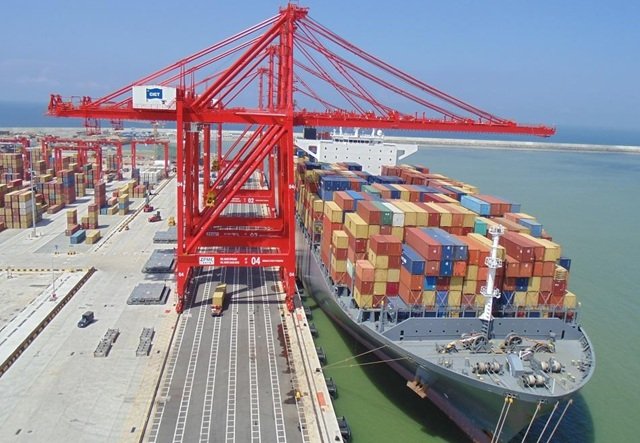
The financing package consists of a sustainability-linked loan of up to US$20 million from the IFC, including financing mobilised through its Managed Co-Lending Portfolio Program, alongside a parallel green loan of up to US$20 million from HSBC. The funds will finance advanced twin-lift ship-to-shore cranes designed to improve quay-side productivity by at least 11 per cent, increase operational reliability, reduce energy consumption, and lower carbon emissions.
Viewed in isolation, the investment appears entirely logical. Colombo remains one of the world’s most important transshipment ports, situated along shipping lanes through which nearly half of global container traffic passes. Every improvement in efficiency enhances the port’s competitiveness, supports Sri Lanka’s logistics ambitions, and strengthens the country’s role within international supply chains.
Yet infrastructure investments cannot be divorced from the legal and commercial frameworks within which they operate. SAGT is not the owner of the terminal it manages. Rather, it operates the Queen Elizabeth Quay Container Terminal under a Build-Operate-Transfer (BOT) concession originally agreed with the Sri Lankan Government and the SLPA. The concession, widely recognised as Sri Lanka’s first major public-private partnership in the ports sector, was established for a period of thirty years. According to publicly available information, that concession is due to expire in September 2029.
Ordinarily, the approaching end of a BOT concession would encourage investors to limit new capital expenditure and maximise returns on existing assets. Heavy port infrastructure such as ship-to-shore cranes typically possesses an operational life extending well beyond a decade. Investing in such equipment only three years before a concession expires therefore appears, at first glance, commercially unusual.
The IFC announcement, however, is striking not for what it says, but for what it does not say.
The statement repeatedly highlights productivity, decarbonisation, resilience, operational excellence, sustainability and Sri Lanka’s ambition to strengthen its position as a regional logistics hub. It describes the financing as IFC’s first sustainability-linked infrastructure investment in Sri Lanka and emphasises the institution’s long-standing partnership with SAGT dating back to 1999. Yet nowhere does it discuss the impending expiry of the concession, whether negotiations are underway regarding its future, or what arrangements might govern the terminal beyond 2029.
That silence inevitably invites questions.
One explanation is entirely commercial. The productivity gains generated by new cranes may enable SAGT to recover its investment within the remaining concession period. Faster vessel turnaround times, increased berth productivity and greater handling capacity could generate sufficient revenue to justify the expenditure even before the concession concludes.
Another possibility is that the concession agreement itself contains provisions governing the treatment of capital investments made near its expiry, including potential compensation mechanisms. The existence or absence of such provisions is not publicly known.
A third possibility is that investors believe SAGT has a reasonable prospect of continuing its role beyond 2029, whether through a concession extension, renegotiation or participation in a future competitive tender. Importantly, however, neither the IFC nor HSBC makes such a claim. Any assumption that an extension has already been agreed would extend beyond the publicly available evidence.
Nevertheless, the investment inevitably fuels speculation regarding the terminal’s long-term future.
The Government undoubtedly retains several options. It may allow the concession to expire and return the terminal to direct SLPA management. It may negotiate an extension with SAGT. It may invite international bids for a new concession under revised commercial terms. Alternatively, it may pursue an entirely new public-private partnership structure.
Each option carries significant economic and strategic implications.
Retaining an experienced private operator may provide continuity, preserve relationships with global shipping lines, and reassure international investors regarding Sri Lanka’s commitment to long-term infrastructure partnerships. Conversely, reopening the concession through competitive bidding could potentially deliver better financial returns to the State while allowing new operators to introduce fresh investment and technology. Direct operation by the SLPA would place a strategic national asset fully under government control but would also require the institution to maintain the operational standards expected by global shipping companies.
These are not merely commercial considerations. Colombo Port represents one of Sri Lanka’s most valuable strategic assets. Decisions concerning its management influence trade, foreign investment, employment, logistics competitiveness and the country’s wider economic resilience.
The IFC itself frames the investment within this broader national context. Rather than presenting the financing solely as support for SAGT, it states that the project aligns with the World Bank Group’s Country Partnership Framework and supports the Government’s ambition to strengthen Sri Lanka’s position as a regional logistics and transshipment hub. This language reflects an investment intended to advance national infrastructure objectives as much as corporate performance.
Yet public policy also demands transparency.
If substantial new assets are being introduced into a terminal whose concession is approaching its scheduled conclusion, questions concerning ownership, depreciation, operational control and future governance deserve clear public answers. If the terminal reverts to the SLPA in 2029, what becomes of the newly financed equipment? If discussions regarding a concession extension have commenced, should those discussions not be disclosed in the interests of transparency? If a fresh international tender is anticipated, when will that process begin?
None of these questions implies impropriety. Rather, they arise naturally from the intersection of public infrastructure, private investment and long-term national planning.
The IFC-HSBC financing may ultimately prove to be an important milestone in modernising Colombo Port. It promises improved efficiency, lower emissions, enhanced productivity and stronger integration into global trade networks. Those objectives are difficult to dispute.
The more profound issue lies elsewhere. As 2029 approaches, the central question is no longer simply whether SAGT will operate more efficiently. It is who will ultimately operate one of Sri Lanka’s most strategically significant maritime gateways, under what terms, and in whose long-term interest.
The newly announced US$40 million investment has therefore done more than finance new cranes. It has placed the future governance of Colombo’s premier container terminal squarely into the public conversation—a discussion that deserves openness, rigorous scrutiny and informed national debate long before the concession reaches its scheduled conclusion.