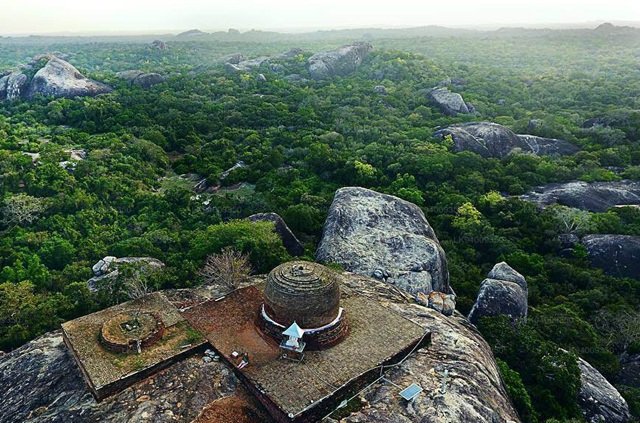
What does it mean to seek stillness in a place that refuses to be tamed? Ven. Nanda Thera, a Czech monk who renounced the world, chose the caves of Kudumbigala to confront suffering, to sit in the slow rhythm of the forest, and to examine the impermanence of all things. For months, he inhabited a space where stone and shadow had witnessed centuries of silent meditation. And yet, on a morning in March, the forest’s quiet revealed the truth he could not alter: its sovereignty precedes devotion.
The monk’s life had been measured against human constructs—cities, screens, deadlines. In leaving them behind, he surrendered to a different measure: time marked by birdsong, by the rustle of leaves, by the slow unfolding of thought and breath. He carried no illusions that solitude ensured safety, yet in the pursuit of insight, risk becomes inseparable from presence. The predator that found him—whether leopard or tiger—acted without moral consideration. Its calculus was instinct, not judgment.
Buddhism names impermanence as the foundation of awareness: anicca. The forest, untamed and indifferent, renders that principle tangible. Each footstep on its earth is a negotiation with forces beyond calculation. Historical accounts echo this truth: Arhat Medhankara in India, Ajahn Mun in Thailand—monks who ventured into wild places encountered danger as a constant companion. Their caution did not diminish their inquiry, nor did their devotion grant exemption from the laws governing life and death.
Ven. Nanda Thera had moved through the forest as if tracing the edges of an unseen geometry, attuned to the present, yet the present holds contingencies the mind cannot fully anticipate. A moment’s stillness invites insight; a moment’s miscalculation invites mortality. The forest does not recognize intent. Its silence is neither benevolent nor hostile; it simply is, and in its being, human life is provisional.
There is a subtle tension here: the desire to cultivate insight versus the necessity of prudence. The Buddha counseled that meditation should occur in spaces that allow the practice of awareness without courting avoidable peril. To inhabit a cave deep in predator territory is devotion; to disregard signals of risk is another matter entirely. Ven. Nanda Thera’s presence in that cave was an encounter between aspiration and reality, a confrontation with limits imposed not by failure but by circumstance.
The monk’s body, discovered by his peers, bore the marks of the forest’s impartiality. Yet his life cannot be reduced to its final moment. Months and years of contemplative practice flowed into that morning, as water flows into an unmeasured river. His pursuit of stillness, of understanding, of liberation, resonates not as a moral parable but as an invitation to perception: the world is neither malleable nor merciful, and clarity arises not from conquest but from attentiveness to conditions.
To walk in the forest is to inhabit interdependence: human aspiration intersects with the rhythms of other beings, other lives, other urgencies. Awareness encompasses not only the mind’s striving but also the body’s vulnerability. Courage reveals itself not in defiance, but in attunement to limits. The forest contains lessons that cannot be summarized, only witnessed.
The caves of Kudumbigala bear inscriptions, silent witnesses of centuries of seekers who, like Ven. Nanda Thera, listened to the cadence of the world rather than the cadence of ambition. The stone endures; life does not. His presence carved a moment into this continuum, not by permanence, but by attentiveness. The silence of the forest, once shared with him, now absorbs the absence of a life fully enacted, yet impermanent.
And so the question persists: how does one pursue awakening without erasing awareness of one’s own boundaries? How does devotion coexist with caution? The answers are not prescribed. They emerge as subtle shifts of perception, as vigilance that does not inhibit practice, as recognition that life is fragile and yet continues to move, breath by breath, leaf by leaf, predator by prey.
Ven. Nanda Thera’s passage does not instruct; it attunes. It asks of the witness an inward listening, a quiet discernment of where aspiration meets reality, and where reverence for life begins. In the forest, nothing is owed, nothing is promised, and yet everything speaks. To meditate, to seek, to breathe, is to move in accord with that voice—attentive, measured, and awake.