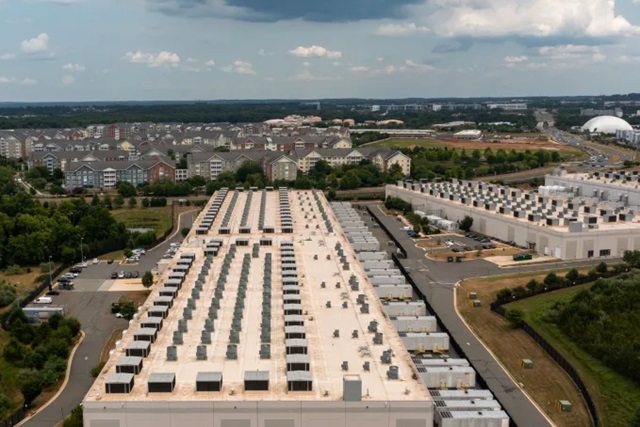
AI might one day help slash carbon emissions—but right now, it’s doing the opposite. A new report from the International Energy Agency (IEA), covered in MIT Technology Review, suggests AI could eventually bring down greenhouse gas pollution, potentially offsetting the massive energy demands of the data centers powering the boom. That’s the hope, at least.
It’s a familiar justification in tech circles. Leaders like OpenAI CEO Sam Altman have claimed AI will deliver “astounding triumphs” like “fixing the climate,” while ushering in nearly limitless intelligence and energy. In other words: don’t worry about the power-hungry infrastructure needed to build AI today—because AI will save us tomorrow.
It’s the same logic that underpins carbon offsets. Companies keep polluting now, with the promise they’ll plant trees or fund green projects later. But just like with offsets, the promised benefits of AI are vague, long-term, and easy to oversell. And in the meantime, the emissions keep rising.
What we know for sure, as MIT Technology Review points out, is that AI data centers are driving massive energy demand—especially in regions where they’re clustering—and most of that power comes from natural gas. These centers run 24/7, and the spike in electricity use is so sharp that companies are proposing new gas plants and even reviving retired coal plants just to keep up.
Cleaner options are already available—geothermal, nuclear, hydro, wind and solar backed by batteries—but they’re often more expensive, slower to build, or politically complicated. So fossil fuels continue to dominate. And the argument that it’s fine to rely on them today because AI will cut emissions in the future? That sounds an awful lot like saying it’s okay to keep polluting because you plan to plant some trees next year.
The risk is that these so-called “AI offsets” are even more speculative than carbon credits. The climate benefits being promised could be decades away—if they ever materialize. Worse, there’s no regulatory system in place to make sure the industry actually follows through. We could end up with a sprawling new layer of fossil-fueled infrastructure, and no real accountability.
To be fair, AI does have climate potential. The IEA highlights real ways it’s already helping: detecting methane leaks, improving efficiency in factories and power plants, cutting energy use in buildings. It’s also showing promise in fields like battery development and advanced materials that could push clean energy forward.
In the best-case scenario, the IEA estimates that AI could help cut 1.4 billion tons of CO₂ by 2035—three times more than what AI-powered data centers are expected to emit that year. But that’s a big “if.” It assumes widespread adoption, major technical advances, and strong economic or regulatory incentives—none of which are guaranteed.
And right now, under political leadership like Trump’s, there’s little reason to think U.S. companies will face pressure to use AI for climate good. In fact, it’s more likely the oil and gas sector will use it to find new fossil fuel reserves rather than stop leaks.
Crucially, the IEA makes clear that their numbers are just scenarios—not predictions. As MIT Technology Review underscores, there’s currently no momentum to guarantee that AI’s climate-friendly applications will scale up. Without strong policies and investment, those potential benefits may never materialize.
Which brings us to the uncomfortable truth: AI is more likely to drive emissions up than down in the near term, just as the world is running out of time. It’s already 2025. We’re fast approaching the 1.5°C warming threshold, and climate risks—wildfires, floods, heatwaves—are growing. Global emissions are still climbing, and every new gas plant built today could still be running in 2065.
Carbon dioxide lingers in the atmosphere for centuries. So even if AI does become a powerful emissions-cutting tool in the future, it won’t erase the climate damage done along the way. And it’s a trade-off we don’t need to make—if AI companies, utilities, and regulators simply make better energy choices now.
Some are trying. A few tech and power firms are investing in nearby solar farms, helping nuclear plants restart, or signing contracts for geothermal projects. That’s the direction we need to go—but it has to become the rule, not the rare exception.