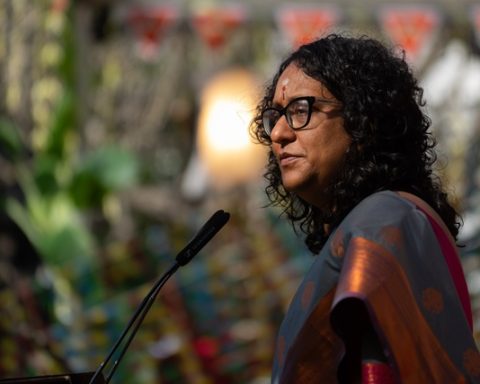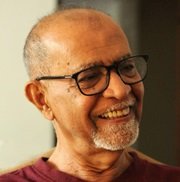

The following essay is based on the speech delivered by the author at a ceremony held in his honour by the Alumni Organisation of the University of Colombo on 2 June 2026 at the New Arts Theatre, University of Colombo.
Let me begin by stating that we all must thank the Vice-Chancellor and the current leadership of the Alumni Association of the University of Colombo for organizing this ceremony to felicitate Dr. Kumari Jayawardena. She has indeed made an incomparable contribution to the transformative development of the social, political, intellectual, and academic fields of our country. She has also done a unique service to the University of Colombo as a teacher in political science and a pioneer in setting up the Institute of Workers’ Education. She also participated in setting up of a Women’s Studies programme at the Faculty of Graduate Studies at Colombo. She taught in the M. A. course in Women’s Studies. Dr. Jayawardena’s association with the University of Colombo goes back to 1969 when she joined the Department of Economics as a lecturer in Political Science.
I personally came to know Dr. Kumari Jayawardena in the same year when my connections with the University of Colombo began. That was in 1980. At that time, I knew of her as a lecturer in Political Science at the University of Colombo as well as an intellectual activist with socialist leanings. By the time I joined the university as a very junior academic in December 1980, she had taken leave to accept a teaching position at the Institute of Social Studies at Hague, the Netherlands. It was during this period that Dr. Kumari Jayawardena began to be recognized as a pioneering scholar in the newly emerging field of Women’s Studies.
Dr. Kumari Jayawardena’s academic life began with the research she conducted for her doctoral studies at the University of London on the development of working-class activism in Sri Lanka. Her research theme was the origins and development of the labour movement in Sri Lanka. In 1972, her doctoral dissertation was published by the Duke University Press in the United States under the title The Rise of the Labour Movement in Ceylon. Later, it was translated into Sinhala and published as Lankave Kamkaru Vyaparaye Negeema.
In the formative years of her life, Dr, Jayawardena has had the privilege of coming under the influence of progressive and socialist thinking and political activism. This formative inspiration she seems to have drawn from the Leftist and anti-imperialist politics of her parents and their colleagues. It has also shaped her personal and intellectual life.
Kumari’s father, Dr. A.P. de Zoysa, was a scholar, a member of the State Council, and a progressive politician with Left leanings. He translated the Tripitaka into Sinhala in a manner accessible to the ordinary people. He also took the initiative to introduce several pieces of social welfare and pro-poor legislation to the State Council. Her mother was Eleanor Hutton, who was involved in the trade union movement and progressive politics in England. Kumari’s parents maintained close ties with the leftist movement in Sri Lanka. Specifically, the leader of the Communist Party, Dr. S.A. Wickramasinghe, his British wife Doreen Wickramasinghe, and their children were close family friends. Similarly, leaders of the Lanka Sama Samaja Party, trade union leaders, and progressively inclined religious clergy were close associates of her parents. The young Ven. Walpola Rahula, a radical political activist at the time, was a family friend who frequently visited their home and engaged in political discussions. It is no surprise that the Left, progressive, and modernist political, intellectual, and cultural background and forces developing in Sri Lanka, India and elsewhere during the 1940s and 1950s had directly contributed to shaping Kumari’s personal, academic and activist life.
Kumari has made a rich and varied contribution to scholarship, social and political thought, and activism in Sri Lanka. In the short time I have, I would like to highlight three facets of Dr. Kumari Jayawardena’s life. Her role as a “Public Intellectual”, her academic life, and her political journey. In my speech, I wish to present these three themes as an interconnected whole.
The concept of a “Public Intellectual” refers to intellectuals who do not limit the creation and dissemination of knowledge to institutional boundaries. They reach out to society and maintain an organic connection with the public. Such intellectuals share their knowledge with the masses and democratize the access to political and academic knowledge. They involve themselves in social efforts aimed at the positive transformation of society, social structures, ideologies, and value systems. As a public intellectual, while conducting academic studies on the working class in Sri Lanka, Dr. Kumari Jayawardena simultaneously engaged with the trade union movement struggling for labour rights. While providing pioneering contributions to introduce feminist academic studies to Sri Lanka and the University of Colombo, she also provided pioneering leadership in starting the “Feminist Movement” in Sri Lanka, aimed at organizing the working-women’s community to struggle for equal rights. Furthermore, she took steps to publish the literature necessary for the studies of the feminist movement in Sinhala, English, and Tamil. It was Dr. Kumari Jayawardena who took the lead in creating a feminist academic stream and a generation of young feminist researchers by connecting the University of Colombo with civil society organizations.
Let us now recall the service rendered by Dr. Kumari Jayawardena to start labour education and labour studies at the University of Colombo. This consists of two main aspects. The first is preparing the necessary background to establish Labour Studies as a field of postgraduate study and research within the University. Previously, the Department of Economics at the University of Colombo had a course called “Labour Economics.” That was a subject that studied “labour” as a factor of production, not the labour of the workers. However, the “Labour Education” introduced to Sri Lanka by Dr. Jayawardena was a multi-disciplinary field of education and research consisting of approaches from Economics, Political Science, Sociology, Women’s Studies, Legal Studies, and History, moving beyond the boundaries of the confines of Economics. The subject area of Labour Studies was intended to address the relationship between the labour and capital within the capitalist system, forms of labour exploitation, social nature of labour, working class struggles, trade union movements, and the contribution of working class struggles to social-political transformation. First introduced to the curriculum of the Institute of Worker’ Education, it eventually became a stream of study at the Faculty of Graduate Studies. By introducing and institutionalizing labour studies, Dr. Jayawardena performed a unique task.
The second is laying the foundation for setting up the Institute of Workers’ Education at the University of Colombo and assisting its teaching and academic programmes. There was a rather unusual background to the establishment of the Institute of Workers’ Education at the University of Colombo. Due to the turmoil caused by the April 1971 insurrection, normal educational activities at the university could not proceed since the universities remained closed. During that time, a few Left-oriented lecturers at the university got together and began conducting classes outdoors, under the shade of trees. In addition to university students, trade union activists, workers, and clerks employed in various jobs both inside and outside the university attended these lectures. Soon, the closed University of Colombo became an “Open University” accessible to the working people. This was the background for the inauguration of the Institute of Workers’ Education (IWE). The leadership provided by Dr. Kumari Jayawardena of the Department of Economics and Professor Osmund Jayaratne of the Department of Physica in designing and teaching these courses was a major reason for its success. The objective of the IWE was to provide an opportunity for university education to workers, clerks, and non-executive grade employees in the state and private sectors who had not received an education up to the Advanced Level or could not get the entry qualifications. It was a bold effort to democratize university education in our country, bringing immense honour to the University of Colombo.
Producing of academic and critical knowledge necessary for public education and social progress was a task unique to Dr. Jayawardena. She published several books in Sinhala for working-class students. Among them was the translation and publication of The Rise of the Labour Movement in Sri Lanka in to Sinhala. She also authored a number of booklets on the history of Sri Lanka’s working class, working class struggles and the trade union movement. Her writings became handbooks for the students and lecturers of the IWE. Within a few years, the IWE developed like a university community college dedicated to labour education for wider sections of society. Through it, the social privilege of obtaining degrees from the University of Colombo was granted to hundreds, if not thousands, of members of the working people.
Dr. Kumari Jayawardena was also a pioneer in founding the “Social Scientists’ Association” (SSA) in 1978, another equally important institution. The SSA was initiated in 1977 by a group of intellectuals, including lecturers from the Universities of Colombo, Peradeniya, and Jaffna, who had progressive and leftist political commitments. There were two main factors behind its establishment. First, there occurred a sudden shift towards a right-wing transition in the fields of political and economic policy and constitutional reform following the 1977 parliamentary election. The second was the surfacing of the ethnic conflict around the mid-1970s. These two developments signalled that the time and necessity had arrived for a new type of courageous, intellectual and academic effort dedicated to understanding and analysing these crisis-driven transformations. It had to be an effort committed to creating critical new knowledge required to prepare Sri Lankan society for new paths of social and political transformation. This was because only such efforts could create an alternative body of knowledge centred on democracy, economic and social justice, and ethnic equality as alternatives to the free-market economy, political authoritarianism, and communalism.
This was a task that could not be performed within state universities during that particular time of rising authoritarianism and petty-tyrannies in university governance. State universities also lacked the institutional capacity to provide the leadership or environment for alternative and dissenting social science knowledge production. The understanding that university intellectuals must perform this task within an institutional space outside the university led to the founding of the Social Scientists’ Association in 1977. In this endeavour, other scholars who partnered with Dr. Kumari Jayawardena included Dr. G.V.S. de Silva, Professor Senaka Bandaranaike, Professor K. Kailasapathy, Professor K. Sivathamby, Professor Leslie Gunawardana, Bernadeen Silva, P. P. Devaraj, Sunil Bastian and several other public intellectuals. All these were eminent scholars and intellectual activists.
Later on, many other university and non-university academics joined and colleabrated with the SSA in research, publication, and Public education. Some scholarts from the University of Colombo who were closely associated with the SSA are Dr. Newton Gunasinghe, and Professors Tressie Leitan, Neloufer de Mel, Farzana Haniffa, Prof. W. D. Lakshman, Prof. Nirmal Ranjith Devasiri and Prof. Premakumara de Silva.
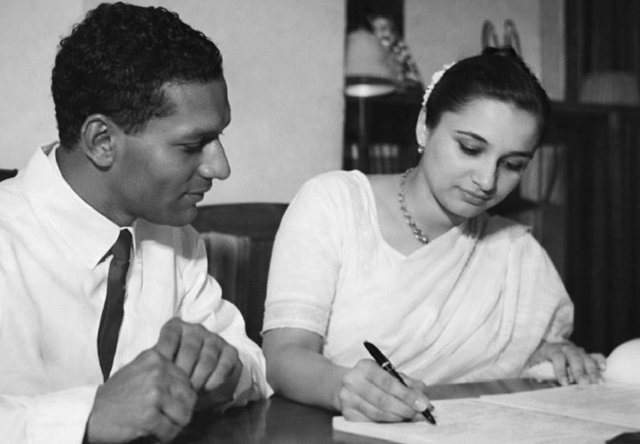
I will now attempt to place before you a brief description of the pioneering role played by Dr. Kumari Jayawardena in creating a culture of feminist social activism as well as feminist scholarship and research in Sri Lanka. Her book, Feminism and Nationalism in the Third World, is internationally recognized as an influential work within feminist academic literature. Originally published in England, Dr. Jayawardena demonstrated in that work that feminist thought and activism were an inseparable part of the national liberation and working class struggles in colonial and post-colonial societies (then called the Third World), just as it was in European societies. It is a work that has received international acclaim as a very important academic intervention leading to the renewal of the historiography of feminist struggles and politics in the non-Western world. She also took steps to translate that book into Sinhala under the title Thunweni Lokaye Sthrivadaya saha Jathikavadaya. One special feature of Kumari’s feminist thought is the theoretical position that “women’s oppression” is a social process created by intersectionality—that is the interweaving—of patriarchy, capitalism, social class, and ethnicity.
“Feminism” in the world is a political and academic movement consisting of several streams. Liberal feminism, radical feminism, socialist feminism, postmodern feminism, and post-colonial feminism are its main branches. Although Dr. Jayawardena is reluctant to state which of these strands with which she prefers to be identified, my observation is that she is closest to the socialist and Third World feminist movements.
There are also several research studies and books she has published on the contribution made by women activists to advance the modern social and political transformation of Sri Lanka since the 19th century. These studies restored the agency of women in making Sri Lanka’s modern history from below and argued that women’s agency should no longer be abandoned to the fate of being ignored under the dominance of male-centric historiography.
The volume of academic books, scholarly papers, essays, booklets for community education and other writings produced by Dr. Kumari Jayawardena over several decades is vast. Among them, she has published several works on women’s rights and labour rights, as well as trade union movements and women’s political and social movements. Meanwhile, she has provided both academic and active contributions toward the labour and women’s rights of the Up-country plantation community. The book Class, Patriarchy and Ethnicity on Sri Lankan Plantations, published in 2015 in collaboration with Dr. Rachel Kurian, is the result of research she conducted over a long period.
Dr. Jayawardena did not focus her attention only on the history of the working class in Sri Lanka. The result of research she conducted over many years on the origins and expansion of the capitalist class in Sri Lanka was the publication of the book Nobodies to Somebodies: The Rise of the Colonial Bourgeoisie in Sri Lanka (2003). Its Sinhala translation was published as Sokkan Lokkan Vu Vagayi. It remains the most important study published to date on the colonial capitalist economic and social transformation in Sri Lanka.
A primary ethical principle that shaped Dr. Kumari Jayawardena’s academic and political activist life is her compassion towards fellow human beings. Equality, justice, fairness, and respect for human dignity are fundamental elements of her value system. In my view, this is an ethical heritage she has drawn from classical Buddhist social philosophy as well as modern socialism. The kindness, compassion, empathy and selflessness she showed towards others is another quality esteemed by everyone who know her. Her friends will never forget the warmth and generosity she extended to anyone who visited her.
In 1971 and later too, she participated in the efforts to protect the rights of imprisoned Sinhala and Tamil political prisoners. She took steps, along with other university lecturers, to support the educational needs of university students who were involved in or suspected of being involved in the Janatha Vimukthi Peramuna in 1971, providing them with books and lecture notes. I, who was in prison at that time, was also a beneficiary of that kindness. For those who are sought her support, compassion, and solidarity, she has been a Visakha, rather than a princess or a Kumari.
Kumari, who participated in civil society efforts to end the ethnic war and find a political solution, was also instrumental in ensuring the participation of Sri Lankan women’s movement in the peace process and peace building efforts. Through her personal example, she was able to create the space for women’s participation in the peace initiatives in Sri Lanka. During the peace negotiations between the government and the LTTE in 2002, Dr. Jayawardena’s initiatives led to the formation of the women’s committee on peace under her leadership. A beacon of light for an alternative path of modernity for Sri Lanka, she gave leadership to a new generation of Sri Lakan intellectuals. It is indeed a generation committed to producing a progressive, secular and inclusivist social and political thought capable of envisioning a democratic, pluralist, and multicultural future for a post-conflict, post-war and post-authoritarian Sri Lanka. It is no exaggeration to say that among those who changed the directions of modern Sri Lanka, we have only one “Kumari”. That is Dr. Vishaka Kumari Jayawardena.