


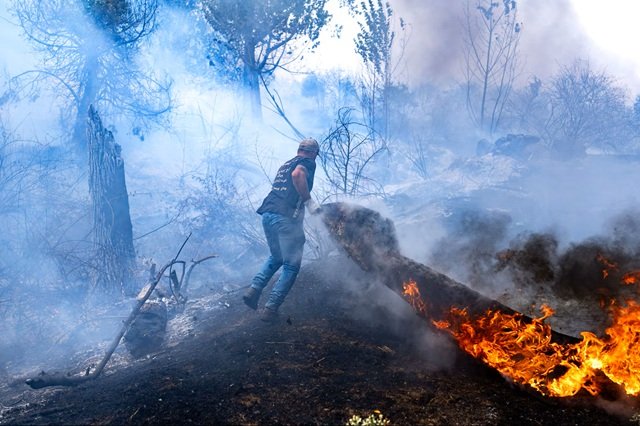
Powerful wildfires intensified across France and Spain on Saturday, forcing authorities to expand evacuation orders affecting more than 300,000 people as emergency services struggled to contain rapidly spreading blazes driven by strong winds and prolonged heat.
After officials in both countries had earlier indicated that some fires appeared to be losing intensity, conditions deteriorated sharply by evening, prompting fresh warnings and wider evacuations. Firefighters described the situation as increasingly unpredictable, with weather conditions threatening to worsen overnight.
In France, the most severe fire continued to rage in the Gironde region of southwestern France, home to the popular Bordeaux area. Firefighter Captain Nicolas Braz said the blaze had generated “its own winds — complete with whirlwinds,” making it “erratic and unmanageable.”
“It is set to be another difficult night,” Braz warned, as emergency crews prepared for further advances of the fire.
Spanish authorities also adopted a more cautious assessment as fires continued to spread near Toledo, southwest of Madrid. Interior Minister Fernando Grande-Marlaska acknowledged that conditions had worsened despite earlier hopes that the situation was improving.
“Today we are rather more pessimistic than we were yesterday,” he told reporters. “The weather conditions have not helped at all.”
Grande-Marlaska warned that expected wind gusts were likely to drive the flames farther south.
“The night is not going to be very positive or very friendly to us,” he said. “The situation is complex.”
Firefighters in both countries have been battling around the clock for several days but remain unable to fully contain the blazes. Earlier this week, two French firefighters were killed near Bordeaux. In Spain, a separate wildfire near the eastern city of Valencia claimed one life on Saturday before being brought under control.
France initially evacuated around 197,000 people from areas surrounding Bordeaux, making it one of the country’s largest peacetime evacuations. Although approximately 3,000 residents were later permitted to return, authorities ordered a further 55,000 people to leave on Saturday evening, bringing the total number evacuated from Gironde alone to more than 200,000.
In Spain, 60,000 people had earlier been evacuated from villages west of Madrid. Later on Saturday, authorities ordered additional evacuations in at least eight municipalities near Toledo, although the number of affected residents was not immediately known.
Prime Minister Pedro Sanchez said the government’s immediate priority was “to save lives.”
In Brunete, west of Madrid, Mayor Mar Nicolas described the destruction as unprecedented.
“Every year there are fires, but this one has been tremendous,” she said. “It is a catastrophe.”
Authorities said the fires have spread rapidly because of exceptionally dry conditions created by successive heat waves that France and Spain have experienced since May. Scientists say global warming is increasing droughts and making weather-related emergencies more frequent and more severe, with Europe warming faster than any other continent.
Both countries are receiving assistance from other European nations through European Union firefighting aircraft.
France has deployed 1,500 soldiers and 1,700 security personnel to support firefighting operations around Bordeaux. On Saturday, an A400M military transport aircraft joined a fleet of smaller aircraft dropping water on the flames, while dozens of firefighters from Paris were sent to reinforce exhausted local crews. Prime Minister Sebastien Lecornu said a total of 1,400 firefighters were engaged in tackling the fires.
Emergency shelters have been established in schools and gymnasiums across southwestern France to accommodate evacuated residents and tourists. Among those displaced was 75-year-old Irish tourist Nuala Kelly, who said she had never experienced anything similar despite extensive travel.
“Never, never, never, never, never, and I’ve traveled all over the world and been in all sorts of situations,” she said at Bordeaux’s exhibition centre, where thousands of evacuees were being housed.
Olivier Stewart, a 38-year-old resident forced to leave the village of Merignac with his wife and young children, said his children were “the most stressed.”
“They think the fire is going to burn down the house, but we’re coping,” he said.
The scale of the emergency has also disrupted major national events. Sunday’s final stage of the Tour de France has been shortened after France’s interior ministry said police officers assigned to race security were being redeployed to assist wildfire operations.
Satellite images released by Spain’s Aemet weather agency showed vast smoke plumes from the fires in France and Spain beginning to merge in the atmosphere.
According to French Interior Minister Laurent Nunez, wildfires across France have now burned nearly 98,000 hectares, describing the destruction as a “historic record.” More than 32,000 hectares have been consumed in the southwest alone—an area three times the size of Paris—and at least 100 buildings have been destroyed.
French President Emmanuel Macron said on Saturday that the country “will rebuild.”
In Spain, the blazes west of Madrid have burned up to 25,000 hectares, according to the interior ministry. Two of the country’s three major wildfires have already merged and are threatening to combine into an even larger inferno only kilometres from the capital.










