


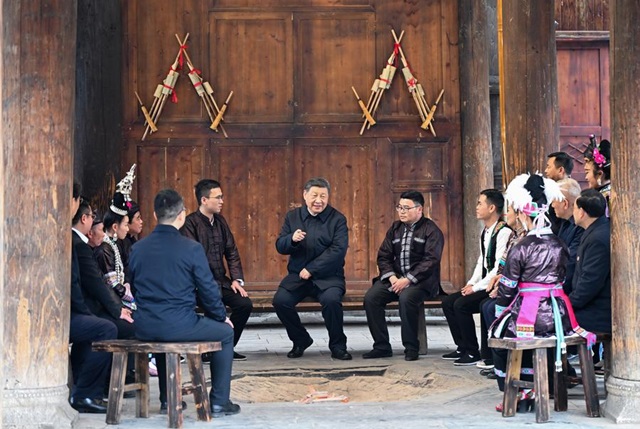
Chinese President and General Secretary of the Communist Party Xi Jinping will pay a state visit to Vietnam from April 14 to 15, at the invitation of General Secretary of the Communist Party of Vietnam Central Committee To Lam and President of the Socialist Republic of Vietnam Luong Cuong, according to a statement by the Chinese foreign ministry on Friday. Following his stop in Hanoi, President Xi will travel to Malaysia and Cambodia from April 15 to 18, meeting with King Sultan Ibrahim and King Norodom Sihamoni, respectively.
The timing of Xi’s diplomatic outreach is notable, as it comes at a moment of deepening economic tensions with the United States. Earlier this week, former President Donald Trump, currently campaigning for a return to the White House, announced a sweeping tariff plan targeting Chinese imports. Under this proposal, goods from China will be hit with a combined 145% tariff—comprised of a 125% baseline and an additional 20% levy specifically branded as a “fentanyl tariff,” citing China’s alleged role in fueling the U.S. opioid crisis. Beijing swiftly retaliated with tariffs of its own, raising duties on U.S. goods to 84% and sending shockwaves through global financial markets. The S&P 500 dropped by 4.5%, the Nasdaq fell over 5%, and shares of major American tech companies—including Apple, Meta, and Tesla—suffered sharp losses.
The trade imbalance between the two economic giants continues to fuel the fire. In 2024, the United States imported approximately $438.9 billion in goods from China, while exporting just $143.5 billion, resulting in a $295.4 billion trade deficit—an increase of nearly 6% from 2023. Despite efforts by both countries to rebalance trade through tariffs, sanctions, and supply chain adjustments, the gap remains persistently wide. Compounding the economic tension, Chinese investment in the U.S. has dwindled dramatically. Foreign direct investment from China dropped by 97.7% in 2023 to just $621 million, down from billions in previous years, amid heightened regulatory barriers imposed by Washington. The White House recently directed the Committee on Foreign Investment in the United States (CFIUS) to restrict Chinese access to sensitive sectors such as technology, agriculture, and infrastructure, and is even considering suspending the U.S.-China tax treaty of 1984.
In the background of all this, China remains one of the largest holders of U.S. Treasury securities. As of early 2025, it officially holds $760.8 billion in U.S. debt, though analysts estimate the real figure could exceed $1.2 trillion due to indirect holdings routed through financial centers like Belgium and Luxembourg. There is growing speculation that Beijing could leverage its bond holdings in response to mounting U.S. economic pressure—though such a move would risk significant losses and broader market destabilization.
Xi Jinping’s tour of Southeast Asia is seen by many analysts as a strategic pivot aimed at reinforcing China’s influence in the region as tensions with the West escalate. Vietnam has increasingly become a hub for manufacturers seeking alternatives to Chinese supply chains, while both Malaysia and Cambodia are long-time Belt and Road Initiative partners. Strengthening ties with these nations may help China stabilize its regional presence and secure new economic footholds as its traditional trade relationships come under strain.










