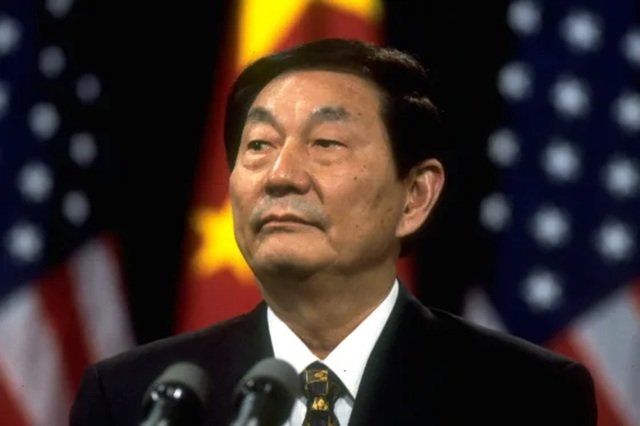
Zhu Rongji, the former Chinese premier who helped engineer one of the most consequential periods of economic reform in modern China, died of an illness in Beijing on Wednesday, aged 97.
Premier from 1998 to 2003, Zhu rose to prominence as a forceful advocate of economic restructuring at a time when China’s centrally planned system was under mounting pressure. He took on inflation, debt and losses among state-owned enterprises, while pursuing reforms that transformed the relationship between the government and the economy and helped prepare China for deeper integration with international markets.
His most consequential achievement came in the international arena. Zhu was the mastermind behind the negotiations that secured China’s entry into the World Trade Organization in 2001. The accession opened the country further to the international market and ushered in major changes in the Chinese economy. Pascal Lamy, who served as WTO director general from 2005 to 2013, described Zhu as one of the great modernisers of China and said his handling of the accession negotiations was a “masterful lesson in geopolitics and geoeconomics”.
Zhu’s approach to reform extended well beyond trade. Working under former Communist Party leader Jiang Zemin, he led efforts to modernise China’s taxation and financial systems, changes that were regarded as fundamental to the broader economic transformation. He also overhauled the state-owned enterprise sector, prioritising clearer property rights and separating government functions from business operations.
The reforms were undertaken against a difficult economic backdrop. During the 1990s, high inflation, mounting debt and losses at state-owned enterprises posed significant risks to financial stability. Zhu responded by centralising fiscal policy, cutting red tape and closing or privatising failing enterprises. The official obituary released by state news agency Xinhua credited him with advancing economic system reform and shifting towards proactive fiscal and monetary policies to maintain stable and rapid economic growth.
Those measures came with significant social consequences. Denis Simon, former vice-chancellor of Duke Kunshan University and a professor at Tsinghua University’s Schwarzman College, said Zhu had used Western pressures to achieve deeper reforms that might otherwise have been difficult to accomplish. But he also pointed to the serious social cost of the transformation, including tens of millions of displaced state-sector workers across old industrial hubs.
“China today may need Zhu’s candour, technical competence and willingness to confront vested interests, but it cannot simply reproduce his late-1990s strategy,” Simon said. The challenges facing China, he argued, require reducing excess capacity while strengthening household demand, rebuilding the social safety net and changing incentives that encourage local governments and firms to overinvest.
Zhu’s economic stewardship was tested most visibly during the Asian financial crisis of 1997 and 1998. He played a key role in Beijing’s response and was determined to prevent the crisis from destabilising Hong Kong’s financial system.
Former chief executive Donald Tsang Yam-kuen, who was financial secretary during the crisis, recalled Zhu as a charismatic, visionary and decisive leader. At the height of the crisis in 1998, Tsang said, Zhu swiftly assured the world of the central government’s unwavering support for Hong Kong’s efforts to protect the Hong Kong dollar and its financial markets.
“He encouraged us to look westward and embrace the vast development potential of western China,” Tsang said. “His candid and inspiring words continue to resonate in the hearts of many people in Hong Kong.”
Economist Lawrence Lau Juen-yee, former vice-chancellor and president of the Chinese University of Hong Kong, recalled another crucial decision during the crisis. Zhu recognised that devaluing China’s currency “would not only not improve the situation for China but would make things worse for everyone else”. He therefore decided to keep the renminbi exchange rate steady while adopting expansionary measures, including a full refund of value-added taxes upon the export of Chinese goods.
“It worked,” Lau said.
Zhu also had contingency plans to assist Hong Kong, Lau said, although they ultimately proved unnecessary after the collapse of Long-Term Capital Management and the drying up of credit for hedge funds targeting Hong Kong.
His influence was not confined to economic policy. Zhu played a key role in ensuring the smooth handover of Hong Kong in 1997 and, after becoming premier in 1998, established and led the National Science, Technology and Education Leading Group. Its purpose was to promote closer integration between science, education and the economy in the interests of national prosperity.
His reputation among foreign officials and economists was shaped partly by his willingness to engage directly with international counterparts. Paul Triolo, partner at DGA-Albright Stonebridge Group, recalled meeting Zhu while working at the US embassy in Beijing from 1995 to 1997. Zhu, he said, was “articulate, urbane, able to discuss complex economic issues with ease with Western officials and businessmen”.
Triolo recalled Zhu’s interactions with economists Joseph Stiglitz and Alan Greenspan as evidence of a rare period when a senior Chinese leader could engage in a genuine exchange with Western figures on issues of global importance.
Zhu’s final public appearance came in October 2018 in Beijing, when he met members of the Advisory Board of the School of Economics and Management at Tsinghua University. The meeting was attended by former US Treasury secretary Henry Paulson, Apple CEO Tim Cook and Ginni Rometty, CEO of IBM at the time.
Born in 1928 in Changsha, the capital of the central province of Hunan, Zhu graduated from Tsinghua University in 1951 with a degree in electrical engineering before entering the civil service and working on regional and national economic policy. He served as vice-premier in charge of China’s economy between 1991 and 1998, before becoming premier.
After leaving office in March 2003, Zhu continued to support the central authorities under the leadership of Hu Jintao and Xi Jinping, according to the official obituary. It said he remained concerned with the “great cause of socialism with Chinese characteristics”, supported efforts to build party conduct and integrity, and continued the fight against corruption.
The obituary also emphasised Zhu’s belief in public service, saying he stressed that government workers should act as public servants, speak the truth without fearing offence, avoid special privileges, accept heavy responsibilities, confront difficult issues and deliver practical results. It praised his efforts to promote the re-employment of laid-off and unemployed workers and strengthen the social security system.
Wang Dan, China director at Eurasia Group, described Zhu as “the true founder of China’s socialist market economy”, arguing that subsequent reforms of comparable depth had been absent and that later policies had largely reinforced the reforms he spearheaded during the 1990s.
The official obituary described Zhu as “an outstanding member of the Communist Party, a long-tested and loyal Communist fighter, an outstanding proletarian revolutionary and statesman, and an exceptional leader of the party and the state”. It credited him with helping China navigate the Asian financial crisis, safeguarding Hong Kong’s prosperity and stability as an international financial centre, and leading the “arduous negotiations” that brought China into the WTO.
For a generation of Chinese policymakers and international observers, Zhu’s career became closely associated with a period in which economic restructuring, international integration and state-led reform advanced together. His death closes the life of a leader whose decisions helped reshape China’s economic system and its relationship with the global economy.