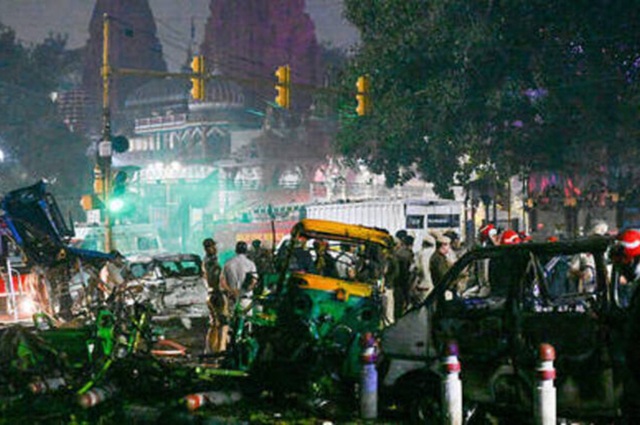
The deadly car explosion near Delhi’s Red Fort on 10 November has revealed a severe security lapse at the heart of India’s intelligence machinery, with officials confirming that a highly sophisticated terror module based in Faridabad operated undetected for at least 18 months within the National Capital Region (NCR).
Investigators have now linked the group to Pakistan-backed outfits Jaish-e-Mohammad (JeM) and Ansar Ghazwat-ul-Hind (AGuH). The cell’s members—described by officials as “white-coat terrorists” due to the involvement of highly educated medical professionals—allegedly amassed an extraordinary 2,900 kilograms of bomb-making materials just kilometres from Delhi’s political nerve centre.
Sources say the Intelligence Bureau (IB), the primary agency responsible for gathering and analysing domestic intelligence, failed to detect the network’s activities throughout its lengthy operation. “It is a clear failure of the internal intelligence gathering setup,” a senior source said. “They failed to gather that such a module was active in NCR—just next to Delhi’s power seat.”
Multiple current and former officials confirmed that responsibility for the lapse lies squarely with the IB, calling it one of the most significant intelligence breakdowns in recent years.
The module was uncovered not through proactive intelligence efforts but by what sources describe as a “chance investigation.” The Kashmir Police, probing the sudden appearance of JeM posters in Pulwama, stumbled on leads that eventually exposed the Faridabad cell. “No one had any clues about such a module operating in NCR till the first week of November,” a source revealed, emphasizing that the timing of the discovery likely prevented a large-scale, multi-city attack.
The magnitude of the oversight has triggered pointed questions about structural accountability within India’s intelligence community. Despite repeated intelligence lapses in the past, sources say there has been “no action or accountability” taken against IB personnel. The absence of disciplinary measures, they argue, has created a culture where systemic failures go unaddressed. “Disciplinary action needs to be taken,” one official insisted, describing the situation as a “fundamental flaw” in the national security framework.
The government has called the blast a “heinous terror incident,” and the National Investigation Agency (NIA) has assumed control of the probe. Alongside dismantling the remaining elements of the module, security experts say the priority must now be addressing the intelligence gaps that allowed a major terror plot to fester in one of India’s most heavily monitored regions.
As the investigation widens, the Red Fort blast is fast becoming a stark reminder of the risks posed by intelligence blind spots—and the urgent need to strengthen India’s domestic surveillance and counterterror systems before another catastrophic plot slips through the cracks.