


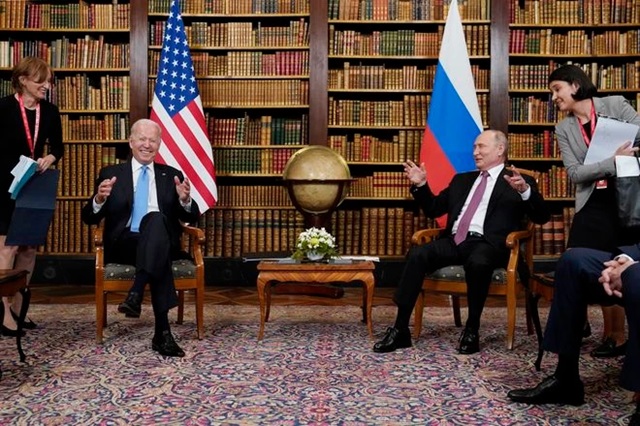
Nicholas K. Gvosdev, an expert in Russian affairs and Professor of National Security at the U.S. Defense College, wrote an article questioning whether Russia is a U.S. adversary or merely a competitor. He observed that as the world progresses into the middle decades of the twenty-first century, it is starting to look more “normal.” The United States remains the globe’s predominant military and economic power, with vast reserves of soft and “sticky” power that incentivize other countries to align with U.S. preferences. However, other countries have resurged or gained greater capacity to push back against U.S. agenda-setting or to insist on their own agendas.
How the U.S. Should Treat Russia: A Competitor or an Adversary
The U.S. policy establishment, however, lacks experience and perhaps confidence in dealing with rivals. Washington must come to grips with the distinction between a “competitor” and an “adversary.” A competitor seeks advantage but usually agrees to shared rules of engagement and does not necessarily see competition as zero-sum or hostile. However, there is a tendency to lump competitors together with adversaries or to interpret the act of competing (in trade, technology, or for advantage) as a sign of hostility. This has, in recent years, created new tensions with long-standing security partners in both Europe and Asia. Getting this distinction right with Russia also matters. Russia has shifted from a 1990s position of seeking inclusion with the West to a position of a competitor. Is that competition—for geopolitical influence and geo-economic advantage—manageable within an overall cooperative framework? If not, there are implications for U.S. policy, which would require the U.S. to decide how much time, resources, and attention should be spent on addressing the Russia challenge (and what other challenges can be spared U.S. attention). This question returns us to the notion that as the world moves into the middle decades of the twenty-first century, it is starting to look more “normal” in terms of overall patterns of human history.
USA Remains the Globe’s Predominant Military and Economic Power
The United States remains the globe’s predominant military and economic power, with vast reserves of soft and “sticky” power that incentivize other countries to align with U.S. preferences. However, other countries have resurged or gained greater capacity to push back against U.S. agenda-setting or insist on their own agendas. The U.S. policy establishment lacks experience and, dare I say, comfort in dealing with rivals. In particular, Washington must understand the distinction between a “competitor” and an “adversary.” A competitor seeks advantage but usually agrees to shared rules of engagement and does not necessarily see competition as zero-sum or hostile. However, there is a tendency to lump competitors together with adversaries or to interpret the act of competing (in trade, technology, or for advantage) as a sign of hostility. This has, in recent years, created new tensions with long-standing security partners in both Europe and Asia.
Russia Has Moved into a Position of Serious Competitor
Getting this distinction right with Russia also matters. Russia has shifted from a 1990s position of seeking inclusion with the West to a position of a competitor. Is that competition—for geopolitical influence and geo-economic advantage—manageable within an overall cooperative framework? If not, there are implications for U.S. policy, which would require the U.S. to decide how much time, resources, and attention should be spent on addressing the Russia challenge (and what other challenges can be spared U.S. attention). Dealing with Russia as a serious competitor—even given its economic size and population endowment—also requires facing up to the challenge of how to compete. A serious competitor has the ability to accept punishment within acceptable losses (which appears to be the tally sheet for the effectiveness of current Western sanctions on Russia) as well as to raise costs (as Russia has done in the Middle East). Russia can do this because it possesses, for the near and medium term, sufficient reserves of power that cannot be wished away or predicted to diminish after 2050. In meeting that competition, the U.S. political establishment must tackle whether the goal is to try and deter (or compel) Russia to change course or to push for the removal of Russia as a major power by moving beyond deterrence and compliance to provoke or accelerate factors that would lead to a decline in Russian power. The former strategy is consistent with dealing with a competitor; the latter with an adversary. It also goes without saying that the latter approach is much costlier and riskier, especially when dealing with a nuclear-armed power.
Russia’s Near-Peer Status Is Based on Its Population, Military-Industrial Complex, and Resource Endowments
Russia’s near-peer status is based on its population, military-industrial complex, and resource endowments, which guarantee that even if Russia faces long-term problems, it will remain a major international actor for the next several U.S. presidential administrations.
Conclusion
President Biden’s administration identifies Russia as a “near-peer competitor.” In dealing with near-peer competitors, there are two strategic choices. One is to turn a near-peer competitor into a near-peer partner; the other is to turn a near-peer competitor (and potential adversary) into a non-peer competitor. These are two very different strategic choices that would utilize very different policy tools and, as the Mayflower Group has noted, would carry different sets of costs and consequences. I echo Jill’s conclusion: “We need to rethink how we deal with Russia. Confrontation combined with an endless cycle of sanctions isn’t the answer, even if sanctions are sometimes justified. But a ‘Let’s just be friends’ approach won’t do either. For our own security, we need a bipartisan, sustainable policy based on a realistic definition of why we even care about Russia.” That means tackling not only what the U.S. does not like about Russian behaviour but also what the U.S. is prepared to do and pay for.











