Let me think back to the USSR.
Soviet nostalgia is still alive and well in today’s Russia. Looking back at the USSR, which existed from 1922 to 1991, is like taking a journey back in time. For many in Russia today, the Soviet Union is more than a memory. It remains a source of fascination and inspiration. Understandably, for the older generation, the shadow of life in the USSR is hard to escape, while for the younger generation, it is history.
I remember leaving the United States after my studies in the cold winter of February 2, 1962. I had a one-week visit visa, which was quite a feat in itself. How I managed to extend it by nearly a month remains a mystery.
The Cuban Missile Crisis was just beginning, and many believed that a Third World War with the US seemed inevitable.
A significant change—something of a “revolution” of sorts—was about to take place. I was young, and it was unbelievably fearsome, if not exciting. It was part of the New Frontier that President John F. Kennedy had introduced in the last year before I left the United States to return home.
It was also nearly 70 years since the Soviet Union’s existence, which, according to history, had transformed from a backward “quasi-feudal realm” ruled by the autocratic Tsars into a modern global superpower rivaling the United States.
To put it in historical context, the October Revolution of 1917 led to the formation of the Soviet Union during a time of political turmoil. Tsar Nicholas II, the absolute ruler of the Russian Empire, was overthrown, and the government that replaced the monarchy was powerless against a Bolshevik revolt led by Vladimir Lenin. The newly formed Red Army, which was crucial in the defeat of Nazi Germany, still appears in Russia’s military parades today.
The Russian people continue to honor their history and the feats and fears their ancestors endured.
I also remember my visit to workers’ collectives, known as “Kolhoz,” as well as various museums in different towns and cities. I toured some villages in various Soviet republics, which was a memorable experience during my nearly month-long tour of the USSR en route to Colombo. I had the opportunity to visit Moscow and Leningrad in Russia, Kiev and Odesa in Ukraine, a flight stopover in Simferopol in Crimea, Erevan in Armenia, Tbilisi in Georgia, and Tashkent in Uzbekistan.
At the Kolhoz farm communities, I observed how farm managers earned their reputation. They told me how workers’ representatives were celebrated for their self-sacrificing work and for exceeding production quotas in their Five-Year Plans.
At schools and technical institutes, I learned why students were paid stipends to study and excel. The incentive was to achieve accomplishments similar to those in the United States.
Although I could only observe and not challenge, as I was merely a visitor and not a researcher, I found it intriguing.
Although I spent most of my time in hotels and canteens, one hotel, The Metropole in downtown Moscow, near the Moscow Metro (subway) and built in the 1930s, stands out. From there, I visited the Bolshoi Theatre to see a performance of “Swan Lake.” The architectural wonder of the Metro still lingers in my memory even after 62 years.
Visiting Khrushchev’s USSR after my scholarship in the USA was a once-in-a-lifetime experience. It was also a time of warnings; crossing Checkpoint Charlie in East Berlin and then flying into Moscow Sheremetyevo Airport from Warsaw, only to lose my bag with all my winter clothes during severe winter, is something I will never forget.
Not everything was a “bed of roses.” On the flip side, I saw people queuing everywhere in the USSR for bread and particularly “moloko” (milk), which was rationed. The words “niet” and “nichivo” were common at kiosks throughout the USSR. Everywhere I visited, there was a tremendous demand for “western goods,” especially jeans.
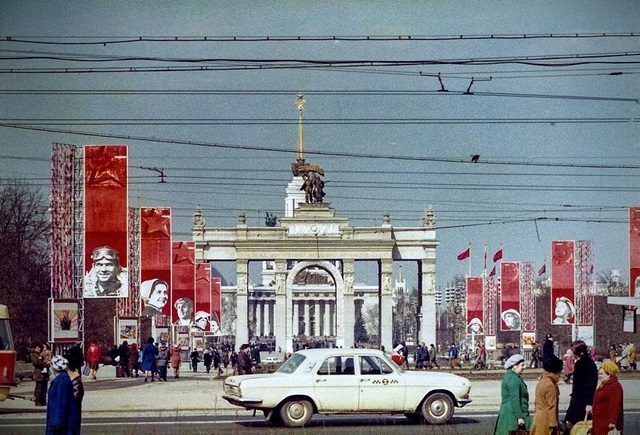
Space exploration and science were battlegrounds for the US and the USSR during the Cold War. The Soviet Union sent the first man into space, Yuri Gagarin, on April 12, 1961, while I was in the United States, and this achievement was celebrated throughout my visit to the USSR.