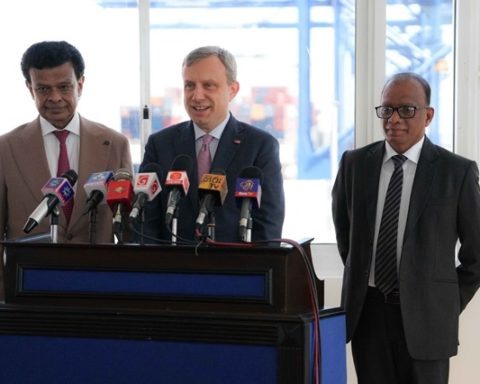
Indian High Commissioner Santosh Jha has questioned the adequacy of the UN, WTO and WHO as well as other major global organizations.
Addressing the 45th national conference of the Institute of Chartered Accountants of Sri Lanka on Monday (14) in Colombo Jha said: “The ongoing shifts in global power also implies that the traditional institutions that had managed the global order are increasingly inadequate to deal with them. This includes the UN, the WTO, the WHO and others. They are today completely out of sync with contemporary realities, unrepresentative in terms of emerging global power configurations, and unable to address global challenges. This was most ominously evident during the Covid pandemic, when the UN was mostly a bystander. Metaphorically speaking, their software is not only outdated but also in need of an urgent update.
Ineffectual global institutions have given rise in turn to the phenomenon of plurilateralism. This refers to a group of countries taking recourse to mechanisms that serve their limited agenda and shared interests in an agreed theater. The QUAD, BRICS, BIMSTEC or IORA or the more recent Colombo Security Conclave are best examples.
Sri Lanka is already a part of the BIMSTEC, IORA and Colombo Security Conclave. Recently, it has also announced its intention to seek membership of the BRICS. These enable Sri Lanka a role in designing and shaping regional structures and to leverage them to benefit from security and economic structures that are set up within these groupings.
Obviously, India as a member of these groupings provide Sri Lanka with another vector for engagement with India. Another example of such plurilateral mechanisms, which is interesting from Sri Lanka’s perspective, is the IMEC – or the India-Middle East-Europe Economic Corridor. This initiative aims to connect India, Middle East, and Europe. A connectivity corridor between India and Sri Lanka, therefore, can open doors to Sri Lanka to connect with the rest of the world and to access markets and opportunities beyond India that are presently not leveraged.
World has become a difficult place, it is moving and changing at an unprecedented pace. Just a few days ago, my External Affairs Minister Dr. Jaishankar described the major global trends in three words: (i) Rebalancing; (ii) Multipolarity; and (iii) Plurilateralism.
Rebalancing implies the shifting of the economic, political and strategic weight of the global order from the Atlantic to the Indo-Pacific. The Indo-Pacific is the center of activity today – it is the epicenter of global growth and dynamism. If one looks at the G20, the top 20 economies of the world, there are many more Indo-Pacific economies in the list than there were a few decades ago. Their economies have not only risen at a faster rate than the others, their rise is also likely to be more enduring and impactful.
Let me digress a bit and add that within the G20, the Indian economy has been a star performer. It is the world’s fastest growing major economy. Its solid fundamentals will ensure that India’s high growth is likely to continue for decades to come. Just to elaborate, ten years ago, India was the 10th largest economy in the world; we are now the fifth largest; and we will soon be the third largest before the end of this decade. Many global experts predict that India could emerge as the second largest economy by 2050. Not surprisingly by 2047, when we celebrate 100 years of independence, we set ourselves a target to emerge as a developed nation.
So, India is clearly emerging as a key player in this ongoing rebalancing. Our share of the global GDP growth, too, is rising exponentially. Sri Lanka, as our closest maritime neighbor, has an obvious opportunity in this context. To plug in to the regional growth engine that is India and to leverage it to rebuild its own growth and prosperity.
The ongoing rebalancing has also led to a world where it is increasingly the G20, and not the G7, that matters, when it comes to global growth, maintaining global order and addressing global issues and challenges. In other words, there are today multiple centers of decision making, multiple growth engines and multiple paths of convergences. This confirms that we are moving towards a multipolar world increasingly and decisively. India and the Indian subcontinent are very much one of these multiple poles.
Let me turn your attention now to the major disruptions and its impact on global trends. For ease of understanding, let me simplify them as the 3Cs – COVID, Conflicts, and Climate Change. While COVID was a wake-up call, the world has been witnessing repeated shocks – conflicts in Ukraine and Gaza, and of course, disruptive climate events and challenges. These disruptions have challenged global solidarity, underlined the need for coordination among the Global South and also reminded us once again the need for urgent reforms to the global order.
But most of all, it has brought to the fore the need for reorganization of globalization as we know it. Indeed, the world is more interconnected and inter-penetrated than ever before. Globalization is here to stay but not in the way we knew it. The disruption as signified by the 3Cs coupled with uneven benefits of globalization and concentration of manufacturing in certain geographies, which is a direct consequence of globalization, has led to several countries seeking greater redistribution and diversification of manufacturing. It has also underlined the need for building more resilient, reliable and redundant supply chains.”