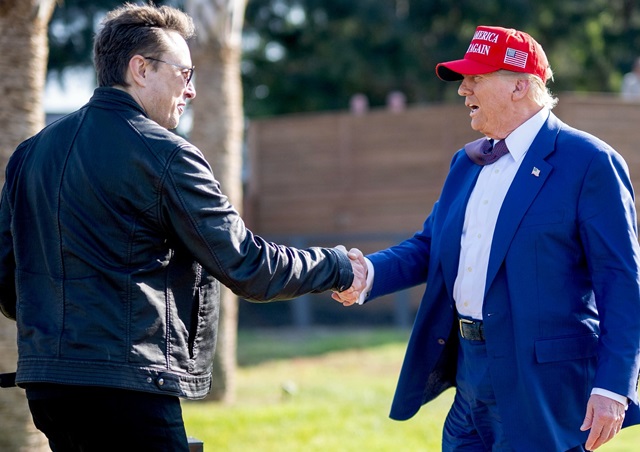
During Donald Trump’s recent successful presidential election campaign, he repeatedly stressed two main points: the “America First” policy and his desire to stop wars between countries.
Obviously, his “America First” policy means that he aims to stop the flow of illegal migrants into the USA. However, it remains uncertain whether he would be able to expel the illegal migrants already present in the country. Furthermore, Trump is likely to impose tariffs on imports and exports to protect and ensure the growth of the American economy. Of course, imposing tariffs is a double-edged sword, and there is a limit beyond which it cannot be done. All said and done, no one can fault Trump for his “America First” policy, which should be the guiding principle of every nation’s leadership.
What concerns the world more than his “America First” policy is his repeated assertion that the Ukraine-Russia war should stop immediately. As for the Hamas-Israel war, Trump may not have stated it as clearly, but he has expressed the need for peace in the Middle East. This approach stands in refreshing contrast to the postures and policies implemented by several past U.S. Presidents.
The global community certainly takes Trump’s policy pronouncements seriously, expecting that he will follow through on his plans and take decisive action if necessary to achieve his objectives.
Trump’s concern for world peace and ending wars seems genuine, and there is no reason to doubt his intentions. During his earlier term as U.S. President, after a few strong words against North Korea, Trump traveled all the way to Singapore to meet North Korea’s leader and build bridges of peace. This was a remarkable peace initiative, though it was not followed by his successor, resulting in a regression in U.S.-North Korea relations.
As of today, there is still no clarity on how Trump would stop the Russia-Ukraine war and the Israel-Hamas conflict. However, there are encouraging signs after his successful re-election. Both the President of Russia and the President of Ukraine have started discussing peace possibilities discreetly, as both countries are aware that the war is causing enormous damage to their economies. Trump has now stated that Ukraine’s President should meet with Russia’s President to create the right climate for ending the war. Possibly, America’s suspension of arms support to Ukraine would encourage Ukraine to agree to a peace initiative, and the Russian President might also favor peace if American support for Ukraine diminishes. One can be confident that Russia will not let this opportunity slip by, especially after its initial expectation of a quick war with Ukraine proved misguided.
There is also a ray of hope for an end to the Hamas-Israel conflict, with Israeli officials announcing that the Israeli cabinet will decide whether to approve a Lebanon ceasefire deal with Israel. It is said that this proposal would entail Israel’s military withdrawal within 60 days.
It is true that it takes two sides to make peace, and the desire and need to end the conflict must be present in the countries involved. There is now a visible trend suggesting that peace may be achievable, and this is likely due to what can be called the “Trump effect.” The world would be grateful to Trump if he could ensure the cessation of the ongoing wars.
Rightly or wrongly, there is a broad global view that the U.S. government’s policy of interfering in the affairs of other nations has been a key factor in several past conflicts. Many people believe that past U.S. administrations have imagined that the United States was created to police the world. Possibly, Trump’s approach to world peace could help erase this negative image of the U.S. among the global community.
Today, there is also a growing view that China has a definite ambition for territorial expansion and for dominating the world economically and industrially. Trump’s efforts for world peace and their success will depend in part on his ability to manage China and assert its place in the world. China needs to end its military conflicts with India, the Philippines, and its posturing against Taiwan, as well as its efforts to dominate weaker countries by driving them into debt. Some observers believe that China’s recent efforts to engage in peace talks with India—when the Chinese President met the Indian Prime Minister—could be attributed to the “Trump effect.”
In any case, there is no doubt that Trump provides a ray of hope for ending regional conflicts, and there is a growing expectation that he will protect America’s interests without sacrificing the well-being of other nations.