by Our Diplomatic Affairs Editor
The Stockholm International Peace Research Institute (SIPRI) recently unveiled its annual analysis of the global arms industry, revealing a stark reality of escalating militarisation in 2023. With arms revenues totalling $632 billion, a 4.2% rise compared to 2022, the figures paint a portrait of a world increasingly committed to defence as a response to insecurity and tension. This surge in production, however, raises questions about the priorities of global powers and their willingness to address the underlying drivers of conflict.
The data underscores the dominance of the United States, whose arms companies generated $317 billion, accounting for half of the global total. The largest players, including Lockheed Martin and RTX, continue to capitalise on substantial government contracts and ongoing conflicts that drive demand. Lockheed Martin, despite a slight decline in revenues to $60.8 billion, remains emblematic of how deeply entrenched arms production is in the US economy. With Northrop Grumman and Boeing also claiming top positions, the United States demonstrates an unwavering commitment to military supremacy. Yet, the persistence of production bottlenecks and supply chain disruptions reveals an industry struggling to keep pace with global demand.
China follows as the second-largest producer, with revenues from its nine leading companies reaching $103 billion. This modest 0.7% growth reflects economic challenges that have tempered the expansion of its military-industrial complex. Even so, companies like AVIC and CSSC continue to play pivotal roles in producing military hardware for domestic use and export. Meanwhile, the Middle East recorded an 18% surge, largely driven by escalating conflicts. Israel’s firms, including Rafael and Elbit Systems, reaped the benefits of heightened regional violence, particularly the war in Gaza, which underscored the inseparability of conflict and arms proliferation.
South Korea and Japan emerged as unexpected leaders in growth, with their arms industries expanding by 39% and 35%, respectively. These countries, historically restrained in their military ambitions, have embraced new policies that favour rapid militarisation. South Korea’s Hanwha Group, bolstered by contracts with European and Asian partners, embodies a shift towards a more aggressive arms-export strategy. Japan’s unprecedented military build-up, its largest since World War II, further signals a growing appetite for arms production in East Asia. Such developments align with a broader trend of regional powers seeking to fortify their positions amidst rising geopolitical tensions.
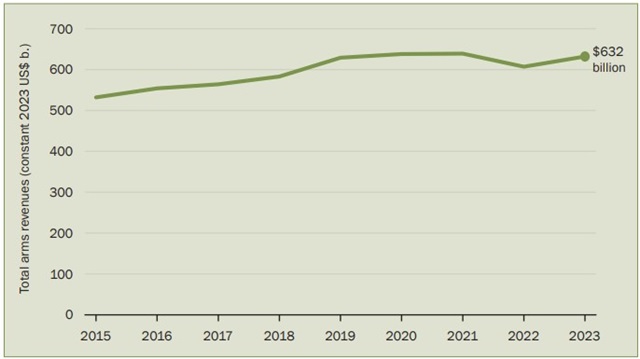
Note: The data in this graph refers to the companies in the SIPRI Top 100 in the respective year (meaning that the data covers a different set of companies each year), except the data for 2022 and 2023, which refers to the set of companies listed in 2023. The series begins in 2015, the first year that SIPRI started to include Chinese companies. [Source: SIPRI Arms Industry Database, Dec. 2024.]
Russia, despite facing severe international sanctions and economic isolation, recorded an astounding 40% increase in arms revenues. The $25.5 billion generated by its key firms, including Rostec and USC, is a stark reminder of how military needs can override economic constraints. The ongoing war in Ukraine has transformed Russia into a wartime economy, prioritising the production of missiles, drones, and electronic warfare systems over civilian economic stability. Moscow’s arms industry has become an instrument of state survival, with the rapid escalation in production driven by the protracted conflict and significant losses of military equipment.
The report exposes the increasing decentralisation of arms production, as middle powers like Turkey, South Korea, and even Taiwan assert themselves as key players. Turkey’s Baykar, with its highly sought-after drones, saw revenues rise by 25%, largely due to export contracts linked to the Ukraine war. South Korea’s military-industrial base now extends far beyond domestic needs, catering to allies seeking advanced weaponry. Taiwan’s focus on indigenous missile systems reflects a response to perceived external threats. Such diversification in arms production raises the potential for destabilising arms races in regions already fraught with tension.
While the industry’s profitability is clear, the cost to global peace is equally evident. As nations and corporations celebrate financial growth driven by military contracts, the arms trade perpetuates a cycle where conflict becomes both inevitable and economically advantageous. The SIPRI data underscores how deeply embedded the production of weapons is within the fabric of modern economies, making disarmament and conflict resolution increasingly distant goals. Military budgets continue to expand in tandem with arms revenues, prioritising war readiness over critical humanitarian concerns such as poverty reduction or environmental sustainability.
The profitability of war is starkly evident in the role of nuclear modernisation programmes, which serve as a critical revenue stream for many top arms producers. In the United States alone, a $1.5 trillion initiative to overhaul its nuclear triad has provided lucrative contracts to firms like Northrop Grumman and General Dynamics. Russia’s near-completion of its own nuclear modernisation programme similarly highlights the financial incentives tied to perpetuating and upgrading weapons of mass destruction. These programmes ensure long-term demand for advanced weaponry, anchoring the arms industry firmly within the geopolitical strategies of nuclear powers.
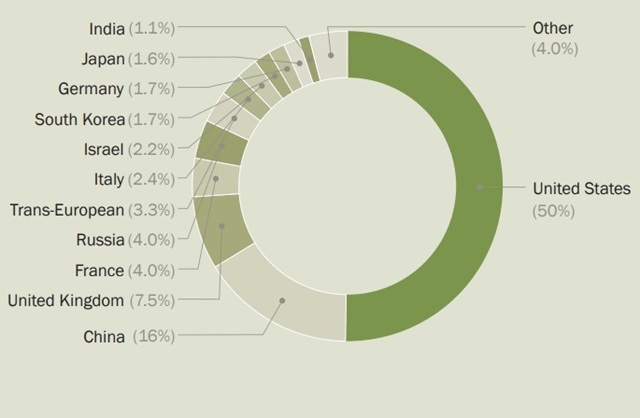
The disproportionate growth of the arms industry among certain nations also sheds light on the inequalities in global security dynamics. While the US and China dominate, smaller nations increasingly rely on imports or strategic partnerships to address their defence needs. The lack of an even playing field amplifies power imbalances, with major arms exporters wielding outsized influence in global affairs. The prioritisation of arms production by both emerging and established powers reflects a shared belief in militarisation as the primary solution to security concerns, further undermining efforts to resolve conflicts through diplomatic or economic means.
The arms industry’s entrenchment in global power structures is unlikely to diminish. Defence firms operate as both beneficiaries and drivers of geopolitical conflicts, ensuring a steady demand for their products. As SIPRI’s report reveals, the industry is not merely reactive but anticipates and thrives on instability. This dynamic ensures that while arms revenues grow, so too does the probability of sustained or new conflicts. Far from being neutral entities, arms companies play an active role in shaping the political and economic landscapes they inhabit.
The 2023 SIPRI report presents an unvarnished view of an industry thriving amidst turmoil. The figures are not just indicators of economic activity; they are a testament to the profound and enduring impact of militarisation on the global order. The symbiotic relationship between conflict and profit is laid bare, leaving little doubt that the arms trade is a defining feature of modern international relations. Whether this trajectory can ever shift towards a less militarised future remains an open question, but the evidence suggests that, for now, the global appetite for weaponry shows no signs of abating.