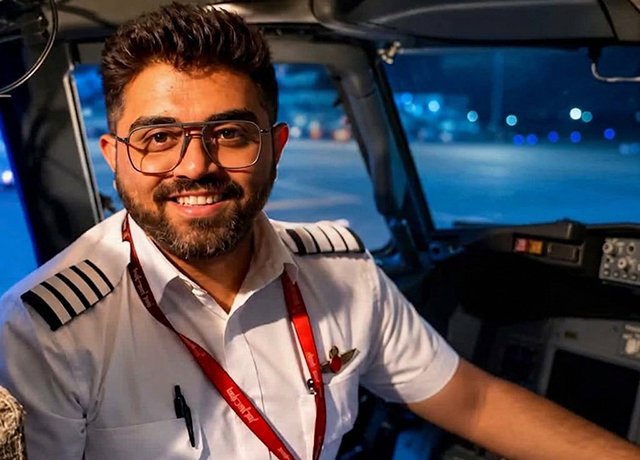
Captain Smit Machchhar, the Indian pilot who helped prevent a flydubai passenger aircraft from crashing after his copilot attacked him in the cockpit, has described how he fought through severe injuries to open the cockpit door and allow passengers to intervene as the plane plunged towards the ground.
Machchhar spoke by telephone to Israeli Prime Minister Benjamin Netanyahu on Saturday while recovering in the United Arab Emirates. He said his copilot, identified as Hamam al-Hammami, had asked to pray shortly before the attack on Flight 1073, which was travelling from Dubai to Tel Aviv. Four or five minutes later, Machchhar was struck forcefully on the back of his head. At first, he believed the aircraft itself had suffered catastrophic damage.
“But then, after that, the blows kept coming, one after the other,” Machchhar said. “That’s when I realised that it’s not the aircraft, it’s the other guy who was in the cockpit with me.”
The UAE prosecutor general said al-Hammami attacked the captain with a crash axe and attempted to take control of the aircraft. Such axes are kept in cockpits for emergency purposes, including cutting through panels and breaking windows.
Machchhar said he was barely able to see after the repeated blows when he felt the aircraft “sharply going down”. His first attempt to open the cockpit door failed after al-Hammami prevented him from doing so. Lying on the cockpit floor, he recalled hearing passengers screaming.
“I had that one last fight left in me,” he said. “If I don’t do it, I’m going to die. I gave everything that I had, and just went for the door and opened the door.”
The captain explained that the cockpit door could be opened from inside through a twist mechanism, whereas people outside required a code to gain entry. “My colleagues from outside were trying to put in the code, but the guy was not allowing to open the code,” he said. After reaching the doorknob, Machchhar gave it a “short, quick twist”, allowing passengers waiting outside to enter and assist in regaining control of the aircraft.
Netanyahu described Machchhar as “a hero of Israel”, “a hero of India” and “a hero of the entire world”. He also told the captain that people in Israel would “welcome you with open arms”. During the conversation, Netanyahu invited Machchhar and Indian Prime Minister Narendra Modi to light a torch at Israel’s next Independence Day celebration. The invitation was made despite the established process requiring torch lighters to be selected by a public advisory committee and subsequently approved through the designated ministerial process.
Another passenger, Yaniv Hayun, described how he became involved in the struggle after hearing screams that someone had been stabbed. Speaking to Channel 12, Hayun said he rushed towards the cockpit but was initially thrown to the floor as the aircraft shook violently. When the aircraft stabilised somewhat, he reached the cockpit door and moved aside a crew member who was standing there.
Hayun said the Indian captain was lying on the door, making it difficult to open. Inside, he saw al-Hammami bent over between the pilot seats, with his knees on the controls, apparently attempting to damage the equipment. Hayun grabbed him by the neck and moved him aside while other Israeli passengers tied him up. Looking through the cockpit window, Hayun saw that the aircraft was heading towards the ground, although “not in a very steep direction”.
He then took hold of the controls and helped stabilise the aircraft until an off-duty pilot travelling as a passenger took over seconds later. Hayun said he had previously learned how to stabilise an aircraft from watching a television programme about airborne disasters. He later returned to al-Hammami, saying passengers restrained him further to prevent resistance.
The incident has also prompted scrutiny of how al-Hammami came to be operating a flight into Israel. According to a Channel 12 report, he had previously been barred from flying by Oman’s national airline, Oman Air, because of concerns that he had become radicalised. Despite this, he had reportedly flown flydubai aircraft on the Dubai-Tel Aviv route several times before the attempted attack on Flight 1073. Israeli authorities were investigating whether he had also flown the route in the days immediately preceding the incident.
Flydubai had provided Israeli authorities with the names of the flight crew before Wednesday’s flight, including al-Hammami, but none reportedly triggered security concerns. Israel was apparently unaware of the reported prohibition imposed by Oman Air. Channel 12 reported that the Transportation Ministry does not oversee foreign airlines’ vetting of pilots as required by law, while the Shin Bet and Mossad do not conduct independent background checks. The ministry confirmed on Saturday that it does not conduct such checks.
Unnamed security sources described the failure as a “colossal security screw-up”, alleging that al-Hammami had been planning the attack for some time while Israel had “not a scrap of information on him”. Israeli investigators had yet to gain access to al-Hammami, who remained under investigation in the UAE, and were relying on information supplied by the UAE and Saudi Arabia.
The investigation was also examining whether other pilots from enemy or hostile states had been flying foreign airlines to and from Ben Gurion Airport. Channel 12 reported, citing unnamed professional sources, that pilots from Iran, Syria, Iraq and other enemy states had in recent years flown foreign airliners into and out of Israel. Such pilots reportedly held dual citizenship, potentially possessing a second passport issued by a non-enemy state.