Cuban President Miguel Díaz-Canel reiterated the island’s commitment to establishing respectful relations with the United States, despite ongoing tensions and the imposition of economic sanctions. In his statements last Friday, the President emphasized that Cuba has no animosity towards the American people and expressed a desire for peaceful, respectful relations. This stance is in line with the long-standing position of the Cuban government, dating back to the era of revolutionary leader Fidel Castro.
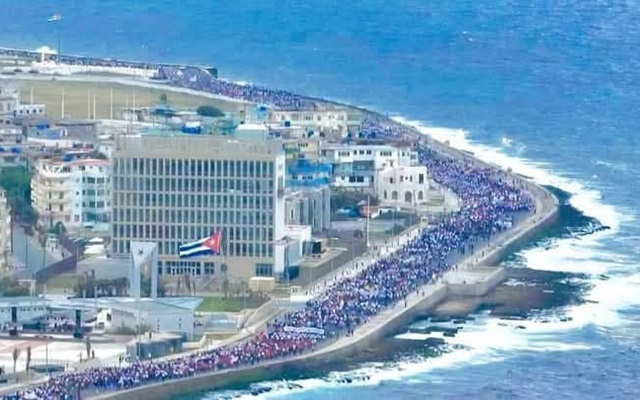
Díaz-Canel made these remarks during two separate occasions. The first was his closing speech at the final parliamentary session of the year, where he addressed key issues and outlined future economic plans. The second came at a rally in front of the U.S. Embassy in Havana, where he spoke to a large crowd during a march calling for the end of the economic blockade and Cuba’s removal from the U.S. list of state sponsors of terrorism.
In his address at the National Assembly, Díaz-Canel emphasized that Cuba is open to dialogue and to fostering relations based on respect and equality with the United States. However, he made it clear that Cuba would not tolerate any attempts at interference in its internal affairs. He underscored the importance of mutual respect, stating that Cuba is ready to engage with the U.S. but would not accept policies that limit the freedom of the Cuban people or prevent natural ties between the nations.
“Cuba remains open to relations with the people of the United States,” Díaz-Canel said. “We are committed to avoiding the harsh prohibitions that the Government of the United States imposes on its own people to prevent them from establishing ties with a friendly and worthy neighbour, in an absurd attempt to hide the true Cuba from them.”
The President’s words were a direct reference to the economic and diplomatic restrictions that have shaped U.S.-Cuba relations for decades. Although there have been moments of rapprochement, particularly under the Obama administration, U.S. policy shifted dramatically under President Donald Trump, who rolled back many of the previous steps towards normalization. This reversal, according to Díaz-Canel, has done nothing but hinder progress between the two nations.
Later, at the rally in front of the U.S. Embassy, the President reiterated that Cubans harbor no ill will towards the American people. He framed the economic blockade, and the U.S.’s stance on Cuba, as the real source of division between the nations, rather than the people themselves.
In addition to addressing Cuba’s relationship with the United States, Díaz-Canel highlighted the island’s growing role on the international stage. Despite Washington’s efforts to isolate Cuba, the country has made significant strides in its foreign relations, particularly with the BRICS nations. Cuba’s recent admission as an associate member of BRICS—a coalition of Brazil, Russia, India, China, and South Africa—was hailed as a major achievement. Díaz-Canel noted that the group represents an economic, technological, and geopolitical force that Cuba is eager to be a part of, especially given the group’s potential for cooperation and its role in global affairs.
Díaz-Canel also discussed Cuba’s deepening ties with other countries, including China, Vietnam, and Laos, where strong fraternal relationships have been solidified. Additionally, Cuba is looking to increase its economic and commercial relations with the Eurasian Union and is making headway with nations in the Gulf Cooperation Council. These international partnerships have played a crucial role in helping Cuba mitigate the negative effects of the U.S. blockade.
The President pointed out that the international community continues to stand in solidarity with Cuba. He referenced the nearly unanimous support Cuba received at the United Nations General Assembly, where the economic blockade was condemned, and numerous countries called for the island’s removal from the U.S. list of state sponsors of terrorism.
Within Latin America, Díaz-Canel reaffirmed Cuba’s commitment to regional integration, particularly through the Bolivarian Alliance for the Peoples of Our America (ALBA-TCP). This organization, which includes countries such as Venezuela, Nicaragua, and Bolivia, has been a pillar of Cuba’s foreign policy. He also expressed strong support for the Community of Latin American and Caribbean States (CELAC), an organization that has worked to establish the region as a “zone of peace” and promote regional cooperation.
The President reiterated that Cuba’s foreign policy continues to be guided by principles of anti-imperialism, peace, solidarity, and internationalism. Cuba’s leadership remains dedicated to fostering relations of friendship and cooperation with all nations, regardless of their political or economic systems. Despite the obstacles imposed by the U.S. and other external forces, Cuba’s diplomatic efforts have shown that the island nation is not isolated, but rather engaged in a global network of cooperation.