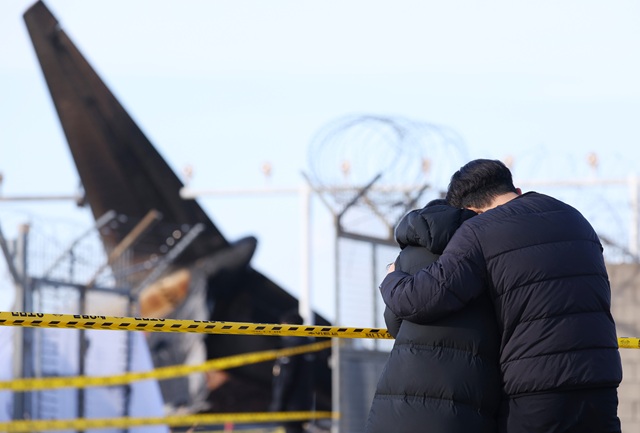
What Happened
Jeju Air flight 7C 2216, operating from Bangkok, encountered a grave mishap upon arrival at Muan County Airport, situated on the southwestern edge of South Korea. The incident occurred at approximately 9 a.m. local time on Sunday (7 p.m. ET Saturday), with the aircraft carrying 175 passengers and six crew members.
Visual documentation of the crash, aired by South Korean media outlets such as YTN, JTBC, and MBC, depicted the Boeing 737-800 skidding along the runway at considerable velocity, its fuselage scraping the surface. The aircraft collided with an embankment, culminating in a fiery explosion. Smoke was seen emanating from the rear of the sliding airframe, with no discernible landing gear—neither fore nor aft—visible in the footage.
Emergency response teams were subsequently observed deploying water cannons to douse the inferno consuming the wreckage. Fragments of the aircraft lay scattered across the runway, underscoring the severity of the impact.
Aviation experts, while noting that the landing gear appeared not to have deployed correctly, cautioned that the root cause of this malfunction remains uncertain. Comprehensive evidence will be required for South Korean investigators to ascertain the precise sequence of events leading to the accident.
In a briefing held on Monday, officials from the Transport Ministry disclosed that the pilot had reported a bird strike before executing the ill-fated emergency landing. CNN reported that, according to Kang Jung-Hyun, a senior official with the ministry, the pilot declared an emergency, issuing a “mayday” three times and referencing both a bird strike and the necessity of a go-around maneuver.
The control tower, aware of avian activity in the vicinity, had warned the pilot of the potential hazard shortly before the incident. The pilot subsequently requested a landing approach in the opposite direction, revising earlier reports that air traffic control had instructed a course change after the mayday call.
This unfortunate event underscores the need for rigorous investigation into the factors contributing to the failure of critical landing systems, as well as heightened vigilance in mitigating wildlife hazards near airports.
The Mystery
At the time of writing, several perplexing questions emerged regarding the accident. Aviation investigators remain confounded by three principal anomalies. First, the apparent failure of the aircraft’s wing flaps to deploy during the landing process raises significant concerns. Flap deployment is critical for reducing landing speed and ensuring stability, yet a malfunction in the hydraulic or electrical systems governing this mechanism could explain their absence. Alternatively, it is possible that the flight crew, under immense stress following the bird strike, overlooked this essential procedure or were misled by erroneous avionics readings that failed to indicate the need for flap deployment.
Second, the question of why the aircraft failed to land at the beginning of the runway, thus forfeiting crucial stopping distance, warrants close scrutiny. The bird strike may have disrupted the pilot’s control over the aircraft’s descent trajectory or led to a late decision to abandon a planned go-around maneuver. Environmental factors, such as poor visibility or gusting winds, could also have contributed to this deviation, as might miscommunication with air traffic control or unfamiliarity with the specific runway configuration at Muan County Airport.
Equally troubling is the failure to deploy the manual landing gear system, a redundancy built into the Boeing 737-800 to address precisely such emergencies. While mechanical failure of the manual override cannot be discounted, human factors loom large in this oversight. It is conceivable that the crew, overwhelmed by the complexity of the situation, were unable to prioritize or execute the manual deployment process in the limited time available. Training deficiencies or procedural ambiguities regarding the activation of the manual system may also have played a role, underscoring the need for rigorous simulation-based training and review of emergency protocols.
These anomalies necessitate a thorough examination of the flight data recorder and cockpit voice recorder to reconstruct the sequence of events and ascertain the crew’s actions. Additionally, a detailed inspection of the aircraft’s systems, including flaps, landing gear, and manual override mechanisms, is imperative. Environmental conditions and air traffic control communications must also be scrutinized to evaluate their contribution to the incident. The intersection of mechanical reliability, human decision-making, and procedural adherence will undoubtedly hold the key to understanding this tragic failure of aviation safety.
Accident Investigation
The necessity of identifying the causes of an aircraft accident or serious incident lies in the imperative to prevent similar occurrences in the future. Article 26 of the Chicago Convention stipulates that when an accident involving an aircraft of a contracting State occurs within the territory of another contracting State, and results in death, serious injury, or reveals a significant technical defect in the aircraft or navigation facilities, the State where the accident occurs is obliged to initiate an inquiry into its circumstances. This inquiry must be conducted, to the extent permitted by the laws of the State, in accordance with procedures recommended by the International Civil Aviation Organization (ICAO). Furthermore, the Article mandates that the State of Registry of the aircraft must be afforded the opportunity to appoint observers to participate in the inquiry, and the findings of the investigation must be communicated to that State.
The process of identifying causal factors is most effectively achieved through a meticulously conducted investigation. Annex 13 to the Chicago Convention underscores this principle, explicitly stating that the primary objective of an investigation into an accident or incident is prevention. Annex 13 establishes international standards and recommended practices for conducting such investigations, providing a framework that is accessible to all stakeholders involved. This accessibility ensures that investigators worldwide, often called upon with little notice, are equipped to address the complexities of an aircraft accident or serious incident. The Annex delineates the roles of States entitled to participate in an investigation, such as the States of Occurrence, Registry, Operator, Design, and Manufacture, and clearly defines their respective rights and responsibilities.
The relationship between Article 26 and Annex 13 is further reinforced by a resolution adopted by the ICAO Council during its Twelfth Session on 13 April 1951. This resolution aligns the obligations of Article 26 with the standards and recommended practices detailed in Annex 13, urging Contracting States to adopt these procedures when conducting inquiries into accidents involving death or serious injury. While allowing for deviations from Annex 13 under Article 38 of the Convention, the resolution emphasizes that certain provisions of Article 26 remain mandatory. Specifically, the State where the accident occurs must institute an inquiry, grant the State of Registry the opportunity to appoint observers, and communicate the findings to the latter.
For accidents that do not involve death or serious injury but suggest a significant technical defect, the resolution permits States to rely on their national investigative procedures until ICAO establishes specific guidelines for such cases.
The accredited representatives and advisers referenced in Annex 13 fulfill the role of observers as envisioned under Article 26, ensuring their presence at the inquiry and their active participation in the investigative process. This structured interplay between Article 26, Annex 13, and ICAO’s resolutions ensures a comprehensive and cooperative approach to understanding and preventing aviation accidents globally.
As already stated, the responsibility for conducting an investigation into an aviation accident or incident resides primarily with the State in which the event occurred. While the State of Occurrence generally undertakes the investigation, it retains the discretion to delegate some or all aspects of the process to another State. Should the incident take place beyond the jurisdiction of any State, the obligation to investigate falls to the State of Registry. States involved in the Registry, Operation, Design, and Manufacture of the aircraft are entitled to appoint accredited representatives to participate in the investigation, accompanied, if necessary, by advisers to support their efforts. The State leading the investigation may seek specialized technical expertise from any source to enhance the investigation’s thoroughness.
The investigative process encompasses the systematic collection, documentation, and analysis of all pertinent information; the identification of causative factors; the formulation of safety recommendations; and the preparation of a comprehensive final report. Additional provisions in Chapter 5 of Annex 13 address key elements such as the designation of the investigator-in-charge, the handling of flight recorders, the conduct of autopsy examinations, coordination with judicial and aviation security authorities, the disclosure of sensitive records, and protocols for reopening an investigation. Furthermore, States whose citizens are among the fatalities in an accident are entitled to appoint experts to participate in the proceedings.
The development and publication of the final report are governed by the Standards and Recommended Practices set forth in Chapter 6 of Annex 13. The prescribed format for this report is detailed in an appendix to the Annex. Modern computerized databases have significantly streamlined the storage and analysis of accident and incident data, enabling more effective sharing of safety information—an essential element in accident prevention. ICAO’s Accident/Incident Data Reporting (ADREP) system serves as a central repository for such data, facilitating the exchange of safety-related information among Contracting States. Reporting requirements for the ADREP system, including Preliminary and Accident/Incident Data Reports, are outlined in Chapter 7 of Annex 13.
Chapter 8 focuses on measures to prevent accidents, emphasizing the importance of incident reporting systems that may be either mandatory or voluntary. To encourage reporting, it advocates for a non-punitive environment that fosters the voluntary disclosure of safety hazards. This chapter also underscores the significance of database systems and analytical tools for examining safety data, identifying patterns, and determining necessary preventive measures. Additionally, it recommends that States actively support the creation of safety information-sharing networks to promote the free exchange of data regarding actual and potential safety deficiencies. Collectively, these provisions form an integral component of a global safety management system designed to mitigate the incidence of accidents and serious incidents.
My Take
The Republic of Korea has a safety record of good standing in the aviation community and one could have confidence in the authorities conducting a prudent investigation into the accident. In approaching the investigation, the Korean authorities will undoubtedly adhere meticulously to the principles enshrined in Annex 13 of the Chicago Convention, ensuring that the process is conducted with the highest degree of transparency, impartiality, and technical rigor. Every effort should be made to engage all relevant stakeholders—particularly the States of Registry, Operator, Design, and Manufacture—allowing for their active and meaningful participation. The inclusion of accredited representatives and advisers will ensure that the investigation benefits from a broad spectrum of expertise, thereby enhancing its credibility and comprehensiveness. Furthermore, the authorities should prioritize the preservation and analysis of critical evidence, including flight recorders and other data sources, while safeguarding the integrity of the investigation from undue external pressures.
Recognizing the interconnected nature of aviation safety, the investigators must also commit to the swift and accurate reporting of findings to ICAO and relevant international stakeholders, contributing to the global knowledge base essential for accident prevention. Above all, the Korean authorities should cultivate a culture of accountability and safety, ensuring that the investigation’s findings are not merely diagnostic but also prescriptive—aimed at formulating actionable recommendations that address both immediate and systemic deficiencies. By anchoring their work in these guiding principles, the authorities can uphold their commitment to the safety of international civil aviation, while honoring their obligation to the victims and their families through a diligent, transparent, and effective investigative process.