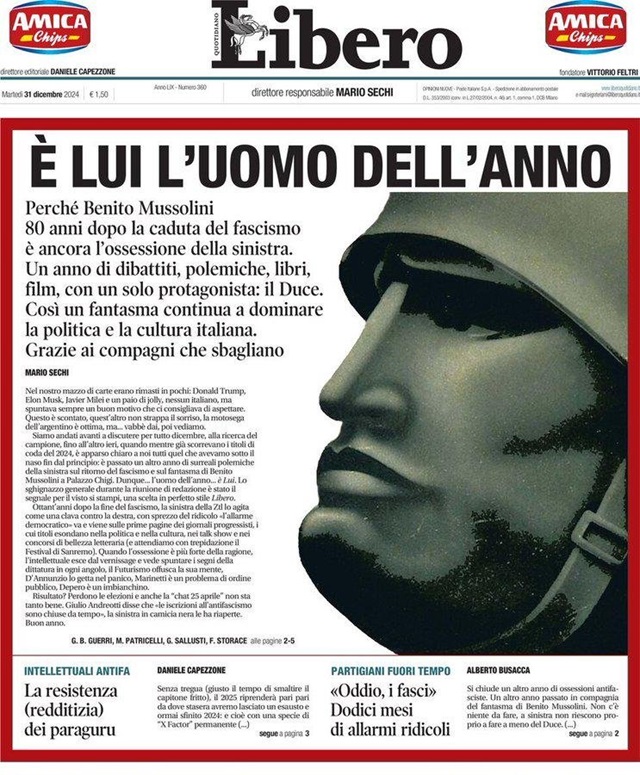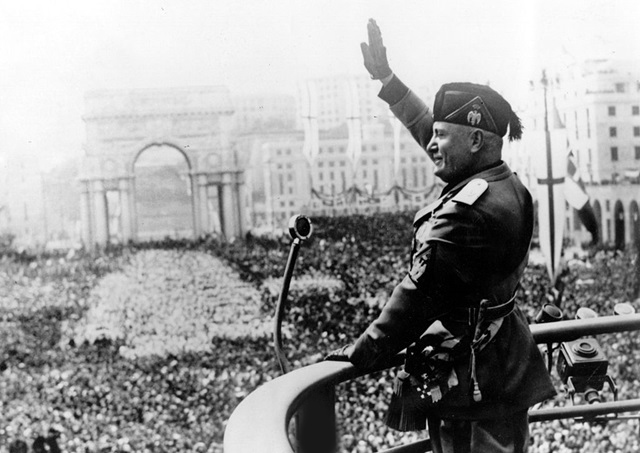
The right-wing Italian newspaper Libero has reignited debate over Italy’s fascist past after it named Benito Mussolini its “Man of the Year.” The announcement, accompanied by a front-page image of a bronze bust of the dictator, sparked outrage on social media and condemnation from commentators, with critics accusing the publication of glorifying a figure synonymous with authoritarian rule, racial laws, and an alliance with Nazi Germany during the Second World War.
According to the Times UK, Mario Sechi, Libero’s editor and a former spokesman for Italy’s Prime Minister Giorgia Meloni, defended the choice as a satirical jab at what he termed “the Italian left’s obsession with Mussolini.” In an editorial, Sechi dismissed claims of admiration for Mussolini, insisting the decision was meant to ridicule the left’s persistent focus on the dictator.
“It’s been another year of surreal arguments from the left about the return of fascism and about the ghost of Benito Mussolini at Palazzo Chigi,” Sechi wrote, referencing Meloni’s office as prime minister. He argued that left-wing critics of Meloni continually use Mussolini as a political cudgel, creating what he described as a “constant talking point.”
A second editorial by Alberto Busacca doubled down on this assertion, claiming that the left “cannot do without the Duce.”
The move by Libero was met with widespread condemnation. Critics on social media accused the newspaper of promoting Mussolini and mocked the editorial by sharing upside-down images of the dictator, a reference to his public execution and humiliation at the end of the war.
Alan Friedman, an American journalist and author based in Italy, described the editorial decision as “grotesque and disgusting,” echoing the sentiment of many commentators who argued the headline trivialized Mussolini’s atrocities.
The controversy has highlighted the deep divisions that persist in Italy over its fascist history and the broader ideological battle between left- and right-wing factions. Nearly eight decades after the fall of Mussolini and 35 years after the Cold War, debates over fascism and communism remain highly polarizing.
Prime Minister Giorgia Meloni, whose Brothers of Italy party traces its roots to the postwar fascist Italian Social Movement (MSI), has worked hard to distance herself from Mussolini’s legacy. Describing herself as a modern conservative, Meloni has consistently rejected accusations of fascist sympathies.
However, incidents involving members of her party’s youth wing—such as an undercover journalist’s recording of anti-Semitic remarks and praise for Mussolini last summer—have kept the issue alive. The Libero editorial has added fuel to the fire, reigniting scrutiny of Meloni’s political ties and ideological lineage.
In its Monday edition, Libero dedicated four pages to articles critiquing what it described as the left’s fascination with Mussolini and fascism. Ironically, many of these articles were authored by right-wing writers who have themselves recently published books about fascism. The newspaper’s writers took particular aim at Antonio Scurati, author of the bestselling M trilogy about Mussolini, accusing him of contributing to the alleged obsession.
Scurati, a vocal critic of Meloni, has frequently addressed the dangers of normalizing fascist rhetoric in modern politics. His works stand in contrast to Libero’s editorial stance, which seeks to diminish the relevance of such discussions in contemporary Italy.