European Union leaders have agreed to review the bloc’s carbon emissions trading system after pressure from Italy, Poland and the Czech Republic, opening the door to changes to a central pillar of the EU’s climate policy as governments grapple with soaring energy prices.
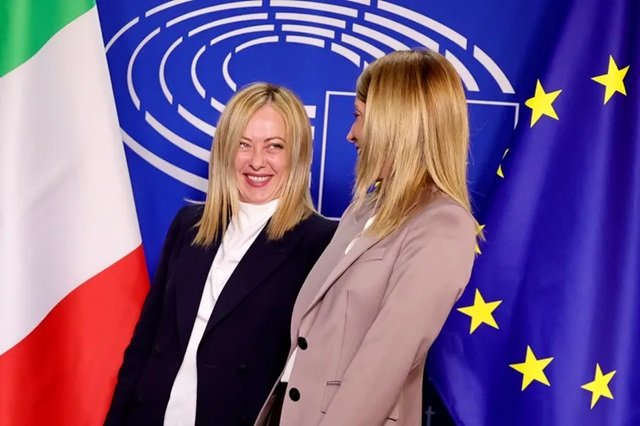
The agreement was reached at a summit in Brussels on Thursday, where leaders had initially planned to focus on urgent measures to reduce energy bills. But disagreements over the EU’s Emissions Trading System (ETS), which puts a price on carbon emissions, dominated discussions, with Italy’s Prime Minister Giorgia Meloni and several central European governments arguing that the system undermines industrial competitiveness and increases costs for households and businesses.
The 27 EU leaders called on the European Commission to “update the assessment” of ETS2, the planned extension of carbon pricing to fuels used for heating and transport, and to review its design and safeguards for vulnerable households. They also called for urgent action and an accelerated reform of the mechanism governing the removal of emissions allowances from the market, with the aim of moderating excessive price volatility.
However, a demand from several governments to postpone the introduction of the expanded system until at least 2030 was dropped from the final conclusions of the European Council. The agreement therefore commits the Commission to reassessing the scheme without specifying a new delay to its implementation.
Italy, supported by Poland, Hungary, the Czech Republic and Slovakia, had pressed for changes to the system for months. The outcome marks the first time EU leaders have explicitly opened the door to a review of its future, giving Meloni a political gain ahead of a crucial election year in Italy.
Supporters of reform argue that carbon pricing adds to energy costs and weakens European businesses competing internationally. Poland has frequently argued that emissions trading accounts for about 25% of the retail electricity price in the country. Governments backing changes say that easing the system could help relieve pressure on households and industry during the current energy crisis.
The dispute comes as energy prices across the EU have risen sharply since the war in Iran began in February. Eurozone inflation reached 3.8% in September, while energy prices were 18.8% higher than a year earlier.
Spain and the Nordic countries, including Finland, Denmark and Sweden, oppose weakening the emissions trading system, arguing that stable carbon pricing is necessary to encourage investment in clean energy and industrial decarbonisation. They have warned that changes could undermine long-term investment decisions and slow the transition away from carbon-intensive production.
In a joint letter, Finnish Prime Minister Petteri Orpo, Swedish Prime Minister Ulf Kristersson and Danish Prime Minister Mette Frederiksen said: “Any weakening of the ETS would undermine the predictability on which investment decisions depend and risk slowing the pace of industrial decarbonisation.”
They added that weakening the system would shift the burden of emissions reductions to other parts of the economy, where options for cutting pollution were often more limited and politically sensitive.
For Finland, Denmark and Sweden, the final agreement was an acceptable compromise because it did not include an explicit postponement of the new carbon-pricing timetable. Italy, meanwhile, secured prominent references to industrial competitiveness, the need for urgent action and faster reform of the market stability reserve, which removes allowances from circulation to manage the supply of permits.
Diplomatic sources said leaders had taken up the issue partly because they better understood the direct impact of energy prices on voters than environment ministers. Even some supporters of the ETS had acknowledged the need for short-term measures to address the concerns of countries such as Poland, where the system is seen as contributing directly to electricity costs.
The European electricity industry association Eurelectric has also urged governments to preserve the system’s integrity. In a letter circulated before the summit, it argued that predictable emissions limits and a rules-based market stability reserve would stimulate demand for clean domestic energy, encourage investment and support industrial innovation.
“Flexibilities or one-off interventions should not weaken this long-term signal,” the industry group said.