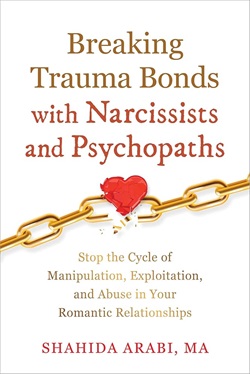
Shahida Arabi’s Breaking Trauma Bonds with Narcissists and Psychopaths emerges as a clarion call for survivors of psychological abuse, delivering a masterfully crafted guide that bridges rigorous scientific research with compassionate advocacy. Through this work, Arabi achieves the extraordinary—she not only elucidates the pernicious dynamics of trauma bonds but also offers survivors a lifeline to reclaim their autonomy and restore their sense of self. The book stands as both a revelatory exposé of manipulative behaviours and a deeply empowering roadmap for healing.
Trauma Bonds Demystified
The opening chapters set the tone with an incisive exploration of trauma bonds—those insidious ties that bind victims to their abusers through a complex interplay of psychological and biochemical dependencies. Drawing from neuroscience and psychological theory, Arabi unpacks the mechanics of betrayal bonding with clarity and precision. The concept of intermittent reinforcement, wherein perpetrators alternate between kindness and cruelty, is presented as the bedrock of these toxic attachments. By situating these behaviours within a scientific framework, Arabi empowers readers to view their experiences through the lens of evidence-based understanding, rather than self-recrimination.
In discussing the physiological underpinnings of trauma, Arabi expertly weaves together insights on the amygdala, prefrontal cortex, and hippocampus to reveal how abuse rewires the brain, compounding victims’ feelings of entrapment. This nuanced explanation underscores the profound impact of psychological abuse on cognitive functioning, memory processing, and emotional regulation—making a compelling case for why escaping trauma bonds requires both internal and external intervention.
The Profiles of Narcissists and Psychopaths
One of the book’s most illuminating sections lies in its typology of narcissistic and psychopathic personalities. Arabi’s delineation of grandiose versus vulnerable narcissists, as well as primary and secondary psychopaths, provides readers with a lexicon to identify and understand the archetypes of manipulative individuals. Through vivid case studies and empirical data, she paints a stark portrait of these personalities, highlighting their propensity for deceit, exploitation, and emotional sabotage.
Arabi’s analysis is not merely diagnostic; it is profoundly validating. She dismantles myths surrounding narcissism and psychopathy, such as the pervasive misconception that all such individuals are victims of childhood trauma. Instead, she posits that narcissistic traits often arise from overvaluation during formative years, challenging readers to reconsider facile narratives about causation.
A Comprehensive Approach to Healing
Where Arabi’s work truly shines is in its actionable guidance for breaking free from toxic dynamics. The second half of the book is a veritable toolkit for healing, replete with exercises, therapeutic strategies, and evidence-based modalities aimed at fostering recovery. From cognitive-behavioural techniques to mindfulness practices, Arabi equips readers with practical tools to recalibrate their neural pathways and rebuild their emotional resilience.
Particularly striking is her emphasis on self-compassion as a cornerstone of recovery. In a culture that often stigmatises survivors of abuse, Arabi’s insistence on validating their experiences and reframing self-blame as a symptom of manipulation is both revolutionary and redemptive. Her guidance to “honour your journey” resonates deeply, inviting survivors to view their healing not as a linear process but as a transformative path to empowerment.
A Broader Cultural Critique
While the book primarily serves as a survival guide, it also functions as a trenchant critique of societal dynamics that enable abusive behaviours. Arabi’s discussion of institutional betrayal, particularly in workplace and familial contexts, extends the book’s relevance beyond romantic relationships. She highlights how systemic inequities and cultural norms often exacerbate the struggles of survivors, urging readers to advocate for structural change alongside personal healing.
Moreover, Arabi’s exploration of the intersections between psychological abuse and gender, race, and socioeconomic status invites critical reflection on how marginalised communities are disproportionately impacted by manipulative dynamics. This intersectional approach broadens the book’s appeal, making it an indispensable resource for both individual readers and professionals in the fields of mental health and social justice.
A Few Reservations
Despite its many strengths, Breaking Trauma Bonds with Narcissists and Psychopaths is not without limitations. Arabi’s reliance on clinical jargon, while necessary for precision, may prove daunting for readers new to the subject. Additionally, the breadth of topics covered occasionally detracts from the depth of analysis in certain sections. For instance, the book’s exploration of psychopathy could benefit from a more granular discussion of the distinctions between subtypes, particularly as they pertain to varying levels of danger posed to survivors.
Conclusion
Shahida Arabi’s Breaking Trauma Bonds with Narcissists and Psychopaths is a triumph of advocacy, empathy, and scholarship. It stands as a beacon of hope for survivors navigating the aftermath of psychological abuse, offering not only a diagnosis of their pain but also a prescription for their healing. By demystifying the dynamics of trauma bonds and equipping readers with tools for recovery, Arabi has created a work of enduring significance.
For those ensnared in toxic relationships or seeking to understand the complex interplay of manipulation and trauma, this book is an indispensable resource. It invites readers to envision a future unshackled from the chains of abuse—a future defined by autonomy, resilience, and the reclamation of one’s self-worth.